The past generation has seen tremendous breadth and depth of scholarship on the 18th-century North Atlantic evangelical awakening, from deep in central Europe to the American frontier. There have been many debates about the origin, character, and significance of evangelical religion during this period. Here are some of the books that best introduce the general reader to early evangelicalism. All of these books are a pleasure to read, and all of the authors are experts in their fields.
 It must strike everybody who carefully reads the Scripture record concerning the virgin birth how simple and sober it is. Of those many theories woven around it later on, and on which the rejection of the virgin birth was based, we find not the slightest indication. One must, indeed, be very critically preoccupied to think that this account fits in beautifully with the heathenish imaginations of the Caesarean era. In the text there is no trace of such indications, but only an account, in simple language, concerning the sovereign act of the Holy Spirit, “The Holy Spirit shall come upon thee, and the power of the Most High shall overshadow thee.” It must strike everybody who carefully reads the Scripture record concerning the virgin birth how simple and sober it is. Of those many theories woven around it later on, and on which the rejection of the virgin birth was based, we find not the slightest indication. One must, indeed, be very critically preoccupied to think that this account fits in beautifully with the heathenish imaginations of the Caesarean era. In the text there is no trace of such indications, but only an account, in simple language, concerning the sovereign act of the Holy Spirit, “The Holy Spirit shall come upon thee, and the power of the Most High shall overshadow thee.”The power of the Spirit is announced here; the overshadowing, a word which is also used in the account of the transfiguration on the mount: a cloud which overshadowed them. The emphasis in this overshadowing is on the divine power by which the birth of Messiah is announced. When Barth remarked that the accent in this power of the Spirit over Mary was not on generatio but on jussio or benedictio, Kohnstamm raised the question how such a fine distinction could be preached and presented to heathen people as a missionary message. But apparently this had been done since earliest times without for a moment impairing the unique character of this overshadowing. There is not a trace of justification for Kohnstamm’s reference to a marriage of deities. This is, moreover, confirmed by Joseph’s position in the Christmas account. The act of the Spirit is of a very special character and must indeed be described as jussio or benedictio, the supreme power in this unique event by which he, who is the Son of the Father, is born as a man of Mary. This limits all speculation. Whoever attempts to draw a parallel between this act of the Spirit and mythological relationships tries to give an explanation of that which finds its origin only in the power of God. This act of the Spirit, of which both Matthew and Luke testify, points out the uniqueness of Christ’s birth which can be known only by divine revelation. The entire story has come to us in an explicitly historic entourage including Mary, Joseph, and the message of the angel. Revelation alone can shed light on this story, not biological theories or historical speculations. It bears no marks of human construction; it speaks only to the fulfillment of that which had been prophesied. Every attempt to explain the birth account mythologically misses the context of the story.… Often a connection was seen between the virgin birth of Christ and those births of children in the Old Testament which revealed a new sovereign act of God. The question was raised whether these events did not indicate some obvious relationship. Stauffer remarks that the idea of the virgin birth was foreshadowed “by the accounts of the miraculous births of Isaac, Joseph, Samson, Samuel, and John the Baptist” (Theol. des. A.T., p. 98). When we read these birth accounts, it always strikes us how God’s activity is emphasized. The accent is on Rachel’s barrenness, which God in answer to prayer terminates. Sarah’s barrenness is no less emphasized. Over against Abraham’s self-willed sovereign doings (Hagar) God places the true sovereignty of his own dealings. Their impotence in connection with the promise is strongly brought out and is accentuated by Sarah’s laughing after the annunciation of the birth of a son (Gen. 18:10, 11). She mentions her own withered condition and Abraham’s old age (vs. 12). Her laughing corresponds with Abraham’s unbelief at the previous annunciation of this birth: he laughed and said in his heart, “Shall a child be born unto him that is a hundred years old? and shall Sarah, that is ninety years old, bear?” (Gen. 17:17). God’s miracle, announced in the answer after Sarah’s laughing, “Is anything too hard for Jehovah?” (Gen. 18:14), and the birth of Isaac are described with great emphasis on God’s activity: “And Jehovah visited Sarah as he had said, and Jehovah did unto Sarah as he had spoken, For Sarah conceived, and bare Abraham a son in his old age” (21:1, 2). Samson’s birth, too, is presented in the light of the miraculous over against the impotent barrenness of Manoah’s wife (Judges 13:2). We also see the miracle of this new soteriological act expressed in the name of the angel of the Lord: “Wherefore askest thou after my name, seeing it is wonderful?” (vs. 18). Again, we read of Hannah’s barrenness. The Lord had shut up her womb (1 Sam. 1:5; cf. vss. 2, 8). Her prayer is answered, but it is expressly stated that Samuel is the child of Elkanah and Hannah (vs. 19). God’s remembering her evidently does not eliminate the procreation, and Hannah sighs praises to God for his wonderful deeds (1 Sam. 2, esp. vs. 5). Finally, we read of Elizabeth’s barrenness on account of her old age (Luke 1:7). She, too, praises God’s doings: “Thus hath the Lord dealt with me in the days wherein he looked upon me, to take away my reproach among men” (vs. 25). When considering these data we may ask what Stauffer means by saying that the idea of the virgin birth is “prepared and pre-arranged” by all these events. He finds the same idea in Matthew and Luke, who, according to him, “wish to bring out that Christology reaches back into the grey past” and that the idea of the virgin birth “has been suggested by similar religious-historical representations.” These Old Testament stories do not, however, explain the virgin birth. They illustrate God’s grace and power in his dealings with his people, but the question of fatherhood plays no role at all. God’s miracle shatters the curse of barrenness; but that is not the point with regard to Christ’s birth. Elizabeth is even mentioned in the annunciation to Mary, “… in her old age; and this is the sixth month with her who was called barren. For no word from God shall be void of power.” But in Mary’s case the situation is entirely different. Christ’s birth is entirely unique: it is the mystery of the incarnation. We are not dealing with a general miraculous power which manifests itself in Mary’s life and which is of the same nature as the other manifestations. The annunciations in the Old Testament birth accounts differ greatly from the annunciation of Christ’s birth, and the reason for this difference lies in the nature of this mystery: the Word is become flesh. The confession of Christ’s virgin birth has been the object of criticism for about a century. To a certain extent this criticism was the result of theories and ideas which in the course of history had been developed with regard to the relationship between this birth and that which, according to Scripture, may and must be considered holy. This article was also criticized for another reason, namely that it seemed particularly to stress the “supernatural” as a reality by itself entering the “natural.” But this was criticizing an article after it had been stripped of the personal character of what took place: the coming of the Son. The anti-mythical tendencies of this century and the preceding one apparently had no more use for this confession. And so the belief in the virgin birth was replaced by a respect either for the miracle (Brunner) or for the sanctity of matrimony. It will be up to the Church to show the way back to the scriptural witness, so that the incarnation may once more be adored not as a breathtaking “cosmological” event but as Christ’s taking the way of poverty and forsakenness. Christ was not an ideal person who groped for the upward way but the incarnated Word, who, as God’s Messiah, was not subjected to God’s curse in order that he might take this curse upon himself. Noordmans says correctly that there is more at stake in the virgin birth than simply an incidental event which does not agree with the scientific mind, or which can become an insurmountable obstacle to those aliented from the Church. A veil must cover this indivisible mystery, and if the Church has any misgivings here she had better return quickly to the old story of the angels’ song and the annunciation; the swaddling clothes and the adoration; the old story of holiness and guilt.—G. C. BERKOUWER, The Work of Christ (Eerdmans, 1965), pp. 111–13, 131–34. Used by permission. |
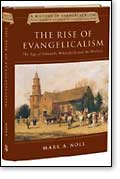
The Rise of Evangelicalism: The Age of Edwards, Whitefield, and the Wesleys Mark A. Noll |
A masterful survey of the whole transatlantic movement. Mark Noll has (as usual) taken the best of the secondary literature and summed it up in a readable narrative with a wide perspective.
|
* * * |
 |
The Inextinguishable Blaze: Spiritual Renewal and Advance in the Eighteenth Century A. Skevington Wood |
A classic account of the evangelical awakenings of the period that covers the ground in a brilliantly written and lucid narrative.
|
* * * |
 It must strike everybody who carefully reads the Scripture record concerning the virgin birth how simple and sober it is. Of those many theories woven around it later on, and on which the rejection of the virgin birth was based, we find not the slightest indication. One must, indeed, be very critically preoccupied to think that this account fits in beautifully with the heathenish imaginations of the Caesarean era. In the text there is no trace of such indications, but only an account, in simple language, concerning the sovereign act of the Holy Spirit, “The Holy Spirit shall come upon thee, and the power of the Most High shall overshadow thee.” It must strike everybody who carefully reads the Scripture record concerning the virgin birth how simple and sober it is. Of those many theories woven around it later on, and on which the rejection of the virgin birth was based, we find not the slightest indication. One must, indeed, be very critically preoccupied to think that this account fits in beautifully with the heathenish imaginations of the Caesarean era. In the text there is no trace of such indications, but only an account, in simple language, concerning the sovereign act of the Holy Spirit, “The Holy Spirit shall come upon thee, and the power of the Most High shall overshadow thee.”The power of the Spirit is announced here; the overshadowing, a word which is also used in the account of the transfiguration on the mount: a cloud which overshadowed them. The emphasis in this overshadowing is on the divine power by which the birth of Messiah is announced. When Barth remarked that the accent in this power of the Spirit over Mary was not on generatio but on jussio or benedictio, Kohnstamm raised the question how such a fine distinction could be preached and presented to heathen people as a missionary message. But apparently this had been done since earliest times without for a moment impairing the unique character of this overshadowing. There is not a trace of justification for Kohnstamm’s reference to a marriage of deities. This is, moreover, confirmed by Joseph’s position in the Christmas account. The act of the Spirit is of a very special character and must indeed be described as jussio or benedictio, the supreme power in this unique event by which he, who is the Son of the Father, is born as a man of Mary. This limits all speculation. Whoever attempts to draw a parallel between this act of the Spirit and mythological relationships tries to give an explanation of that which finds its origin only in the power of God. This act of the Spirit, of which both Matthew and Luke testify, points out the uniqueness of Christ’s birth which can be known only by divine revelation. The entire story has come to us in an explicitly historic entourage including Mary, Joseph, and the message of the angel. Revelation alone can shed light on this story, not biological theories or historical speculations. It bears no marks of human construction; it speaks only to the fulfillment of that which had been prophesied. Every attempt to explain the birth account mythologically misses the context of the story.… Often a connection was seen between the virgin birth of Christ and those births of children in the Old Testament which revealed a new sovereign act of God. The question was raised whether these events did not indicate some obvious relationship. Stauffer remarks that the idea of the virgin birth was foreshadowed “by the accounts of the miraculous births of Isaac, Joseph, Samson, Samuel, and John the Baptist” (Theol. des. A.T., p. 98). When we read these birth accounts, it always strikes us how God’s activity is emphasized. The accent is on Rachel’s barrenness, which God in answer to prayer terminates. Sarah’s barrenness is no less emphasized. Over against Abraham’s self-willed sovereign doings (Hagar) God places the true sovereignty of his own dealings. Their impotence in connection with the promise is strongly brought out and is accentuated by Sarah’s laughing after the annunciation of the birth of a son (Gen. 18:10, 11). She mentions her own withered condition and Abraham’s old age (vs. 12). Her laughing corresponds with Abraham’s unbelief at the previous annunciation of this birth: he laughed and said in his heart, “Shall a child be born unto him that is a hundred years old? and shall Sarah, that is ninety years old, bear?” (Gen. 17:17). God’s miracle, announced in the answer after Sarah’s laughing, “Is anything too hard for Jehovah?” (Gen. 18:14), and the birth of Isaac are described with great emphasis on God’s activity: “And Jehovah visited Sarah as he had said, and Jehovah did unto Sarah as he had spoken, For Sarah conceived, and bare Abraham a son in his old age” (21:1, 2). Samson’s birth, too, is presented in the light of the miraculous over against the impotent barrenness of Manoah’s wife (Judges 13:2). We also see the miracle of this new soteriological act expressed in the name of the angel of the Lord: “Wherefore askest thou after my name, seeing it is wonderful?” (vs. 18). Again, we read of Hannah’s barrenness. The Lord had shut up her womb (1 Sam. 1:5; cf. vss. 2, 8). Her prayer is answered, but it is expressly stated that Samuel is the child of Elkanah and Hannah (vs. 19). God’s remembering her evidently does not eliminate the procreation, and Hannah sighs praises to God for his wonderful deeds (1 Sam. 2, esp. vs. 5). Finally, we read of Elizabeth’s barrenness on account of her old age (Luke 1:7). She, too, praises God’s doings: “Thus hath the Lord dealt with me in the days wherein he looked upon me, to take away my reproach among men” (vs. 25). When considering these data we may ask what Stauffer means by saying that the idea of the virgin birth is “prepared and pre-arranged” by all these events. He finds the same idea in Matthew and Luke, who, according to him, “wish to bring out that Christology reaches back into the grey past” and that the idea of the virgin birth “has been suggested by similar religious-historical representations.” These Old Testament stories do not, however, explain the virgin birth. They illustrate God’s grace and power in his dealings with his people, but the question of fatherhood plays no role at all. God’s miracle shatters the curse of barrenness; but that is not the point with regard to Christ’s birth. Elizabeth is even mentioned in the annunciation to Mary, “… in her old age; and this is the sixth month with her who was called barren. For no word from God shall be void of power.” But in Mary’s case the situation is entirely different. Christ’s birth is entirely unique: it is the mystery of the incarnation. We are not dealing with a general miraculous power which manifests itself in Mary’s life and which is of the same nature as the other manifestations. The annunciations in the Old Testament birth accounts differ greatly from the annunciation of Christ’s birth, and the reason for this difference lies in the nature of this mystery: the Word is become flesh. The confession of Christ’s virgin birth has been the object of criticism for about a century. To a certain extent this criticism was the result of theories and ideas which in the course of history had been developed with regard to the relationship between this birth and that which, according to Scripture, may and must be considered holy. This article was also criticized for another reason, namely that it seemed particularly to stress the “supernatural” as a reality by itself entering the “natural.” But this was criticizing an article after it had been stripped of the personal character of what took place: the coming of the Son. The anti-mythical tendencies of this century and the preceding one apparently had no more use for this confession. And so the belief in the virgin birth was replaced by a respect either for the miracle (Brunner) or for the sanctity of matrimony. It will be up to the Church to show the way back to the scriptural witness, so that the incarnation may once more be adored not as a breathtaking “cosmological” event but as Christ’s taking the way of poverty and forsakenness. Christ was not an ideal person who groped for the upward way but the incarnated Word, who, as God’s Messiah, was not subjected to God’s curse in order that he might take this curse upon himself. Noordmans says correctly that there is more at stake in the virgin birth than simply an incidental event which does not agree with the scientific mind, or which can become an insurmountable obstacle to those aliented from the Church. A veil must cover this indivisible mystery, and if the Church has any misgivings here she had better return quickly to the old story of the angels’ song and the annunciation; the swaddling clothes and the adoration; the old story of holiness and guilt.—G. C. BERKOUWER, The Work of Christ (Eerdmans, 1965), pp. 111–13, 131–34. Used by permission. |
Wesley and the People Called Methodists Richard P. Heitzenrater |
A balanced and expert introduction to the biography of John Wesley and the rise and progress of Methodism. Rich in detail and explanation.
|
* * * |
 At no point in Romanism is the conflict between tradition and Scripture more evident than in the cult of Mary. One can confidently predict that the more Scripture is studied, the more the foundations of the Marian cult will be shaken. So far, however, official pronouncements have shown no indications of any desire to curb this cult. On the contrary, modern popes have been the foremost in promoting it. From the Roman Catholic viewpoint, it may be said that we have been living in a Marian era since the middle of last century. At no point in Romanism is the conflict between tradition and Scripture more evident than in the cult of Mary. One can confidently predict that the more Scripture is studied, the more the foundations of the Marian cult will be shaken. So far, however, official pronouncements have shown no indications of any desire to curb this cult. On the contrary, modern popes have been the foremost in promoting it. From the Roman Catholic viewpoint, it may be said that we have been living in a Marian era since the middle of last century.The dogma of the Immaculate Conception of the Blessed Virgin was proclaimed in 1854 by Pope Pius XI, speaking infallibly ex cathedra; 1858 saw the institution of the shrine of Mary at Lourdes in France and 1917 the shrine of Fatima in Portugal, not to mention many other less celebrated centers where the cult of Mary thrives; in 1891 Pope Leo XIII affirmed in his encyclical Octobri mense that, “as no one can come to the Most High Father except through the Son, so, generally, no one can come to Christ except through Mary”; in 1904 Pope Pius X in his encyclical Ad diem praised Mary as the restorer of a fallen world and the dispenser of all the gifts of grace won for us through the death of Christ, and in 1907 he sanctioned February 11 as the Feast of the Apparition of Our Lady of Lourdes; in 1918 Pope Benedict XV stated that Mary had redeemed the human race in cooperation with Christ, and his successor Pope Pius XI approved the practice of calling Mary Co-Redemptrix”; in 1942 Pope Pius XII dedicated the world to Mary’s Immaculate Heart; in 1950 the same pope promulgated the dogma of the Bodily Assumption of Mary, speaking infallibly ex cathedra, and in 1954 he inaugurated May 31 as the Feast of Mary Queen of Heaven. But surely the ultimate was said in 1946, again by Pope Pius XII, at the time of the coronation of Mary’s statue at Fatima: “Mary is indeed worthy to receive honor and might and glory. She is exalted to hypostatic union with the Blessed Trinity.… Her kingdom is as great as her Son’s and God’s.… Mary’s kingdom is identical with the kingdom of God.” To the ear attuned to the teaching of the New Testament such affirmations are blasphemous, both because they derogate from the glory and merit that are due to Christ alone as our unique Redeemer and Mediator and because they exalt to a position of equality with the eternal Creator one who, though blessed, was no more than a creature. This mother—goddess cult—which, as has often been pointed out, has its roots in paganism rather than in apostolic Christianity, and which in effect gives to Mary the Holy Spirit’s place in the Trinity—is disruptive of the very heart of the Gospel of the grace of God in and through Christ alone. As Professor Wilhelm Niesel has said, “Here we come to the heart of the matter. Here the gulf which separates Rome from the Church of the Gospel becomes quite visible” (Reformed Symbolics, Edinburgh, 1962, p. 115). Bishop Gustaf Aulén, speaking of modern Roman theologians and the Marian dogmas of 1854 and 1950, complains: In neither case have they shown any concern to justify these dogmas on the basis of Scripture or even the tradition of the ancient church. In reality these two dogmas are foreign to Scripture and contrary to the ancient tradition of the church. Indeed, the development of Mariological dogma in the Roman Catholic Church affords a startling example of the assertion by the teaching office of its supremacy over the authority of Scripture and even, in some measure, over tradition. To quote Bishop Aulén again: This indicates with perfect clarity that the infallible office of teaching by no means guarantees the integrity of the interpretation of Scripture. On the contrary, it results in a dissolution of integrity. The ecclesiastical teaching office goes its own way and tries to compel intractable Scripture to follow [Reformation and Catholicity, Edinburgh, 1962, p. 145]. Mariological dogma stands out as the highpoint to which the logic of the Roman Catholic doctrine of man leads. If man, as Rome teaches, contributes to his own justification by a proper disposition, good works, penances, and, in the end, purgatory, then it follows that man has a share with God in the accomplishment of his salvation. And it follows, further, that man has a measure of independence and sovereignty alongside the independence and sovereignty of Almighty God. The distinction between God and man is reduced to one that is no longer absolute but relative, not only in the matter of ability but even in that of being. This human potential is symbolized in a concrete manner in the person of Mary, free from taint of sin, collaborating in redemption—without whose consent and cooperation, indeed, our redemption would not have been effected—and exalted to the heights of divinity as the queen-mother of heaven, there to intercede with a mother’s compassionate heart and turn aside the displeasure of a less indulgent Mediator. Those who had hopes that the Second Vatican Council would apply the brakes to the rapidly advancing cult of Mary and seek to restore to Christ the uniqueness of his mediatorial office were soon disillusioned. On the first day of the council, October 11, 1962, Pope John XXIII declared at the very beginning of his opening speech that the assembled delegates were met together “under the auspices of the virgin Mother of God”; and that same speech concluded with a prayer to Mary, “Help of Christians, Help of Bishops,” to “dispose all things for a happy and propitious outcome” and, together with her spouse “St. Joseph, the holy Apostles Peter and Paul, St. John the Baptist, and St. John the Evangelist,” to intercede for them to God (The Documents of Vatican II, New York, 1966, pp. 710, 719; further references to this volume will use the abbreviation DV II followed by the page number). In his papal brief declaring the council closed, which was read on December 8, 1965, Pope Paul VI spoke to the same effect. These, however, are but straws in the wind compared with the concluding chapter of the Dogmatic Constitution of the Church—a document that, according to Father Avery Dulles, S. J., has been hailed “with something like unanimity” as “the most momentous achievement of the Council” (DV II, 10). The theme of this concluding chapter is “The Role of the Blessed Virgin Mary, Mother of God, in the Mystery of Christ and the Church.” In fairness it must be said that theologians and preachers are earnestly exhorted that ‘in treating of the unique dignity of the Mother of God” they should “carefully and equally avoid the falsity of exaggeration on the one hand and the excess of narrow-mindedness on the other” (DV II, 95); that it is explicitly stated that because Mary “belongs to the offspring of Adam” she is “one with all human beings in their need for salvation” (DV II, 86); and that assurance is given that “the maternal duty of Mary toward men in no way obscures or diminishes” the “unique mediation of Christ” (DV II, 90). But there is nothing new about all this; similar admonitions and reassurances have been uttered numerous times in the past. Protestations of scriptural orthodoxy have a hollow ring when they are used to justify teachings manifestly alien to the evangelical doctrine of Scripture. Besides, as has already been shown, the modern popes bear a heavy responsibility for the encouragement of the unbiblical exaggerations of the cult of Mary. Despite all qualifying clauses, the effect, in both logic and practice, of the Mariology of the Roman church is to rob Christ of the uniqueness of his redemptive and mediatorial office. How can it be otherwise, when Christ declares that it is he who gives life to the world (John 6:33), whereas the council, without disputing this, affirms that Mary “gave Life to the world” (DV II, 86); when the apostles consistently declare that the likeness to which we are to be conformed is that of Christ (Rom. 8:29; 2 Cor. 3:18; Phil. 3:21; 1 John 3:2), whereas the council affirms that Mary is “the Church’s model” and that those who “strive to increase in holiness … raise their eyes to Mary who shines forth to the whole community of the elect as a model of the virtues” (DV II, 86, 93); when the Scriptures consistently declare that Christ alone was without sin (2 Cor. 5:21; Heb. 4:15; 7:26; 1 Pet. 1:19; 2:22; 1 John 3:5), whereas the council affirms that Mary was “entirely holy and free from all stain of sin,” was “adorned from the first instant of her conception with the splendors of an entirely unique holiness,” and in what she subsequently did was “impeded by no sin” (DV II, 88); and when the New Testament consistently declares that Christ is the sole and unique Mediator between God and man and the only Redeemer of our race (1 Tim. 2:5; Heb. 9:15; John 14:6; Acts 4:12; 1 John 2:1), whereas the council—though, as we have mentioned, it acknowledges this—applies the title “Mediatrix” to Mary and affirms that by her “cooperating in the work of human salvation” there was a “union of the Mother with the Son in the work of salvation” (DV II, 84). In other words, though the term itself is not used, Vatican II propounds the heresy that Mary is Co-redemptrix with Christ. It is deplorable that the council’s work of aggiornamento did not extend to two scriptural mistranslations that for centuries have done heavy duty as props for the mystique of Mary but that are discredited by the humblest linguistic tyro. For so erudite an assembly to have dressed up these two mistranslated verses (Genesis 3:15 and Luke 1:28) and pressed them into service yet again is inexcusable. In Genesis 3:15 the Hebrew pronoun that stands for the seed of the woman is masculine in gender, agreeing with the Hebrew noun for “seed.” The Vulgate (Latin) version, however, misrendered it as feminine (ipsa, “she”), and on the strength of this the verse was commonly applied as though it were prophetic of the role of Mary. The Jerusalem Bible, to cite the most recent English version, renders the clause legitimately, “It will crush your head.” But the council, evidently leaning on the old mistranslation, states that Mary “is already prophetically foreshadowed in that victory over the serpent which was promised to our first parents after their fall into sin (cf. Gen. 3:15)” (DV II, 87). Again, the Vulgate wrongly rendered the Greek of Luke 1:28 as Ave, gratia plena (“Hail, thou that art full of grace”), and for centuries this rendering has been used to bolster up the doctrine of the unique sinlessness and holiness of Mary. The passage is translated legitimately, once more, in the Jerusalem Bible: “Rejoice, so highly favored!” But the council persists in buttressing its concept of Mary’s “entirely unique holiness” by adducing the manner in which she was “greeted by an angel messenger as ‘full of grace’ (cf. Lk. 1:28)” (DV II, 88). To mishandle Scripture can only lead, as it has done, to confusion. Far from restraining the tide of Mariolatry, the Second Vatican Council has strongly endorsed it, admonishing “all the sons of the Church that the cult, especially the liturgical cult, of the Blessed Virgin be generously fostered,” and charging “that practices and exercises of devotion toward her be treasured as recommended by the teaching authority of the Church in the course of centuries, and that those decrees issued in earlier times regarding the veneration of images of Christ, the Blessed Virgin, and the saints be religiously observed” (DV II, 94). The concluding exhortation of the Dogmatic Constitution of the Church makes this appeal: Let the entire body of the faithful pour forth persevering prayer to the Mother of God and Mother of men. Let them implore that she who aided the beginnings of the Church by her prayers may now, exalted as she is in heaven above all the saints and angels, intercede with her Son … [DV II, 96]. How else can this be understood except as an infringement of the unique Mediatorship of Christ? And if the mediation of Mary is necessary before we can be heard in heaven, what has happened to that boldness with which the believer is invited to “enter into the holiest by the blood of Jesus” and to that “full assurance of faith” with which we are urged to draw near to God through him who is our great High Priest, who ever lives to make intercession for us in heaven (Heb. 10:19–23; 7:25). Nothing less than the Gospel of our redemption is at stake here. Today the challenge comes afresh to us and to our Roman Catholic friends to “hold fast the profession of our faith without wavering.” The Gospel forbids us to acknowledge any mediator or intercessor or means of entry into the presence of God other than our Saviour Christ, who alone is the Way, the Truth, and the Life. Philip Edgcumbe Hughes is editor of the “Churchman,” Anglican theological quarterly, and visiting professor of New Testament at Columbia Seminary, Decatur, Georgia. Jesus was a new star in the firmament of religious teachers. His character was so majestic that many followed him and memorized his sayings. He spoke with authority and not like the scribes. Yet always he stood upon the Scriptures. You and I dwell in magnificent company when we study the Bible and submit to its authority. We stand with Christ. And our ranks are swelled by Augustine, Huss, Tyndale, Wycliffe, Luther, Calvin, Wesley, and a host of others. We give thanks for Scripture. May it yet be said of us, as the heavenly Christ said of the church of ancient Philadelphia, “For thou hast a little strength, and hast kept my word, and hast not denied my name.”—The Rev. Harry B. Schultheis, minister of the United Presbyterian Church in the U. S. A., Gilroy, California. Magnificent Company |
Jonathan Edwards: A Life George M. Marsden |
A prize-winning biography of Edwards that richly places him in his historical context, offering a great introduction to Edwards' thought and his times.
|
* * * |
An up-to-date survey of the rise of the evangelical movement in America and the persistence of revival in New England, the Middle Colonies, and the South throughout the 18th century.
By Bruce Hindmarsh, professor of spiritual theology at Regent College in Vancouver and author of The Evangelical Conversion Narrative: Spiritual Autobiography in Early Modern England
Copyright © 2009 by the author or Christianity Today/Christian History & Biography magazine. Click here for reprint information on Christian History & Biography.