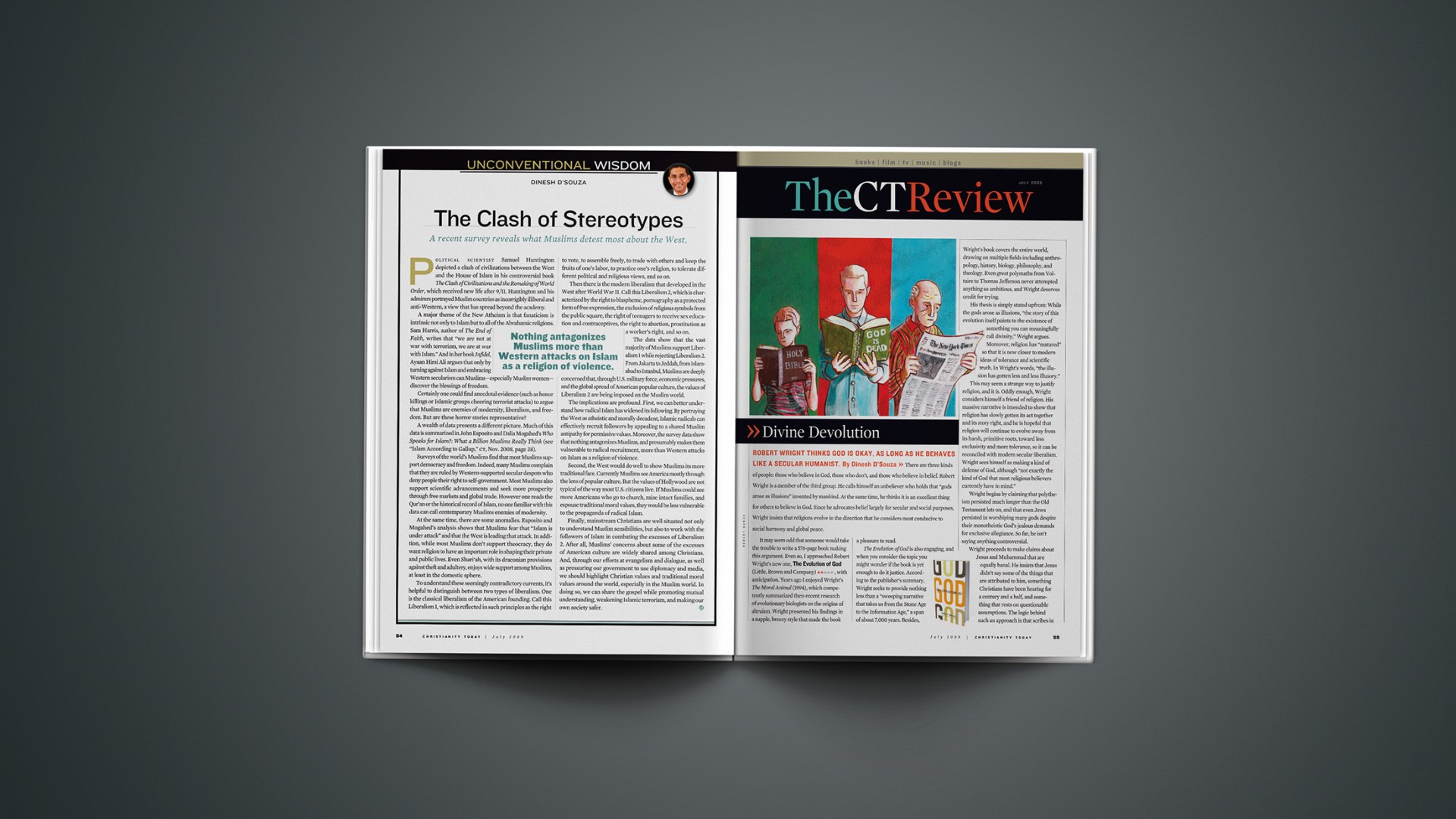

Political scientist Samuel Huntington depicted a clash of civilizations between the West and the House of Islam in his controversial book The Clash of Civilizations and the Remaking of World Order, which received new life after 9/11. Huntington and his admirers portrayed Muslim countries as incorrigibly illiberal and anti-Western, a view that has spread beyond the academy.
A major theme of the New Atheism is that fanaticism is intrinsic not only to Islam but to all of the Abrahamic religions. Sam Harris, author of The End of Faith, writes that “we are not at war with terrorism, we are at war with Islam.” And in her book Infidel, Ayaan Hirsi Ali argues that only by turning against Islam and embracing Western secularism can Muslims—especially Muslim women—discover the blessings of freedom.
Certainly one could find anecdotal evidence (such as honor killings or Islamic groups cheering terrorist attacks) to argue that Muslims are enemies of modernity, liberalism, and freedom. But are these horror stories representative?
A wealth of data presents a different picture. Much of this data is summarized in John Esposito and Dalia Mogahed’s Who Speaks for Islam?: What a Billion Muslims Really Think (see “Islam According to Gallup,” CT, Nov. 2008, page 38).
Surveys of the world’s Muslims find that most Muslims support democracy and freedom. Indeed, many Muslims complain that they are ruled by Western-supported secular despots who deny people their right to self-government. Most Muslims also support scientific advancements and seek more prosperity through free markets and global trade. However one reads the Qur’an or the historical record of Islam, no one familiar with this data can call contemporary Muslims enemies of modernity.
At the same time, there are some anomalies. Esposito and Mogahed’s analysis shows that Muslims fear that “Islam is under attack” and that the West is leading that attack. In addition, while most Muslims don’t support theocracy, they do want religion to have an important role in shaping their private and public lives. Even Shari’ah, with its draconian provisions against theft and adultery, enjoys wide support among Muslims, at least in the domestic sphere.
To understand these seemingly contradictory currents, it’s helpful to distinguish between two types of liberalism. One is the classical liberalism of the American founding. Call this Liberalism 1, which is reflected in such principles as the right to vote, to assemble freely, to trade with others and keep the fruits of one’s labor, to practice one’s religion, to tolerate different political and religious views, and so on.
Then there is the modern liberalism that developed in the West after World War II. Call this Liberalism 2, which is characterized by the right to blaspheme, pornography as a protected form of free expression, the exclusion of religious symbols from the public square, the right of teenagers to receive sex education and contraceptives, the right to abortion, prostitution as a worker’s right, and so on.
The data show that the vast majority of Muslims support Liberalism 1 while rejecting Liberalism 2. From Jakarta to Jeddah, from Islamabad to Istanbul, Muslims are deeply concerned that, through U.S. military force, economic pressures, and the global spread of American popular culture, the values of Liberalism 2 are being imposed on the Muslim world.
The implications are profound. First, we can better understand how radical Islam has widened its following. By portraying the West as atheistic and morally decadent, Islamic radicals can effectively recruit followers by appealing to a shared Muslim antipathy for permissive values. Moreover, the survey data show that nothing antagonizes Muslims, and presumably makes them vulnerable to radical recruitment, more than Western attacks on Islam as a religion of violence.
Second, the West would do well to show Muslims its more traditional face. Currently Muslims see America mostly through the lens of popular culture. But the values of Hollywood are not typical of the way most U.S. citizens live. If Muslims could see more Americans who go to church, raise intact families, and espouse traditional moral values, they would be less vulnerable to the propaganda of radical Islam.
Finally, mainstream Christians are well situated not only to understand Muslim sensibilities, but also to work with the followers of Islam in combating the excesses of Liberalism 2. After all, Muslims’ concerns about some of the excesses of American culture are widely shared among Christians. And, through our efforts at evangelism and dialogue, as well as pressuring our government to use diplomacy and media, we should highlight Christian values and traditional moral values around the world, especially in the Muslim world. In doing so, we can share the gospel while promoting mutual understanding, weakening Islamic terrorism, and making our own society safer.
Copyright © 2009 Christianity Today. Click for reprint information.
Related Elsewhere:
Previous columns by Dinesh D’Souza include:
Why We Need Earthquakes | Without them, the planet couldn’t support creatures like us. (April 28, 2009)
The Evolution of Darwin | The scientist’s problem with God did not spring from his theory. (January 22, 2009)
Staring into the Abyss | Why Peter Singer makes the New Atheists nervous. (March 17, 2009)
Christianity Today also has a special section on Islam on our site.