“Watching Donny beat Nazis to death is the closest we ever get to going to the movies.” And with that choice line of dialogue, America’s geekiest film director Quentin Tarantino simultaneously justifies and condemns the violence in his blood-laced WWII slaughterfest Inglourious Basterds.
Led by Lt. Aldo Raine (Brad Pitt), the Basterds of the deliberately misspelled title are a scalping, torturing cadre of Jewish American soldiers who conduct a reign of terror against the Nazis, under direct orders of the U.S. military. (The film never explains the misspelling, except for a shot of the phrase written on Raine’s helmet.) The Basterds’ tactics are brutal, vengeful, and certainly wouldn’t be condoned under the Geneva Convention, particularly Raine’s trademark—carving a swastika into the forehead of the lone survivor they leave in the wake of every ambush.
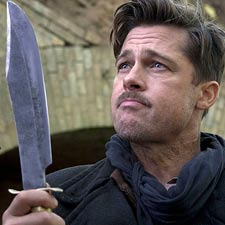
Lt. Raines and company are tapped to join forces with German film star Bridget von Hammersmark (Diane Kruger) in a covert operation set to take place at the premiere of Joseph Goebbels’ (Sylvester Groth) latest propaganda film. Nation’s Pride tells of the exploits of Private Fredrick Zoller (Daniel Brühl), a Nazi war hero after singlehandedly killing several hundred enemy soldiers from a bell tower. Pvt. Zoller is trying—and failing—to pitch the woo at Emmanuelle Mimieux (Mélanie Laurent), the comely owner of the theater chosen for the premiere, unaware that her real name is Shosanna. Having narrowly escaped the slaughter of her whole family at the hands of notorious Jew hunter Col. Hans Landa (Christoph Waltz), Shosanna has her own plans for the premiere, thanks to a basement filled with explosive nitrate 35mm prints.
The intricate plot offers a wealth of opportunities for scene-stopping showpieces of all kinds, from epic spectacle to intimate character work. From a storytelling standpoint, InglouriousBasterds is airtight, suspenseful, and totally gripping, thanks largely to Waltz, whose screen-busting performance ranks as one of the best that Tarantino has ever directed. As the spiky, predatory Col. Landa, Waltz unnerves everyone he encounters with an unsettling joie de vivre and penetrating intensity. His dedication to the Nazi cause and expertise at sniffing out Jews, traitors, and terrorists infuses every scene—with or without him—with tension and menace.
As Shosanna, Col. Landa’s foil, Laurent’s human, affecting performance proves that Tarantino is serious about creating meaty roles for women. In Shosanna, Tarantino combines the relentless focus of Kill Bill‘s The Bride (Uma Thurman) with the believable femininity of the women of Death Proof, and gives her a plotline with meaning and emotional depth. Laurent is more than up to the task, especially in a fantastic scene where she prepares for battle to David Bowie’s deliciously anachronistic “Cat People.”

Of course, the nominal star of the film is Pitt, who seems to be channeling his buddy George Clooney in O Brother Where Art Thou? Though some (like the Academy) believe Pitt to be deserving of top acting accolades, a comedian he has never been, and his attempt at a hillbilly accent fails miserably. He’s painful in every single scene, always overshadowed by the other Basterds—even the ones who don’t have speaking roles. One wishes that Tarantino had had the guts to cast a Jewish actor as Raines, rather than forcing Brad Pitt to pretend he came down from the Smoky Mountains.
Fortunately, the rest of the cast proves worthy of the star turns given by Laurent and Waltz, with Kruger in particular sparkling things up as a glamorous movie star. The film is a treat to watch, but only if you can stomach Tarantino’s idiosyncratically inventive signature violence.
As always, the director bathes his camera in blood. No punches are pulled, no eye looks away. Much like the “House of Blue Leaves” segment in Kill Bill, much of the violence in InglouriousBasterds is operatic to the extreme. Yet Tarantino has not forgotten the power of a single, small act of cruelty, such as the one in Reservoir Dogs that launched him to fame, and employs several effectively here as well. He clearly revels in his ability to shock, disturb, and horrify, even as his clever dialogue and commanding directing elicits laughs and cheers along with the gasps and screams.

On the surface, InglouriousBasterds seems like yet another gratuitously violent exercise in nihilism. Yet certain elements lead one to wonder whether Tarantino has begun to question his own aesthetic. The climax of the film takes place at a screening of a film celebrating a savage act of violence. Watching the Nazi audience scream with joy at Nation’s Pride, which skillfully reenacts every single one of Private Zoller’s 300 sniper kills, it’s hard not to reflect on how fun it was to watch the Basterds kill a bunch of Nazis with savage glee. It’s almost as if Tarantino is punishing the audience for enjoying his film.
In an interesting and revealing bit of casting, Tarantino chose Hostel director Eli Roth to play Sergeant Donny Donowitz, The Bear Jew, a Basterd whose specialty is bashing Nazi brains in with a baseball bat. (Tarantino also tapped Roth to direct Nation’s Pride, the movie-within-the-movie.)
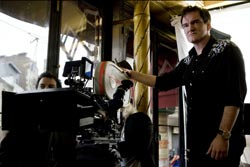
Roth infuses Donowitz with a savage glee that is sure to elicit cheers from audiences, particularly because he’s on “our” side. You have to be a member of the Aryan Nation not to enjoy watching Nazis get what’s coming to them. But having the vengeance delivered by the man who made torture porn a hot new movie genre adds a level of ambiguity to things. Are we cheering because we hate Nazis? Or because we like violence?
It doesn’t seem as though Tarantino himself knows the answer. It’s interesting to note that all of his films have explored vengeance of one kind or another, dancing around the notion of righteous wrath. In Inglorious Basterds, he unleashes hell on some most-deserving villains, only to turn things around and indict the audience for their own complicity in the culture of violence. It’s a more-than-fair critique.
Talk About It
Discussion starters- Where do you draw the line between justified and gratuitous onscreen violence?
- What distinguishes righteous from unrighteous vengeance?
- What is to be our response when we encounter great evil?
The Family Corner
For parents to considerInglouriousBasterds is rated R for strong graphic violence, language and brief sexuality. The violence is spectacular and graphic, with incidences too numerous to detail. Suffice it say, the body count is high and there is a lot of blood. There is one shot with sexual content, and a great deal of profanity of all kind.
Photos © The Weinstein Company
Copyright © 2009 Christianity Today. Click for reprint information.