 There may be a lesson in the recent troubles of the social giant Twitter.
Don’t mess with The Babylon Bee.
Started as a site to poke fun at Christian subculture, the Bee’s political satire has come to overshadow its more kindhearted Christian humor in recent years, landing the site in hot water with fact-checkers and social media gatekeepers—including Twitter.
Twitter suspended The Babylon Bee’s account on March 22, after labeling a post about transgender Biden administration official Rachel Levine as hateful content. Not long afterward, billionaire Elon Musk, a fan of the site, got a text from his former wife, Talulah Jane Riley.
“The Babylon Bee got suspension is crazy!” read the text, which was made public earlier this year. “Why has everyone become so puritanical?” Then Riley suggested Musk buy Twitter and either delete it or “make it radically free-speech.”
Musk, who recently bought Twitter for billion and instituted mass layoffs, was a critic of censorship on social media long before the Bee’s troubles. But the satire site’s connection to one of the most powerful men in the world is the latest example of the Bee’s rise from a would-be pastor’s side project to a conservative powerhouse.
The Bee, modeled similarly to secular satire site The Onion, began as the brainchild of Adam Ford, who quit his day job in the mid-2010s to start creating web content. Ford’s dreams of becoming a pastor had been derailed by panic and depression, he told The Washington Post in 2016.
With the help of medication, Ford got better and began writing about faith, first for a webcomic and then in 2016 for the Bee. From the beginning, the site was a hit, especially with evangelical Christians who appreciated the good-natured jokes about the foibles of church life, which at the time caught on more than political jokes.
Among the more memorable of the site’s early jokes was headlined, “Holy Spirit Unable To Move Through Congregation As Fog Machine Breaks.”
“We barely got through our new song. It was a real train wreck,” a fictional Nashville worship leader is quoted as saying.
Other early jokes poked fun at church committees and prosperity gospel pastors like Joel Osteen, including this headline: “Joel Osteen Sails Luxury Yacht Through Flooded Houston To Pass Out Copies Of ‘Your Best Life Now.’”
Jon Glass, pastor of Cropwell Baptist Church in Pell City, Alabama, appreciated the church humor at the Bee in its early days, calling it “the kind of sarcasm that hits home and makes you think, ‘Is that what we look like?’”
Writer and former pastor Jelani Greenidge was also an early fan of the Bee’s attempts to poke fun at the weird side of evangelical culture. Those early posts, he said, helped Christians laugh at themselves.
“The best satire comes from a place of love,” said Greenidge. That love, he said, seems in short supply these days at the Bee, which Greenidge said seems too focused on skewering the politicians and progressive figures conservatives hate.
Babylon Bee’s current CEO, Seth Dillon, a pastor’s son and former internet marketer who bought a majority stake in the Babylon Bee in 2018, said the site still publishes plenty of church jokes. But fewer people share them.
“We still do lots of church jokes—they just don’t go as viral as the other stuff,” he said, while the opportunities for satire in the daily news cycle are endless. He pointed to the site’s repeated satire of Donald Trump—a Trump joke tops the Bee’s “greatest hits” list of pages that have drawn the most traffic—whom Dillon called an “outrageous figure” who deserved to be mocked.
Today, though, the site is known most for its critique of liberal politicians and what Dillon called the “woke mind virus.” He describes the Bee as a satire site with a Christian worldview that is devoted to mocking bad ideas in popular culture.
“We don’t want our audience to feel bad about themselves like we’re bullying them,” he said. “We want our audience to take bad ideas less seriously.”
Ford remains a part owner of the Bee and also runs “Not the Bee,” which aggregates weird headlines, often about progressives.
While the Bee’s website still offers a mix of jokes—twin headlines “Churchgoer Turned Into Pillar Of Salt After Turning To Glare At Sound Guy” and “Satan Leads Prayer At Trump Rally” topped the site on Monday—the political jokes and jabs at progressive culture attract the most attention, dominating both the site’s “buzzing” list, which tracks trending stories on the site, as well as the Bee’s greatest hits.
“They do a great job at bringing awareness to the absurdity that drives much of our culture,” said Alex MacArthur, a software engineer and Bee fan from Nashville, Tennessee.
The site’s writers seem particularly obsessed with U.S. Rep. Alexandria Ocasio-Cortez, running two dozen stories about the New York Democrat in 2022 alone. For subscribers, who pay between .17 and a month for ad-free content and other premiums, the site offers a top 10 list of Ocasio-Cortez jokes (“AOC Engaged, Registers For ,000 ‘Tax The Rich’ Toaster,” “AOC Cries Outside Disney World In Dress Reading ‘Groom The Kids’”).
The site has run a number of anti-trans jokes—mocking both particular transgender people like Levine as well as fictional trans people. One of the site’s greatest hits is about a motorcycle rider who wins races by “identifying as a bicyclist.”
The Bee’s satirical forays into culture war issues have earned a loyal following—the site draws about 20 million page views a month, said Dillon—and the ire of many.
Along with having its Twitter account suspended, The Babylon Bee has been dinged by fact-checkers and social media sites for sharing disinformation. That has cost the site traffic and money, said Dillon. Even so, the Bee tries to capitalize on what Dillon called big-tech censorship of conservative viewpoints by running ads highlighting its clashes with social media gatekeepers to attract subscribers.
“It helps expose them for being not just humorless scolds but big-tech tyrants,” he said.
Matt Sienkiewicz, chair of the communication department at Boston College and co-author of That’s Not Funny: How the Right Makes Comedy Work for Them, said The Babylon Bee is part of a larger, highly successful conservative comedy ecosystem.
But the Bee’s success in promoting “anti-liberal comedy” has come at the cost of drowning out the Christian satire, in Sienkiewicz’s opinion. Fans who came to the site for church humor likely no longer see those jokes because they don’t feed the outrage algorithm or because they are turned off by the politics.
“The stuff that no one else can do has been lost,” he said.
Much of today’s humor, he said, is shaped by what he called “clapter”—where people applaud because they agree with the person making the joke, rather than laughing at themselves.
“It might be funny but it loses some of the joy,” he said.
Sienkiewicz said attempts to label the Bee as misinformation are silly, as the site is clearly satire. But, he said, the Bee risks falling into a “risk-averse strategy” when it comes to comedy by only telling the jokes its audience will agree with.
“One of the saddest things about the state of American politics is that it makes comedy harder and less interesting,” he said.
Ethan Nicolle, a conservative writer from California and a Babylon Bee staffer from 2018 to 2022, agrees.
Nicolle, who was creative director of the Bee in the early days of working out of editor in chief Kyle Mann’s garage, said he loved working for the Bee and having the chance to poke fun at the state of American culture—some of which he believes is very unhealthy.
“They tell the jokes you aren’t supposed to tell,” he said.
Still, he suspects the country’s polarization makes satire more difficult. People are afraid to critique their own side—and unwilling to be friends with anyone on the other side.
“All of the joy of life comes from your relationships with other people,” said Nicolle. “And to cancel another human being because of something political they said makes no sense. And we’re doing that with half the country.”
So far, Musk’s takeover of Twitter hasn’t paid off for the Bee—the site’s Twitter account remained suspended as of early November. But the Bee’s staff did score a long, in-person interview with Musk, in which he discussed censorship, sustainable energy and his own religious background, which included attending both Hebrew school and Sunday school at an Anglican church and believing in “the God of Spinoza.”
Musk also said he’s a fan of the teachings of Jesus.
“Things like turn the other cheek are very important, as opposed to an eye for an eye,” he said. “An eye for an eye leaves everyone blind.”
In 1963, Dr. Martin Luther King Jr. told an audience at Western Michigan University, “At 11:00 on Sunday morning when we stand and sing Christ has no east or west, we stand at the most segregated hour in this nation. This is tragic.” Sunday morning segregation was especially tragic at two Methodist churches in Philadelphia, separated by one mile and more than 200 years. The two churches, St. George’s and Mother Bethel, reunited for the first time October 25, 2009.
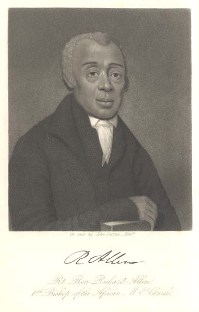
The split between the churches dated back to the late eighteenth century and the career of Richard Allen. Born a slave in Philadelphia in 1760, Allen and his family were sold to a Delaware farmer, Stokely Sturgis, who allowed him to attend church. Slaves’ exposure to Christianity in the early eighteenth century had largely consisted of exhortations to obey their masters, but by the later years of that century, Methodists and Baptists had begun effective evangelism to slave communities. These two churches’ practice of licensing black preachers proved a key to their success but also, unfortunately, brought the racial tensions building in American society in-house.
In 1777, Allen and Sturgis both converted to Methodism. Sturgis became convinced that God would judge slaveholders harshly, so he offered his slaves their freedom for $2,000 each. Allen purchased his and his brother’s freedom in 1783, became a Methodist preacher, and spent the next six years itinerating around Delaware, Pennsylvania, New York, Maryland, and South Carolina. Eventually he worked his way back to Philadelphia. He was invited to serve as assistant minister at St. George’s Methodist Church and to preach publicly in the city’s black neighborhoods. As his popularity grew, so did the black congregation worshiping at St. George’s, much to the consternation of some white members.
In his autobiography, Allen recounted the events that divided the church:
A number of us usually attended St. George’s Church in Fourth street; and when the coloured people began to get numerous in attending the church, they moved us from the seats we usually sat on and placed us around the wall, and on Sabbath morning we went to church and the sexton stood at the door, and told us to go in the gallery. He told us to go, and we would see where to sit. We expected to take the seats over the ones we formerly occupied below, not knowing any better. We took those seats. Meeting had begun and they were nearly done singing, and just as we got to the seats, the elder said, “let us pray.” We had not been long upon our knees before I heard considerable scuffling and low talking. I raised my head up and saw one of the trustees, H— M—, having hold of the Rev. Absalom Jones, pulling him up off of his knees and saying, ‘You must get up — you must not kneel here.” Mr. Jones replied, “wait until prayer is over.” Mr. H— M— said no, you must get up now, or I will call for aid and I force you away.” Mr. Jones said, “wait until prayer is over, and I will get up and trouble you no more.’ With that he beckoned to one of the other trustees, Mr. L— S— to come to his assistance. He came, and went to William White to pull him up. By this time prayer was over, and we all went out of the church in a body, and they were no more plagued with us in the church.
This raised a great excitement and inquiry among the citizens, in so much that I believe they were ashamed of their conduct. But my dear Lord was with us, and we were filled with fresh vigour to get a house erected to worship God in. … We then hired a store room and held worship by ourselves. Here we were pursued with threats of being disowned, and read publicly out of meeting if we did continue worship in the place we had hired; but we believed the Lord would be our friend. We got subscription papers out to raise money to build the house of the Lord.
By this time we had waited on Dr. Rush and Mr. Robert Ralston [two prominent white citizens of Philadelphia], and told them of our distressing situation. We considered it a blessing that the Lord had put it into our hearts to wait upon those gentle-men. They pitied our situation, and subscribed largely towards the church, and were very friendly towards us and advised us how to go on. … Here was the beginning and rise of the first African church in America.
Allen’s church became known as Bethel, or Mother Bethel. Though he had severed ties with St. George’s, he remained connected to the Methodist Church and was ordained its first black deacon in 1799. Over time, though, he became increasingly frustrated with the Methodists’ pattern of subjecting their black churches to white oversight. And so, in 1816, Allen organized the African Methodist Episcopal Church and became its first bishop.
Fast forward to 2009. St. George’s, the oldest Methodist church in America, prepared to celebrate its 240th anniversary. The 250th birthday of Richard Allen was right around the corner. It seemed like the perfect time for a reunion.
St. George’s minister Rev. Alfred Day, quoted in a press release, said, “The incidents that pulled us apart so many years ago do not have to be as powerful as the things that brought the first black and white Methodists together. The experience of God’s Spirit is breaking down barriers instead of erecting them.”
Mother Bethel pastor Rev. Mark Kelly Tyler concurred and looked to the future: “It’s tragic that many of the divisions that led to the splitting of these two congregations over 200 years ago are still alive and well. This worship service is not just about remembering what happened, but we gather in the hope that one day such a service will not even be newsworthy because we have overcome issues of racism, sexism, classism, and all other -isms that separate us from one another and God.”
For now, though, the story is definitely newsworthy.
* * *
For more on Richard Allen, read “You Must Not Kneel Here,” from Christian History issue 62.
Click here to purchase a copy of Christian History issue 62, “Africans in America.”
Public domain image of Richard Allen from the frontispiece of ”History of the African Methodist Episcopal Church” (1891) by Daniel A. Payne via Wikimedia Commons.