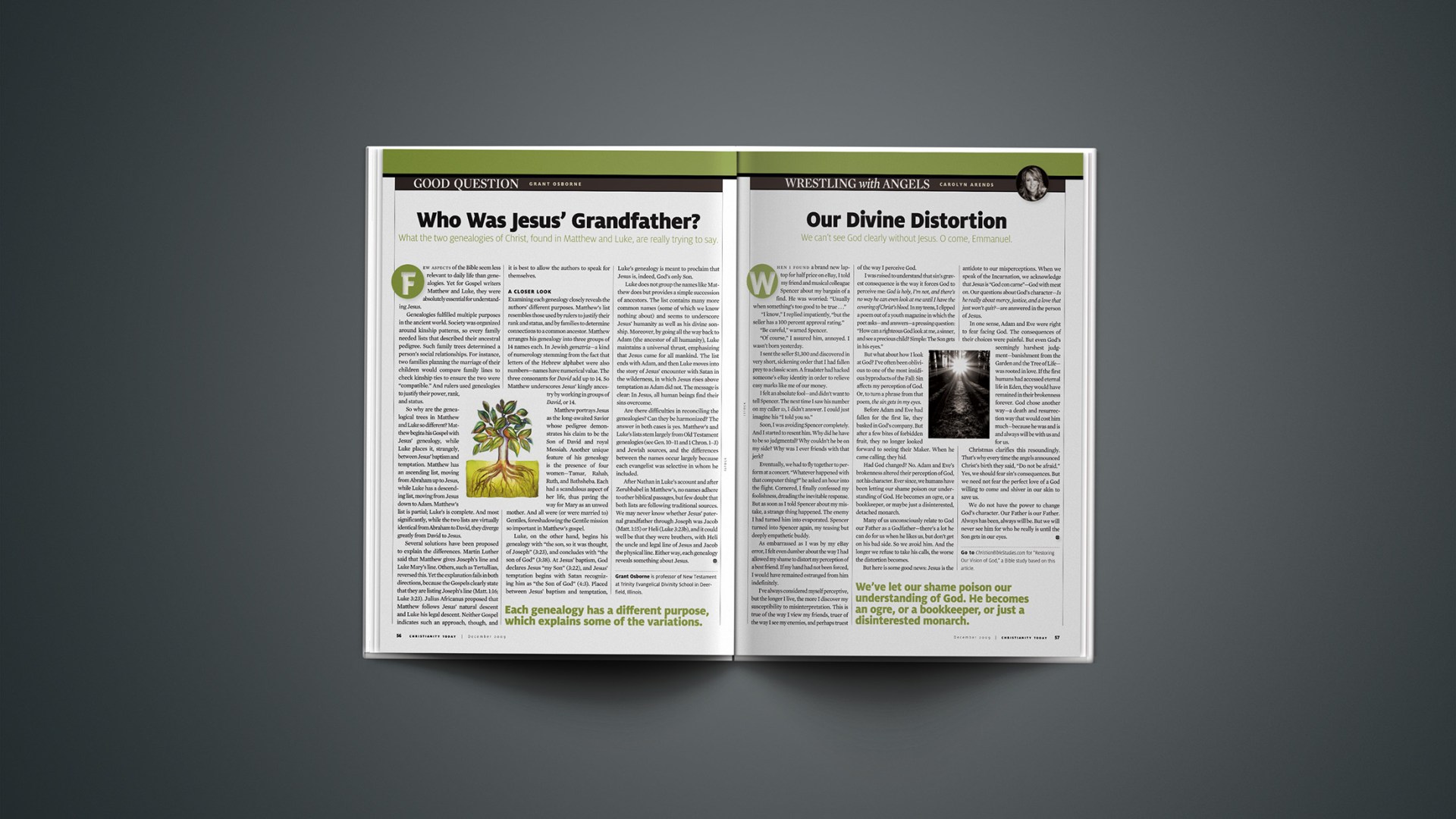

Few aspects of the Bible seem less relevant to daily life than genealogies. Yet for Gospel writers Matthew and Luke, they were absolutely essential for understanding Jesus.
Genealogies fulfilled multiple purposes in the ancient world. Society was organized around kinship patterns, so every family needed lists that described their ancestral pedigree. Such family trees determined a person's social relationships. For instance, two families planning the marriage of their children would compare family lines to check kinship ties to ensure the two were "compatible." And rulers used genealogies to justify their power, rank, and status.
So why are the genealogical trees in Matthew and Luke so different? Matthew begins his Gospel with Jesus' genealogy, while Luke places it, strangely, between Jesus' baptism and temptation. Matthew has an ascending list, moving from Abraham up to Jesus, while Luke has a descending list, moving from Jesus down to Adam. Matthew's list is partial; Luke's is complete. And most significantly, while the two lists are virtually identical from Abraham to David, they diverge greatly from David to Jesus.
Several solutions have been proposed to explain the differences. Martin Luther said that Matthew gives Joseph's line and Luke Mary's line. Others, such as Tertullian, reversed this. Yet the explanation fails in both directions, because the Gospels clearly state that they are listing Joseph's line (Matt. 1:16; Luke 3:23). Julius Africanus proposed that Matthew follows Jesus' natural descent and Luke his legal descent. Neither Gospel indicates such an approach, though, and it is best to allow the authors to speak for themselves.
A Closer Look
Examining each genealogy closely reveals the authors' different purposes. Matthew's list resembles those used by rulers to justify their rank and status, and by families to determine connections to a common ancestor. Matthew arranges his genealogy into three groups of 14 names each. In Jewish gematria—a kind of numerology stemming from the fact that letters of the Hebrew alphabet were also numbers—names have numerical value. The three consonants for David add up to 14. So Matthew underscores Jesus' kingly ancestry by working in groups of David, or 14.
Matthew portrays Jesus as the long-awaited Savior whose pedigree demonstrates his claim to be the Son of David and royal Messiah. Another unique feature of his genealogy is the presence of four women—Tamar, Rahab, Ruth, and Bathsheba. Each had a scandalous aspect of her life, thus paving the way for Mary as an unwed mother. And all were (or were married to) Gentiles, foreshadowing the Gentile mission so important in Matthew's gospel.
Luke, on the other hand, begins his genealogy with "the son, so it was thought, of Joseph" (3:23), and concludes with "the son of God" (3:38). At Jesus' baptism, God declares Jesus "my Son" (3:22), and Jesus' temptation begins with Satan recognizing him as "the Son of God" (4:3). Placed between Jesus' baptism and temptation, Luke's genealogy is meant to proclaim that Jesus is, indeed, God's only Son.
Luke does not group the names like Matthew does but provides a simple succession of ancestors. The list contains many more common names (some of which we know nothing about) and seems to underscore Jesus' humanity as well as his divine sonship. Moreover, by going all the way back to Adam (the ancestor of all humanity), Luke maintains a universal thrust, emphasizing that Jesus came for all mankind. The list ends with Adam, and then Luke moves into the story of Jesus' encounter with Satan in the wilderness, in which Jesus rises above temptation as Adam did not. The message is clear: In Jesus, all human beings find their sins overcome.
Are there difficulties in reconciling the genealogies? Can they be harmonized? The answer in both cases is yes. Matthew's and Luke's lists stem largely from Old Testament genealogies (see Gen. 10-11 and 1 Chron. 1-3) and Jewish sources, and the differences between the names occur largely because each evangelist was selective in whom he included.
After Nathan in Luke's account and after Zerubbabel in Matthew's, no names adhere to other biblical passages, but few doubt that both lists are following traditional sources. We may never know whether Jesus' paternal grandfather through Joseph was Jacob (Matt. 1:15) or Heli (Luke 3:23b), and it could well be that they were brothers, with Heli the uncle and legal line of Jesus and Jacob the physical line. Either way, each genealogy reveals something about Jesus.
Grant Osborne is professor of New Testament at Trinity Evangelical Divinity School in Deerfield, Illinois.
Copyright © 2009 Christianity Today. Click for reprint information.
Related Elsewhere:
Christianity Today has more Good Question columns, including:
Nothing New | Popular spiritual author and Oprah favorite Eckhart Tolle quotes Jesus a lot. Is he a Christian? (July 23, 2008)
Hour of Decision | "How can I know I'm a Christian if I can't remember when I first responded to the gospel?" (December 26, 2007)
Until We Meet Again | 'Does the Bible teach that we will recognize our loved ones in heaven?' (October 23, 2007)