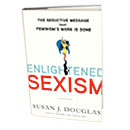
For my money, Susan J. Douglas is one of the most interesting feminist critics writing today. Her Where the Girls Are, a study of how women were portrayed in American media in the decades after World War II, is on my top-20 list of fabulous history books. The argument of her new book, Enlightened Sexism, is simple, disturbing, and thought-provoking. In real terms—terms that have to do with, say, women’s actual power—there’s still an awful lot of work for feminism and feminists in the United States to do. (One striking statistic Douglas produces: 17 percent of the U.S. House of Representatives is female. By contrast, in Rwanda’s equivalent body, 56 percent of the seats are held by women. The United States “ranks sixty-ninth in the world in terms of number of women in national legislatures.) But the media has presented a picture of equality—or something like equality. When you turn on the TV, you are likely to see women doing just about anything they want, women who don’t encounter real-world sexism very often. To wit, the women on Grey’s Anatomy, just one example of TV women holding jobs that 30 years ago would have gone to men, on both television and in the real world. Yet these pictures of gender-equity and women’s advancement exist side-by-side with the “enlightened sexism” of Douglas’ title.

Enlightened sexism “insists that women have made plenty of progress … indeed, full equality has been allegedly achieved … so now it’s okay, even amusing, to resurrect sexist stereotypes of girls and women.” Douglas’ readings of various cultural artifacts, from magazines’ disturbing obsession with Hollywood stars’ “baby bumps” to quasi-pornographic Calvin Klein ads, are consistently smart, but she’s at her best when juxtaposing television fantasies with reality. The late 1990s saw both the emergence of “Girl Power” (a phrase soon used to hawk “body glitter, lip gloss, and thongs”) and “a series of highly publicized school shootings involve[ing] teen boys with guns most frequently aimed at ex-girlfriends or females in general”: Pearl, Mississippi; West Paducah, Kentucky; Jonesboro, Arkansas; “this wasn’t,” Douglas points out, “as was often reported in the press, students killing students: it was boys killing girls.”
The bottom line? “On dramatic TV … the extent to which we see women in top positions exaggerates women’s conquest of male-dominated professions and implies that women have done much better in career-land than they remotely have.” These escapist images also erase the “plight of millions of real-life women whose annual income is about the same as the price of a new Ford truck.” All this raises an important question for those of us who care about women’s equality. As studies of second-wave feminism (like my favorite, Alice Echols’ Daring to be Bad) have consistently made clear, feminism doesn’t just naturally occur; it is politics; it requires organizing. So maybe those of us who care about feminist politics need to turn off the television and get to work.
Lauren Winner is an assistant professor at Duke Divinity School.
Copyright © 2010 Books & Culture. Click for reprint information.