NASCAR is said to be the second largest spectator sport in the U.S., behind only the NFL in TV ratings. But it might be the largest anti-spectator sport.
Its roots are in the South—a 2001 article about NASCAR in Southern Cultures is titled “The Most Southern Sport on Earth”—and though it has long since spread nationwide (and then some), it is still far less understood in most places than football, basketball, or baseball. Such ignorance led to the making of the documentary Racing Dreams.
Director Marshall Curry was intrigued by a story he read about the World Karting Association (WKA) Championships—an unofficial Little League for NASCAR. So Curry, whose 2005 documentary (and feature-length debut) Street Fight was nominated for an Oscar, decided to educate himself by making a film. The end result is a thrilling look into this racing sub-culture, but even more, it is a poignant look at the transition from childhood to adulthood.
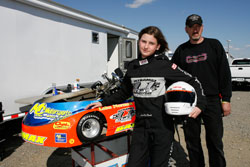
Racing Dreams follows three kids who are competing in the year-long WKA National Series. Brandon is 13 years old, has been raised by his grandparents since he was four, and has problems keeping his cool. Josh, 12, is a model student and perfectionist who emulates the pros in every way he can. Annabeth, 11, is the least experienced driver and must contend as a girl surrounded by guys, but is also competitive, confident, and spunky.
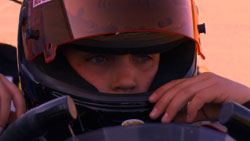
The film alternates between home and the track. At the races, we are inducted into a competition of maddeningly precise angles, these kids scooting along at 70 mph with no suspension systems and their rear ends only an inch off the ground. Speaking as someone typically benumbed by watching cars make laps, I was transfixed. The editing moves things along, but the film gives you enough context to help you begin to appreciate the artistry in the driving.
Most of all, though, I was emotionally invested in these drivers because of the sequences at home. Curry chose to shoot Racing Dreams with compact cameras rather than heavier, shoulder-mounted models, so that he could work in tighter spaces and be less intrusive. This rewards us with surprisingly vulnerable glimpses into these families—sometimes charming, as when Brandon curls up in his room and flirts sheepishly over the phone with Annabeth, and occasionally haunting, as when Brandon’s grandfather goes out one night onto a pitch-black porch with Brandon’s resurfaced father and gravely warns him about getting into more trouble.
Curry says his pre-adolescent subjects were the perfect age: “young enough to be honest and open, but old enough to be interesting and insightful.” This is absolutely true. Take, for instance, when Josh, the most precocious of the three, explains very deliberately how important it is for a professional driver to please the sponsors, and how he is already working on carrying himself in the right way.

Or consider how Annabeth is not too embarrassed to show the camera her personal Top 5 Things to Learn list. (Number four: “how to roll back time.” Number five, with some bashful giggles: “how to kiss a boy on the lips.”)
But then she is old enough, for instance, to suppose that one of her suppliers, Ultramax, is more willing to give her equipment free of charge because if as a girl she succeeds with it, then other drivers will think that much more highly of the equipment. “That’s totally sexist and wrong,” she says, smiling good-naturedly, “but if it gets Ultramax more customers, then it’s okay with me.”
The kids are also old enough to articulate reasons for their love of racing, reasons deeper than the need for speed. Annabeth says racing gives her an independence she can’t have otherwise. Later, she calls it “God’s given talent to me.” And Brandon, who usually seems to just shrug off his family problems, laughing and roughhousing and singing, in one quieter moment admits how racing helps him: “When I come to a race, I don’t even think about what’s going on at home. Everything goes away.”
But what is most moving in Racing Dreams is to see how, on the verge of adolescence, these kids must begin to reconcile their dreams with reality. Their beloved sport is quickly becoming a career decision with steeper and steeper costs. In a way, their superlative talent forces them to grow up a little sooner. As Annabeth says, “It’s hard for an 11, 12, 13-year-old to think about what they want to do for the rest of their life.”
There are not many films that treat childhood with as much balance as Racing Dreams does. It is lighthearted and earnest, playful and respectful, exhilarating and heartbreaking.
By the end of the film, Annabeth is the one who has most visibly changed—different hair, now in braces, and truly a teenager. She is still charming, but she is not the Annabeth we first met. Sometimes, even when one good thing takes the place of another, it’s hard not to want to “roll back time.”
Talk About It
Discussion starters- Did you have any pre-existing stereotypes about NASCAR culture? If so, how did the film fulfill or subvert those?
- In what ways does racing help these kids? How might it not be good for them?
- What does the film show about our capacity to dream and be ambitious? What is lost and gained as we grow older?
- How does this film show the relationship between parents’ dreams and their children’s dreams? What should this look like ideally?
- Does our culture usually ask too much or too little of children? How so?
The Family Corner
Racing Dreams is rated PG for some thematic elements and brief language. Also, there are some sobering expressions of family dysfunction. Brandon’s father is clearly irresponsible, and we get indications that he’s been involved in drugs. We also learn that he robbed Brandon’s grandparents.
Photos © Hannover House
Copyright © 2010 Christianity Today. Click for reprint information.