"Your baby has hydrocephalus, a possible chromosome disorder, and what appears to be a cleft lip. We don't know what his odds for survival are."
When my friend Jen Gibson heard those words back in April of last year, her heart dropped. She and her husband Tim had known there were complications with their son Eli's development in the womb, but now their fears were confirmed.
Birth defects are more common than we think. The Centers of Disease Control and Prevention report:
Every 4.5 minutes, a baby is born with a birth defect…. Birth defects are a leading cause of infant death, accounting for more than 1 of every 5 infant deaths. In addition, babies born with birth defects have a greater chance of illness and long-term disability than babies without birth defects.
Within just a few weeks of my friend learning about her son's condition, my midwife called me with sobering news: I was carrying conjoined twins, something that happens in only one of 200,000 live births.
After an MRI, I found out my girls had developed almost no lung tissue and would not survive for long outside of the womb. It was devastating.
Christian mothers who receive news of birth defects or fatal diagnoses for their babies face overwhelming questions. For me, the question of whether to continue the pregnancy was the most black-and-white choice I had to make. I believe life is sacred and that my daughters deserved as much life as I could give them.
The tough questions came when I tried to make sense of verses like: "I praise you because I am fearfully and wonderfully made" (Ps. 139:14). Did I believe God created my children just they way they were meant to be, birth defects and all?
I struggled with Exodus 4:11, where Moses expresses his reluctance to speak in public: "The Lord said to him, 'Who gave human beings their mouths? Who makes them deaf or mute? Who gives them sight or makes them blind? Is it not I, the Lord?'" Is God taking credit for all physical defects?
In the passage, God is frustrated with Moses to the point of anger. Moses is worried that God won't be able to help him with a small speech problem, just after God has shown Moses some convincing miracles to demonstrate his power. As Terence Fretheim observes in his commentary on Exodus, the point of this passage isn't to show that God reaches into every woman's womb and singles out who becomes blind or mute or deaf. Rather, God emphatically tells Moses that he is in control of the world, a world that includes speech problems, hearing loss, and loss of sight. God shows Moses that he can work around these things and still accomplish his purpose.
Still, many of us with children who are ill grapple with the questions, "Why do we suffer? Why do our children have to suffer?"
Like so many things, it dates back to the Garden of Eden.
In his book, Give Me an Answer, Pastor Cliffe Knechtle writes, "When we human beings told God to shove off, he partially honored our request. Nature was adversely affected. Genetic breakdown, disease, pain, and death became part of the human experience. We are born into a world made chaotic and unfair by a humanity in revolt against its Creator."
God isn't responsible for things like suffering, birth defects, and the general breakdown of our world. It is the consequence of original sin.
A family in Nashville welcomed a daughter last year who was born with a similar disorder to my friend's son. The Browns say of their daughter Pearl: "Things didn't go wrong. God has designed Pearl the way he wanted, for his glory and our good."
While the Browns, a Christian family, are dealing with their situation with grace and dignity, I disagree with their perspective. Things did go wrong. Pearl's brain development stalled in the first few weeks in the womb. I don't believe that was God's perfect plan for Pearl or her parents.
Things went wrong with my twins' development, too. The girls didn't fully separate when their bodies were being formed, resulting in a shared stomach, intestines, and abdomen. They had no lungs. This was surely not the way God wanted it.
It brings me comfort to consider Psalm 139:14 with regard to our souls. God says we're made in his image, but he acknowledges that he is a spirit, a non-corporeal being. Even though our physical bodies may not be formed perfectly in the womb, our souls, the parts that matter the most to our Creator, are indeed fearfully and wonderfully made.
Eli Gibson passed away on Oct. 25, 2012. He brought his family great joy during his five short months. Jen, Tim, and their daughters cherish the short time they had together with him.
My twins Amelie Lillian and Adaline Genevieve were born on Sept. 21, 2012, and passed away in my husband Caleb's arms after 52 very short minutes. My heart misses them every day.
Almost a year later, I still wrestle with questions. For many of us who have had lost a child to birth defects or live with a child with physical problems, sometimes we can only take comfort in the hope that one day we will hold our children, free from pain and made completely whole in the presence of God.
I've got two arms reserved for Amelie and Adaline.
Heather King has a passion for music and writing. For the past 15 years she's fronted the worship band Daniel's Window and taught piano and voice in her private studio just south of Chicago. She loves scary movies, Stephen King novels, her salsa garden, her daughter Hayden, and her freelance comic book artist husband Caleb. Connect with Heather at her blog, hit her up on Facebook, or check out her band's music on iTunes.
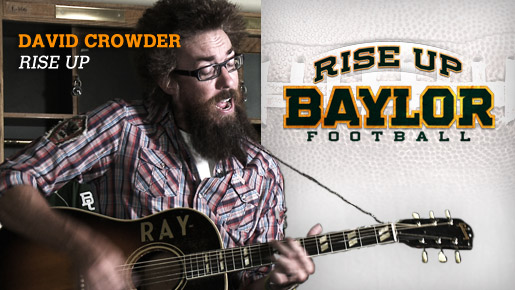
Baylor University alum David Crowder loves his Bears – so much that he wrote something of a fight song, “Rise Up,” for his alma mater’s football team, which will take the field to the playing of the song at every home game this season.
Crowder had seen some of the team’s commercials over the summer, which had the theme of “rise up.” He went to sleep one night, and woke up the next day with the song in his head.
“I don’t want to talk about Manifest Destiny,” he told Baylor, “but I woke up the next morning and I’m sort of in a dream state with this song in its entirety. Later in the day I remember I had a song in my head when I woke up, and I started talking to a guy I work with. I said I feel like I had a dream, something about Baylor football, and I started reciting lyrics to it. About halfway through, I go, ‘This is a good song. I gotta go, I gotta record it quick before it disappears.’ So that day I recorded it and sent it to some folks in the athletic department, and they got pretty excited. I was already excited, so we went ahead and polished it up.”
At last Saturday’s opener, the 42,821 fans in attendance heard the song, and the Bears rose up and whipped Sam Houston State, 34-3.
The song is now available for listening and downloading.