On August 16, the Los Angeles Times ran an op-ed by the widely published evolutionary biologist David Barash. It was titled “Science, Such a Sweet Mystery,” with a subtitle to flesh it out: “It’s not what science knows, but what it doesn’t, that really matters.”

Taken literally, of course, that’s a silly claim (what does “really matters” mean?), but it’s calculated to draw you into the piece itself, where the provocation is redoubled in the first sentence:
I have been teaching and doing research at the university level for more than 40 years, which means that for more than four decades, I have been participating in a deception—benevolent and well-intentioned, to be sure, but a deception nonetheless ….
When scientists speak to the public or to students, we talk about what science has discovered. Nothing wrong with this. After all, we work hard deciphering nature’s secrets and we’re proud whenever we succeed. But it gives the false impression that we know pretty much everything, whereas the reality is that there’s a whole lot more that we don’t know.
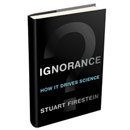
Barash doesn’t refer to Stuart Firestein’s Ignorance: How It Drives Science, but clearly there’s an affinity between them—especially when Barash says that scientists should “start teaching courses, giving lectures and writing books about what we don’t know about biology, chemistry, geology, physics, mathematics.”
This mixture of intellectual humility and the thrill of ongoing discovery is winsome, but Barash issues a warning to go along with it: “Mystery is not the same as mysticism, and I’m not referring to some sort of ineffable spiritualistic claptrap beyond human understanding”—you know, the sort of “claptrap” that one finds in the writings of Aquinas, Pascal, C. S. Lewis, and other purveyors of mumbo-jumbo.
Oddly, at the end of his piece—after a bit of shopworn cheerleading for “the scientific enterprise to continue attracting new adherents who will keep pushing the envelope of our knowledge rather than resting satisfied within its cozy boundaries”—Barash quotes a line from singer/songwriter Leonard Cohen: “There is a crack in everything. That’s how the light gets in.” It’s a great line, but evidently Barash doesn’t understand it. The “crack” in everything isn’t measurable by science. It’s a sign of human brokenness, fallenness, all around us (and in us), evident as far back as we can trace the human record.
To acknowledge the reality of this brokenness is not to indulge in “ineffable spiritualistic claptrap” nor is it any way to reject the quest for scientific knowledge that Barash celebrates. To see that we are broken is the beginning of wisdom.
John Wilson is the editor of Books & Culture.
See also:
Part 1, by Jennifer Gruenke
Part 2, by Alan Love
Part 3, by Myles Werntz
Copyright © 2012 Books & Culture. Click for reprint information.