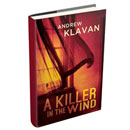
The title of Andrew Klavan's sizzling new novel has three meanings. "We had gotten a warrant a week before. Out of Tennessee," recalls Klavan's narrator and protagonist, Dan Champion, who works for the Sheriff's Department in the Bureau of Criminal Investigation. "A killer in the wind. Frank Bagot, his name was. He had beaten a girl to death in Nashville—God knows why. Had outrun the police when they moved in on him, shooting one officer in the leg, shattering his shinbone. He was armed and dangerous, without much to lose. And I had a feeling from the start he'd be heading my way."

Champion's intuition is well-founded: he knows that Bagot has a sister in "the little corner of downstate New York" that's Champion's turf. By the end of the short first chapter, Bagot is in custody. Killer in the wind #1, taken care of.
This may sound like the beginning of a crime novel in the police procedural vein, but there are signs from the outset that something a bit different is in store. "Maybe it was the dark house on the edge of town, the murderer waiting for me inside," Champion muses, "but I thought about the ghosts that night, that last April night before they all came back to haunt me."
We learn about those ghosts in the second chapter, "Flashback: The Emory Case." Let's pause a moment on that chapter title. What kind of low-rent novelist labels his flashbacks? Does he think he's writing for semi-literates? The answer tells you something about Klavan. He writes fiction in various registers—including, in recent years, a half-dozen Young Adult novels. In A Killer in the Wind, he puts a premium on clarity. If some of his more literary readers are vexed by it, tough.
Three years earlier—in the period of the first flashback—Champion was in Manhattan, an undercover vice detective for the NYPD. He's trying to track down a mysterious figure known as the Fat Woman. She's the second killer in the wind. She doesn't kill her victims—stray children—with her own hands, but she procures them for those who do. Champion explains that he had "developed … I'm not sure what to call it—a preoccupation, say," with this embodiment of evil. "As with the devil himself," he adds, "some people, even some police, didn't believe she existed."
I can't go any further without spoiling your first reading of the novel by giving too much away. In particular, I can't reveal the third point of reference for the novel's title, which isn't made explicit until the very last page. But I can say a little more about the nature of this compelling story. It's dark, violent, seasoned with wit and fueled by anger. (What kind of anger? Read the Psalms.) Like many of Klavan's earlier books, it explores the consequences of evading unpleasant realities (not least, the communal evasion that permits a lot of people to pretend that they don't know what's going on: That's awful! We had no idea!)
And like a number of Klavan's earlier books, A Killer in the Wind deals in the uncanny. (Klavan's faithful readers will be reminded especially of his early novel The Scarred Man, published under the pseudonym Keith Peterson.) You see something that seems impossible. What do you do? Tell yourself you didn't see it? Make an appointment with a psychiatrist? Or do you say, all right, that happened, even though I can't explain it. What does it tell me? What does it mean?
I don't know who all is on your list of crime and suspense novelists to read and re-read and read yet again: your personal canon. Andrew Klavan is on my list. If you haven't tried him, A Killer in the Wind is a good place to start.
John Wilson is the editor of Books & Culture.
Copyright © 2012 Books & Culture. Click for reprint information.