
Poetry reminds us that theology is never finished business—that there's always more than one way of saying something without being false to the truth. Theological writing tends to flatten dynamic realities. Rowan Williams, an accomplished theologian and poet, observes that poetry piles the pressure on theology—through imagery, sound, form, and figures of speech—to release wonder from the familiar. Poetry helps us penetrate the truth more deeply and embrace it more passionately. And, if "masterpieces should be kept for High Holidays of the Spirit," as the poet W. H. Auden wrote, then a great poem deserves our careful attention at Eastertime.
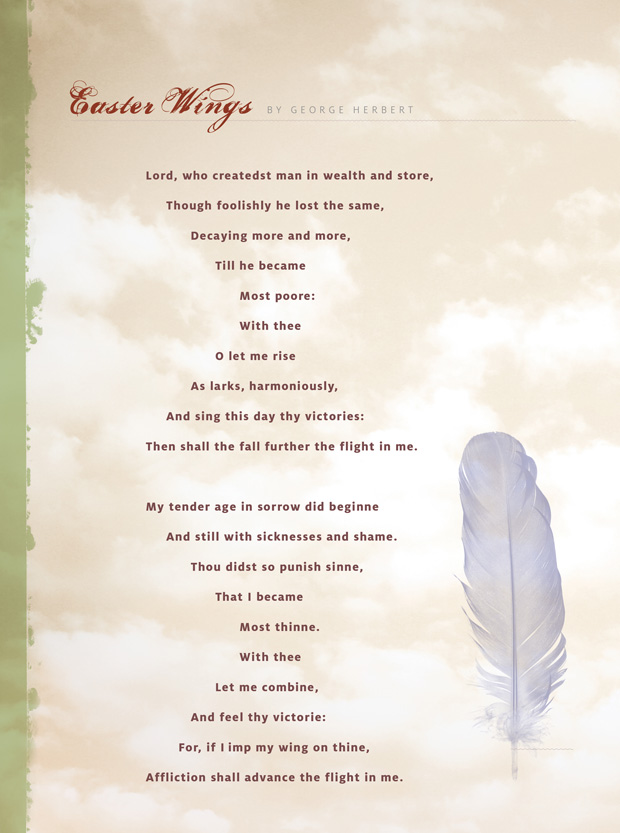
"Easter Wings" comes from The Temple (1633), a posthumous collection of poems by the 17th-century Anglican minister George Herbert. Originally published on two facing pages, the lines appeared sideways to evoke birds flying upward, wings outspread, as if to symbolize eternity. In a horizontal presentation, like the one at left, the lines evoke an hourglass figure, which connotes time. This contrast is fitting because Easter should be regarded as a kairos: an in-breaking of eternity within the flux of time, and the Greek word that Paul and other early Christians used for the coming kingdom of God.
The classic poem tells—and shows—how Christ's resurrection lifts us into flight.
Herbert invites us to explore the kairos of Easter through the metaphor of flight. Easter arrested our downward fall to death and began our upward flight in the resurrection of Jesus Christ. Each stanza contains two halves: the first marks a descent while the second marks an ascent. In the first stanza, the speaker recalls how the riches of man at Creation were squandered in the Fall, making him "most poore." In the second stanza, he testifies to the way his own affliction—"sorrow," "sicknesses," "shame," and "sinne"—has made him "most thinne." Descent is visualized by thinning lines.
In the middle of both stanzas are two momentous words: with thee. These two words are the center of the poem's energy, its kernel of truth. At the point of greatest frailty, the sinner's "decaying" is reversed through union with the death and resurrection of Christ, through Christ being "with thee." Here Herbert draws on Paul's teaching: "Now if we died with Christ, we believe that we shall also live with Him, knowing that Christ, having been raised from the dead, dies no more" (Rom. 6:8-9, NKJV, emphases added). The all-important preposition reminds us that ascent is not possible on our own strength.
Does this imply a hijacked flight, as if God takes over the cockpit, relegating Christians to the passenger cabin? On the contrary, Herbert offers a vision of combined flight ("Let me combine, / And feel thy victorie"). Behind the lines of poetry is a biblically saturated mind that recognizes that Christ rises first, according to this messianic text: "To you who fear My name / The Sun of Righteousness shall arise / With healing in His wings" (Mal. 4:2, NKJV). Then, and only then, the Christ follower rises: "Those who wait on the Lord / Shall renew their strength; / They shall mount up with wings like eagles" (Isa. 40:31, NKJV).
Beautifully improvising on this imagery, Herbert compares the rising soul to larks, who are known for their exuberant songs during flight. After the horror of Good Friday and the radical uncertainty of Holy Saturday, the disciple beholds an empty tomb on the morning of Easter Sunday. The triumphant Christ gives him a new song like "the lark at break of day arising / From sullen earth, sings hymns at heaven's gate" (Shakespeare, Sonnet 29). Christ's victories over sin, death, and Satan fill the disciple's mouth with praise, enriching previously impoverished lines. The poet also compares the redeemed sinner to an injured falcon, whose flight is restored when feathers are engrafted ("imped") on its wings. The feathers for his flight come from Christ's healing wings.
At the end of each stanza, Herbert, against intuition, welcomes the Fall because it produces redemption. This is the paradox that Augustine of Hippo called felix culpa or "fortunate fall": "God judged it better to bring good out of evil, than not to permit any evil to exist." Instead of lamenting our Paradise lost, with all its "wealth and store," we should rejoice in "the unsearchable riches of Christ" (Eph. 3:8, NKJV). On Easter, Jesus stops our nosedive to hell and equips us to fly heavenward, taking wing on his promise that "after a little while you will see me" (John 16:16).
Christopher Benson teaches literature at the Cambridge School of Dallas. His blog is found at
.