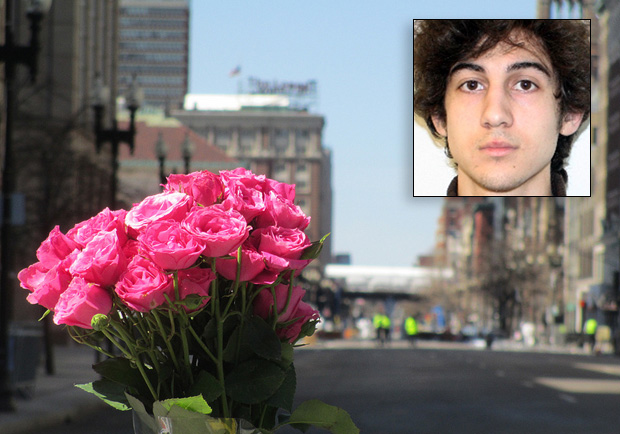
In the weeks since two bombs went off near the finish line of the Boston Marathon, we've learned much about the two young men first introduced to us as "Suspect 1" and "Suspect 2" in blurry images released by the FBI. The ongoing investigation into the lives of Dzhokhar Tsarnaev and his now deceased brother, Tamerlan Tsarnaev, have revealed detail after detail about their family, friends, education, hobbies, travels, religious practices, politics, and personalities. But no degree of in-depth reporting or FBI investigation will be able to answer our biggest question: What makes someone commit such unimaginably evil acts?
That's what we really want to know. What terrible things could've burrowed deeply into Dzhokhar's soul? What horrors drove him and Tamerlan to unleash a nightmare reality upon the innocents of Boston? The questions loom larger for Dzhokhar, the surviving younger brother, now in a prison medical facility. By all accounts, he was a good guy, and his friends never dreamed that he'd be involved in this kind of crime. High school teacher Larry Aaronson notes:
There is nothing in his character, in his deportment, in his demeanor that would suggest anything remotely capable of any of these things that he is now suspected of doing. He was so grateful to be here, he was so grateful to be at the school…he was compassionate, he was caring, he was jovial.
Is it any wonder that Dzhokhar's mother, Zubeidat Tsarnaeva, refuses to believe that her sons are the jihadist kind, repeatedly telling the media they were framed? While we may shake our heads in utter disbelief over her refusal to face reality, I suppose that it's hard for any of us, at least initially, to believe that those we know, and maybe even love, could be guilty of bold-faced evil.
Maybe we forget that evil, like the devil, can come disguised as an angel of light. We've all been shocked—and perhaps denied it possible—when friends, acquaintances, relatives, and even Christian leaders do something unthinkable. It's hard to reconcile their good public behavior with the evil deeds that eventually become public. Maybe we forget how quickly each one of us can become ugly. We doubt our own depravity often thinking that the evil person is always the other person, someone we don't know.
During the week of the bombings and police chase, Dzhokhar alternated between criminal behavior and good-guy demeanor, killing and maiming innocent strangers one day and partying with college friends and working out at the gym the next.
We wrack our brains to make sense of his actions, evil and good so close together. Did Tamerlan brainwash him into terrorism? Did a feeling of being left out motivate them to hurt others? Could a deep sense of place and strong communal ties have prevented this horrific tragedy and others like it? Or was it purely vengeance for the wrongs they believe America has committed against Muslims across the world?
I should be quick to point out that self-proclaimed Muslims aren't the only ones who have engaged in terror. Self-proclaimed Christians have been terrorists, guilty of abominable crimes. We need only recall President Andrew Jackson and his Indian removal policies, our history of slavery and segregation, and the Christians who flocked to the Nazi Party during World War II. If only we could claim that terror, genocide, and the abominable treatment of our fellow human beings were the results of atheism, something that atheists inflicted upon others, it'd be a lot easier for us to explain away. But it isn't.
Like others, I seek answers in hopes of wrapping my mind around the horror. Maybe I believe that comprehending what makes someone do evil will enable me to assert some sort of control over it. Terrorism is linked to anger and hatred, which give birth to disillusionment and the deluded idea that the actions we take against another are actually fair and just. On a smaller scale, when we act out of sins such as anger, hatred, jealousy, or malice, we convince ourselves that the objects of our contempt are receiving justice. By dehumanizing others, every one of us becomes capable of the worst atrocities.
So are Dzhokhar and I really any different? That depends. In his insightful book, People of the Lie, psychologist M. Scott Peck explains the difference between "ordinary" sins and evil.
It is not their sins per se that characterize evil people, rather it is the subtlety and persistence and consistency of their sins….the central defect of evil is not the sin but the refusal to acknowledge it…. Evil is not committed by people who feel uncertain about their righteousness, who question their motives….evil…is committed by…the Pharisees…the self-righteous who think they are without sin.
Even so, we must remain careful not to resort to overly simplified explanations for terror or other forms of evil, just because it's easier for us to understand. As Jennifer Bryson explains, "Complex causality is what we need to grasp if we are to understand how the interaction of multiple factors can escalate individual and group actions to the point of international terrorism." Terror can't be the result of religious beliefs alone. The majority of Christians, Muslims, and others who've suffered at the hands of one another do not terrorize humanity.
J.R.R. Tolkien, in the Return of the King, reminds us that we may not be able to fully comprehend and control evil, both in the abstract and in the individual cases that we encounter in our lives:
It is not our part to master all the tides of the world, but to do what is in us for the succour of those years wherein we are set, uprooting the evil in the fields that we know, so that those who live after us may have clean earth to till. What weather they shall have is not ours to rule.
Even if we get our answers about the Tsarneav brothers' motivations, the explanations can't absolve Dzhokhar and Tamerlan from responsibility. The "whys" can't bring back lives destroyed or dull the suffering that the victims and their families endure.
"Any explanation of suffering, no matter how solid or reasonable, fails in the face of a person's deepest pain," Ellen Painter Dollar said in a comment thread about suffering. "In those moments, we need to simply be present, offering kindness, helping to tip the balance toward the good."