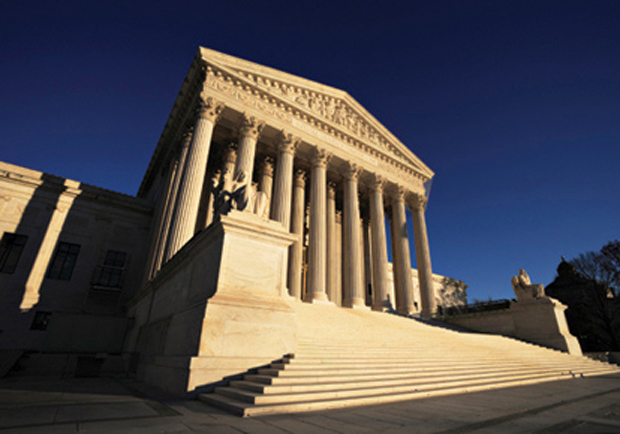
The U.S. Supreme Court this week said it would not take up a case involving an anti-abortion protester's free speech right vs. a Denver church's right to free exercise of religion.
The Colorado Court of Appeals last year upheld a lower court decision restricting the time, place and manner of protests near St. John's Church in the Wilderness, the Episcopal cathedral of Colorado.
The church initiated a nuisance complaint after demonstrators "intentionally disrupted" outdoor Palm Sunday and Easter services in 2006 and 2007, according to the plaintiffs' attorneys.
The appeals court barred Kenneth Tyler Scott from "displaying large posters or similar displays depicting gruesome images of mutilated fetuses or dead bodies in a manner reasonably likely to be viewed by children under 12."
"We recognize the presence of a compelling governmental interest in protecting children from disturbing images, and we further conclude that the prohibition is narrowly tailored," Judge John R. Webb wrote in the appeals court ruling.
St. John's Church, which declined an interview request, wants its parishioners to be able to "pray and worship in peace," according to court documents.
But on Scott's behalf, Eugene Volokh, a UCLA law professor who said he personally supports abortion rights, asked the Supreme Court to consider the case. (He also wrote several posts about the case for his popular law blog.)
Volokh cited conflicting rulings by lower courts nationwide on whether the government may restrict "gruesome" material in a traditional public forum to protect the sensibilities of children.
The church obviously has a right to worship without disruption inside its sanctuary, Volokh said in an interview with Christianity Today.
"The question is whether that extends to the right to eject people from neighboring public sidewalks," he said.
Using an analogy, Volokh cited the American Civil Liberties Union and the National Rifle Association—saying they engage in constitutionally protected activities and would be free to ban anyone they want from their lobbies.
At the same time, he added, "They can't turn around and say, 'You can't carry insulting signs or offensive material in your picketing on the sidewalk.' The same is true of a church."
Volokh's Supreme Court petition drew the support of several church-state experts who usually find themselves siding with churches, not against them.
Carl Esbeck, a law professor and church-state law expert at the University of Missouri, joined a group of religious freedom scholars in a brief supporting Volokh's Supreme Court petition.
"Of course, there is a right for houses of worship to carry out their activities with a certain level of tranquility, but almost always that is in the interior of the building," Esbeck told CT.
Traditional public forums include sidewalks, streets and parks, the Missouri professor said.
"Here, the speaker (Scott) was standing on a car parked in a public street," Esbeck said. "The right of free speech never gets stronger than when you're in a traditional public forum."
Two religious liberty advocates contacted independently by CT—Charles Haynes with the Washington, D.C.-based First Amendment Center and Jeff Mateer with the Texas-based Liberty Legal Institute—also voiced concerns about the Colorado ruling.
"Government may, of course, apply reasonable time, place and manner restrictions on protests in some circumstances," Haynes said in an e-mail before the Supreme Court declined to hear the case. "But government must not be allowed to impose content-based restrictions on speech because the speech may offend or disturb young children."
Allowing the Colorado ruling to stand, he said, could "seriously weaken First Amendment protection for speech in the innumerable settings where children might be present."
The high court doesn't disclose the reasoning behind denials of certiorari, so it's impossible to know why the justices declined to hear the case, Volokh said.
"I'm disappointed, of course, but I'm very glad that I participated in the case," he said. "It was a First Amendment fight very much worth fighting, even if in this instance we lost."