The American economy, experts cautiously say, is strengthening. According to a recent NPR report, many households have recovered most of their wealth lost in the 2008 Wall Street fiasco. Consequently, consumer confidence is at a five-year high, and spending is up.
More spending means a more robust economy and an increase in hiring, and more money in consumers' pockets usually leads to a bump in spending. Around and around it goes. Theoretically, the good vibrations leave few untouched.
The improving economic climate may offer a chance for us to get right with our finances—both paying down debt, and addressing our skewed, and often sinful, views of money.
Freedom to spend as we desire—as often, as much, on whatever—is one of the blessings of a free-market economy, we Americans say. Problems emerge, though, with distortion. Greed scoops up more money than it is needed. Stinginess refuses to share. Prodigal spending thinks of only the here and now, and often uses credit to pay for it. Narcissism sees money as a tool for satisfying our own needs and wants.
A year ago, my husband and I were in deep financial trouble. Years of recklessly contributing to the economy with big spending, all done on credit cards, took their toll. We found ourselves with five figures' worth of debt, and no clear plan for getting out. Monthly payments were as much a part of our lives as our children.
Despite the fact that we are Christians, our approach to money was all wrong. To us money was currency, that which with we could buy shelter, food, clothes, fun, status, and security. A sermon series at church changed everything. It wasn't new information, but this time God had us ready to hear.
"Money isn't 'ours' in the sense that we're somehow entitled to it," the pastor said. "It is a gift of God, the Giver of all good things. And God gives money to us to steward it well, not to worship it or to think so little of it that we're frivolous."
My husband and I unofficially enrolled ourselves in Dave Ramsey U (specifically his Seven Baby Steps), hit the restart button on our financial lives, and made huge shifts in the way that we were living. We're now less than $2,000 away from paying off our credit card debt, with a downsized lifestyle, a small amount of savings, and a radically different view of money. Apparently, we are not alone.
Americans' personal debt loads have steadily shrunk since 2008, and this year, more are making their monthly payments on time. As the economy strengthens, more of us see paying down debt as a real possibility, not just a far-off dream, and Ramsey's advice has become more popular and relevant than ever.
Ironically, we may be more vulnerable now than the immediate months following the 2008 market crash. Much like King David in the aftermath of his sin with Bathsheba, we are quick to cry out to and lean on God in times of trouble. We cling to our Maker with more trust and faithfulness when all is awry.
When we gain strides, though, and begin to feel at peace, we are likely to stray. We forget that we do not live by bread alone, but by the very Word of God when our stomachs are satisfied. When we have enough of what we need, we tend to build bigger barns to hold it all and indulge further. We lose track of the truth that apart from God we are (have) nothing.
How easy is it to fall back into bad financial ways? Just ask our culture that emphasizes ease, efficiency, and thoughtlessness in spending. Master Card engineered the perfect emotional storm with their 9-year-long "Priceless" campaign. Their message: Just swipe your card, and tick off your bucket list dreams. Don't think about the cost. Spend and be happy now, pay later. (And do we ever pay!)
A 2007 Visa commercial showed a marketplace flowing in perfect rhythm until someone has the audacity to pay with cash. Everything comes to a screeching halt, people bump into one another, and food spills all over the place. All of the customers and the cashier give the person a look that says, "Really?", and he shamefully makes his purchase. "Visa check card," says the voice over, "Because money shouldn't slow you down, life takes faster money." In image and words they communicate that cash embarrassingly slows us down and halts the pace of our quick-swipe economic lives. (Never mind the fees that Visa charges businesses per debit transaction to pay for our convenience, nor the consequential fact that all businesses prefer cash payments..)
Cultural messages and familiar spending habits die hard. All we need is a little comfort to relieve us of financial anxiety, and we loosen our grip on the disciplines that enabled our reprieve. Ramsey suggests specific behavior changes that take commitment to implement, but become routine as we practice them day-to-day. Tithing, paying in cash, simplifying our living, and thinking beyond the here-and now turned my family's financial situation from "Holy Cow!" to holiness.
Can a healthy U.S. economy and Christians' financial and spiritual equilibrium co-exist? After all, our economy depends on spending and building wealth, and Christians' call is to live as did Jesus. He gave with abandon out of meagerness; instructed the very rich to sell all of their possessions, give the money to the poor, and follow him; had no where to lay his head; and worried not.
Jesus also instructs us through the words of Scripture to give to Caesar what is Caesar's and to God what is God's (Mark 12:2). We should recognize whose money is in our accounts and remember God's purposes for spending and sharing it.
Paul's imperative to the Philippians speaks aptly to this increasingly comfortable financial time: "So let's keep focused on that goal, those of us who want everything God has for us. If any of you have something else in mind, something less than total commitment, God will clear your blurred vision—you'll see it yet! Now that we're on the right track, let's stay on it" (Phil 3: 15-16, The Message).
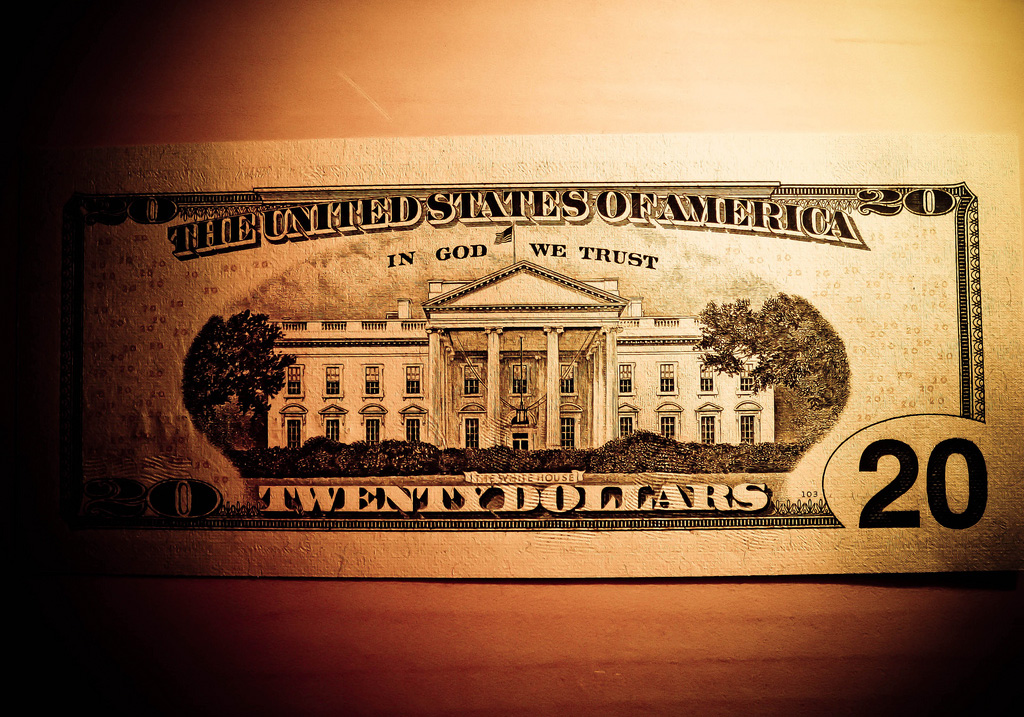
A theological view of money and all material things is our sole protection. Simply stated, it all belongs to God, and our task is to focus not on the money itself, but on the message at the top of the bills: In God We Trust.
Rev. Angie Mabry-Nauta is a writer and an ordained Minister of Word and Sacrament in the Reformed Church in America. She served as a solo pastor for six years. A regular contributor to Gifted for Leadership, and member of the Redbud Writer's Guild, Angie blogs at "Woman, in Progress…". Follow her on Facebook and Twitter @Godstuffwriter.