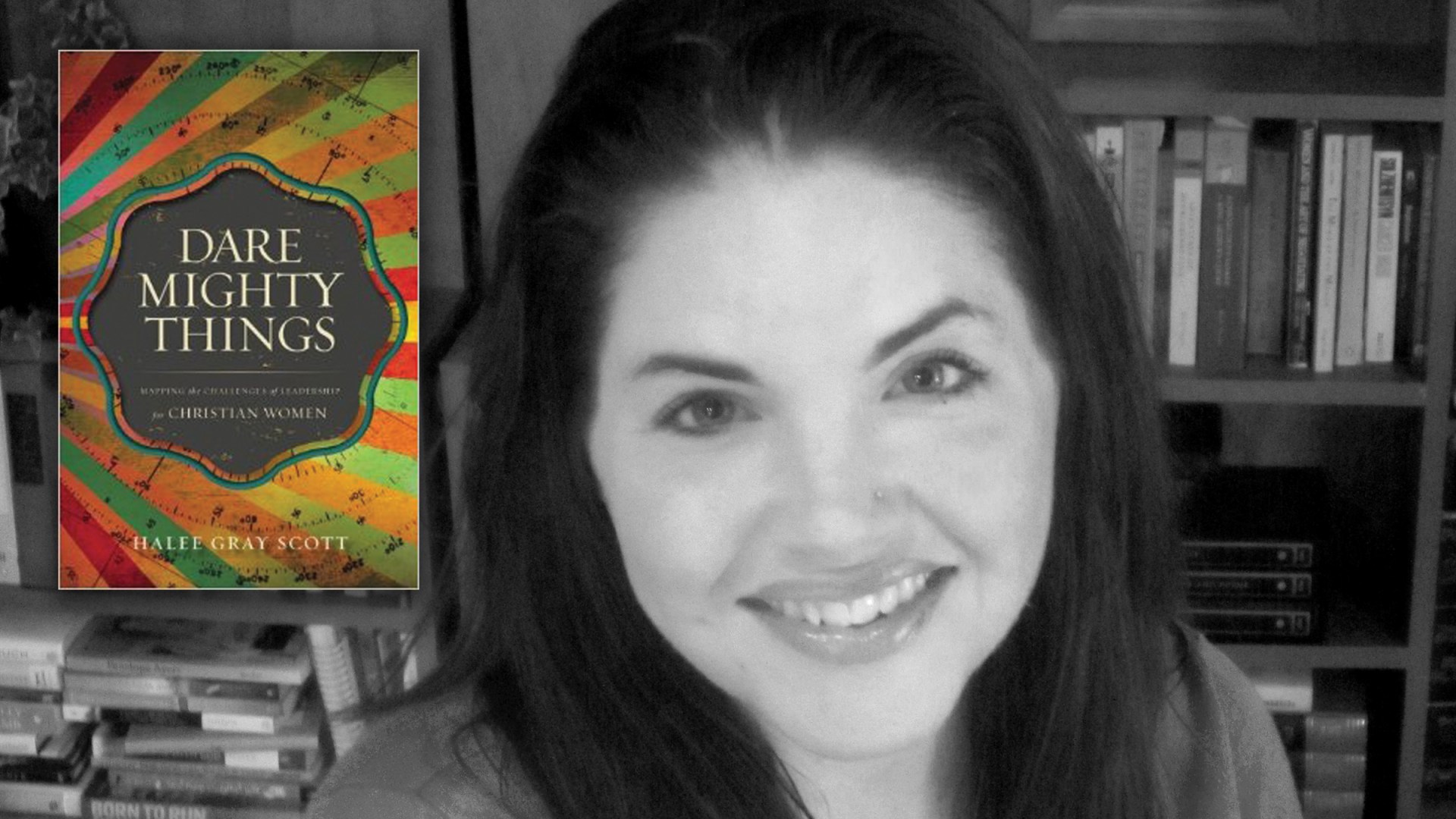

All around the world, there are women who are capable of great things, but they are afraid to step out and try. This is the central argument of Halee Gray Scott's debut book, Dare Mighty Things: Mapping the Challenges of Leadership for Christian Women (Zondervan). Author, wife, mother, scholar, and global leadership expert, Scott focuses her research on the experiences of women in leadership and the obstacles they face. In addition to sharing her findings, Scott's book casts a larger vision for women in the church and calls women to the faithful stewardship of their gifts. Her.meneutics contributor Sharon Hodde Miller spoke with Scott about the difficulties facing women in leadership.

Dare Mighty Things: Mapping the Challenges of Leadership for Christian Women
HarperCollins Children's Books
256 pages
Women don't always think of themselves as leaders. Why are they hesitant?
Two things contribute to this problem. First, the business world has dominated the conversation on leadership. We see many churches adapting business principles to the church context. Whenever we take secular leadership and apply it to the church, we have an idea of leadership that is very masculine, very business-oriented, very "get things done." Women tend, instead, to organize around people and causes. It's hard for women, especially Christian women, to relate to the type of leadership models we most often talk about.
Second, many people don't look at women and think to intentionally develop their leadership gifts. But women need that encouragement. Women need someone to look at them and say, "Hey, I see potential in you."
What would be a more Christian understanding of leadership, one that transcends male and female?
Authentic Christian leadership is more cause-centered—around the cause of Christ—and focused more on developing people than on developing principles. It also takes a team approach. In the Gospels, Jesus built a team of people to go out and deliver the Good News. It wasn't just one person in charge.
Christian leadership pays attention to the people and to the cause. It's not about building a bigger church or audience, but rather about bringing people to experience and understand God.
Women have made gains both inside and outside the church, but you state that "women's advancement in leadership has altogether stalled." How so?
Research has shown this is true—even in business sectors. The progress women are making is not that remarkable compared to the progress they made 15 to 20 years ago. Within the church, this is happening for several reasons.
First, there is a lack of mentoring between women who have become successful leaders and women who are still developing. Without that mentoring, women have no vision for all that God can accomplish through their lives.
Also holding women back is the myth of the exceptional woman—the belief that women who are leaders are somehow exceptional. We think they're innately different from other women in ways that can't be bridged with education and skill training.
That reminds me of a topic that has been hotly debated in the last couple years: Can women "have it all"? How does this book speak to that question?
I hope to encourage women that they don't have to have it all together in order to find deep satisfaction. This is really hard for me, because I gave up a university teaching job I loved in order to stay at home with my girls.
If I let myself, I can get very discouraged, rather than seeing the beauty of this stage in life and how God is using my gifts now. It's important for women to remember they can have it all—just not all at once.
Although your book is about women and leadership, does it have a message for men?
In my research, I talked to a lot of men in leadership positions who wanted to know how to support the women around them. I hope men can use this book to understand the challenges women face, so they can help hold the doors open for them.
What about young mothers or other women for whom daring mighty things might sound overwhelming? What would you say to this sort of woman?
We need to reconsider what we call "mighty." In college, I waited tables at an Applebee's. At the time, I was an agnostic and very bitter toward religion. But there was a hostess who radiated Christ. She was willing to talk about Jesus in ways that called me deeply to him. She didn't do any more than show up for her shift every day, but that was enough to transform my life.
Like the woman who anointed Christ's feet with oil, sometimes the things we think are small are the very things God uses to accomplish the mighty.