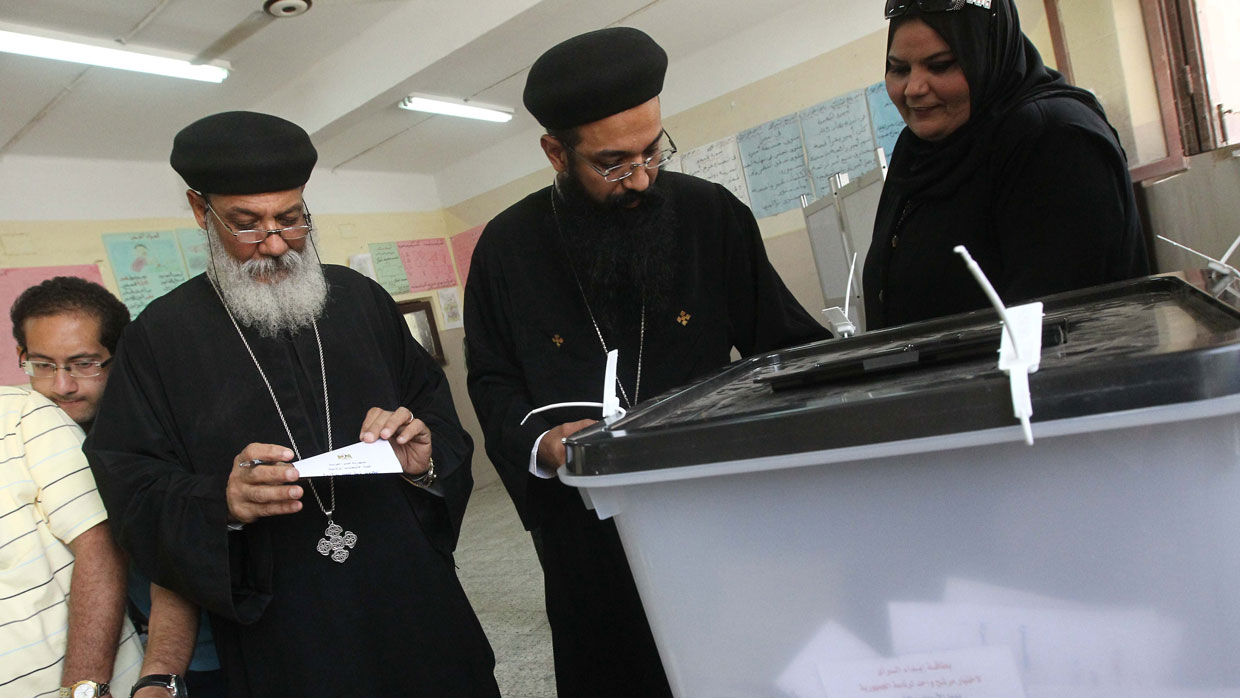
For Egyptian Christians, today's presidential election is not much of a contest.
Most support General Abdel Fattah al-Sisi in appreciation for his role in deposing previous president Mohamed Morsi and ending the rule of the Muslim Brotherhood. A smaller, younger contingent leans toward leftist politician Hamdeen Sabbahi out of appreciation for the revolution and skepticism of another military leader. But most on both sides expect Sisi will win handily, and most welcome the new era to come.
"This election [brings] great expectations to welcome a new Egypt with Muslims and Christians as equal citizens," said Fawzi Khalil, a pastor at Cairo's Kasr el-Dobara Church, the largest evangelical congregation in the Middle East.
But while most Christians are solidly in the camp of Sisi, many are taking advantage of the opening of political space after the January 2011 revolution to win leadership positions in a variety of political parties.
Before, Egyptian political figures preferred to interact with just one Christian figurehead on religious rights—typically a pope, such as the late Pope Shenouda of the Coptic Orthodox Church. Now, Copts can participate from several directions at once, believes Ishak Ibrahim, a Sabbahi supporter and researcher with the Egyptian Initiative for Personal Rights.
The current Coptic pope, Pope Tawadros, initially indicated he would keep the church establishment from playing politics with the government, but troubles from Morsi's policies increasingly prompted his criticism. Today, while the church officially stands neutral toward the two candidates, it enthusiastically endorses electoral participation.
"The Orthodox church is very aware of their authority over their own people," said Khalil. "They are just encouraging people to vote."
Khalil supports Sisi because the general demonstrates the leadership necessary to run the state successfully—a task at which Morsi failed. But Khalil recognizes that many of his own church's youth support Sabbahi, and he praises their commitment that helps keep Egypt from returning to dictatorship.
"If Sisi tries to be a dictator, the nation will not help him at all," he said. "Our young people are willing to pay the price and will be in the streets again."
But within political party leadership, Copts are on both sides of the Sisi question.
 Jayson Casper
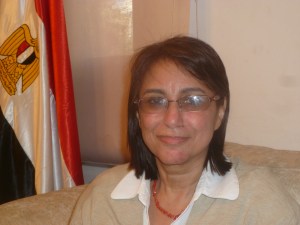
Hala Shukrallah, a long-time opposition activist, joined the Constitution Party founded by Nobel Prize winner Mohamed al-Baradei in April 2012. The party's goal was to promote a consensus national charter against the Islamist constitution written largely by Morsi's partisans. In February 2014, she was elected the party's president—the first female and first Copt ever to head a political party in Egypt.
The diminutive 59-year-old Shukrallah is unusual in a party where 85 percent of members are 35 years old or younger. Constitution Party members are among Sabbahi's most eager supporters, seeing in him hope for the revolutionary slogans of "bread, freedom, and social justice."
The majority of Christians welcome the greater involvement of Copts in politics, though they do not follow Shukrallah's endorsement of Sabbahi. After living through revolutionary excitement and Islamist worry, they are ready for a leader who can guarantee their rights and keep the Muslim Brotherhood at bay.
 Jayson Casper
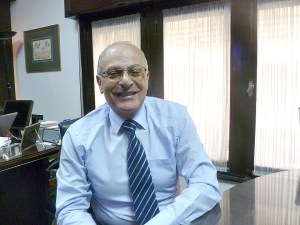
Naguib Abadir, a Coptic founding member of the secular Free Egyptians Party and a reserve member of the committee that rewrote Egypt's constitution, supports Sisi.
"It is not a religious choice but an Egyptian identity choice," he said. "The Egyptian identity was fading away into a perverted version of Islam promoted by terrorists."
Sectarian tension has been high in Egypt since Morsi was toppled. Last August, dozens of Egyptian churches were torched. Since then, terrorist activity has increased. The government and most Christians believe the Muslim Brotherhood is to blame.
Only a few Christians, though, have called for fair treatment of the Brotherhood, whose members have been sentenced to death by the hundreds in recent mass trials. Ibrahim has chastised Copts for not defending Brotherhood members' rights to fair trials. Many Christians, he said, are still reeling from unfair treatment under Morsi, but fail to extend the provisions of justice toward their political enemies.
"Regardless of what the Bible says about justice and mercy, many Christians are affected by the overall climate," he said. "When a political order comes and says it will return the glories of the Islamic state, it scares them."
Shukrallah believes such fear threatens to undo the gains of the revolution toward greater Coptic participation in society. She is sympathetic but critical of the Christian community, which she says has retreated from political engagement since its experience under Islamist government.
"There has been a withdrawal, once more, of Copts into the church," she said. "And the church is again speaking on their behalf."
As political regimes shift in Egypt, it is time for Coptic Christians to speak for themselves, Shukrallah believes.
"Egyptian Christians are an integral part of this nation. This message has been given by the priests—it should be given by the people," said Shukrallah. "It happened for a very short time [after the revolution], and it made a huge impact. I hope we can see it over a much longer period."