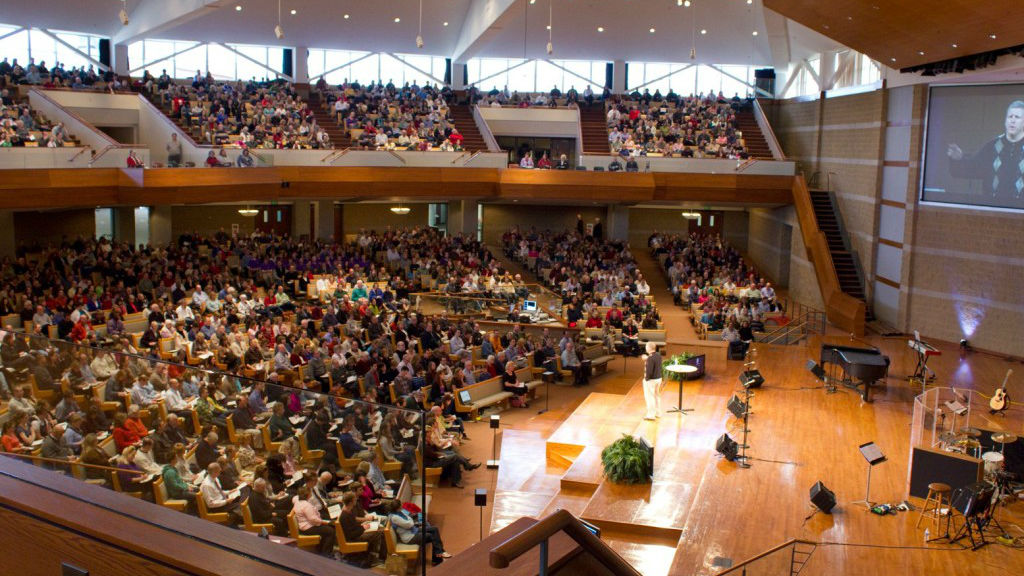
The U.S. Supreme Court has allowed a court ban on churches renting their facilities for public school graduations to remain standing, despite the implications of the high court's recent divided ruling in favor of Jesus prayers at government meetings. [Correction noted below.]
The case dates back to 2000, when some Wisconsin students and parents protested a suburban Milwaukee school district's decision to hold graduation ceremonies in a local megachurch's auditorium because of the high schools' poor facilities (such as lack of air conditioning). A federal district court banned the rental arrangement between Elmbrook School District and Elmbrook Church as unconstitutional, and the Seventh Circuit Court of Appeals agreed.
In its previous ruling, the Seventh Circuit wrote that "the sheer religiosity of the space created a likelihood that high school students and their younger siblings would perceive … a message of endorsement."
However, the appeals court's decision was limited to the particular church and situation in question, not a broad ban on all public school use of church spaces:
We do not speculate whether and when the sanctuary of a church, or a synagogue, or mosque could hold public school ceremonies in a constitutionally appropriate manner. Nor do we seek to determine whether and when this sanctuary, or one akin to it, could be properly used as the setting for a graduation under other circumstances. … Rather, our duty is to consider the set of facts before us, and on those facts, we conclude that an unacceptable amount of religious endorsement and coercion occurred when the District held important civil ceremonies in the proselytizing environment of Elmbrook Church.
Despite the limited scope of the Seventh Circuit ruling, the Supreme Court's refusal to hear the case Monday "effectively ruled that schools cannot use church facilities for graduation ceremonies," argues Daniel Bennett for Religion News Service.
In a dissent to the Supreme Court's refusal to grant cert yesterday, Justices Scalia and Thomas wrote that the high court should have heard the case or sent it back to a lower court in light of the court's recent decision to allow prayers to Jesus at town meetings in Greece, New York.
The offense presented by religious symbols at Elmbrook Church may be annoying, but the First Amendment does not mandate that such annoyance be prevented, and use of church space does not amount to religious endorsement, Thomas wrote.
"I can understand that attitude: It parallels my own toward the playing in public of rock music or Stravinsky," he wrote. "It is perhaps the job of school officials to prevent hurt feelings at school events … But that is decidedly not the job of the Constitution."
Religion Clause notes that Scalia is "reading that opinion more broadly than many commentators have so far done," and "implicitly sees Town of Greece as impacting more than just invocations before legislative bodies, and says almost nothing about the special concern that the Court has shown historically for religious activities in public schools."
The court's decision along with Thomas' and Scalia's dissent "suggests the court remains very closely split on religion and that Kennedy, and perhaps other justices in the middle, sees a key distinction between cases involving children and those involving adults," David Savage notes in a McClatchy-Tribune story. In the Greece ruling, Kennedy said that "adults often encounter speech they find disagreeable," and they are free to stand up and leave the room.
CT previously reported on the Elmbrook case. The New York Times and the Christian Science Monitor offer more details on the Supreme Court declining to hear the appeal.
[Correction: An earlier version of this story stated the Supreme Court's decision in Greece v. Galloway was unanimous. It was 5-4.]