
Here’s a chilling thought experiment that, given the arc of world events, might seem eerily like a peek into the not-so-distant future.
Imagine a community of Middle East Christians under assault from a ferocious, well-armed band of terrorists. The Christians live peaceably and faithfully, their presence stretching back centuries. The terrorists aim to destroy them or drive them out, and they have both the power and ruthlessness to prevail. Imagine, further, that the United States can halt the onslaught and restore harmony—but only by deploying military might. Should Uncle Sam send in the troops?
Now repeat the same thought experiment, but replace the besieged Christians with a community representing some other religious faith. Then ask yourself, once more, whether America should intervene to prevent genocide.
If the first scenario stirs you to demand boots on the ground, but the other doesn’t, perhaps some soul-searching is in order. Why favor an aggressive national response only when Christians need protection?
Of course, few of us give voice to such blatant chauvinism. We’re unlikely to tolerate a foreign policy governed by crude religious litmus tests. And yet, as Christians, the suffering of fellow believers tends to pierce our hearts more profoundly. We sympathize, often achingly, with the plight of non-Christians under persecution. But it’s savagery against Christians that really gets our blood boiling.
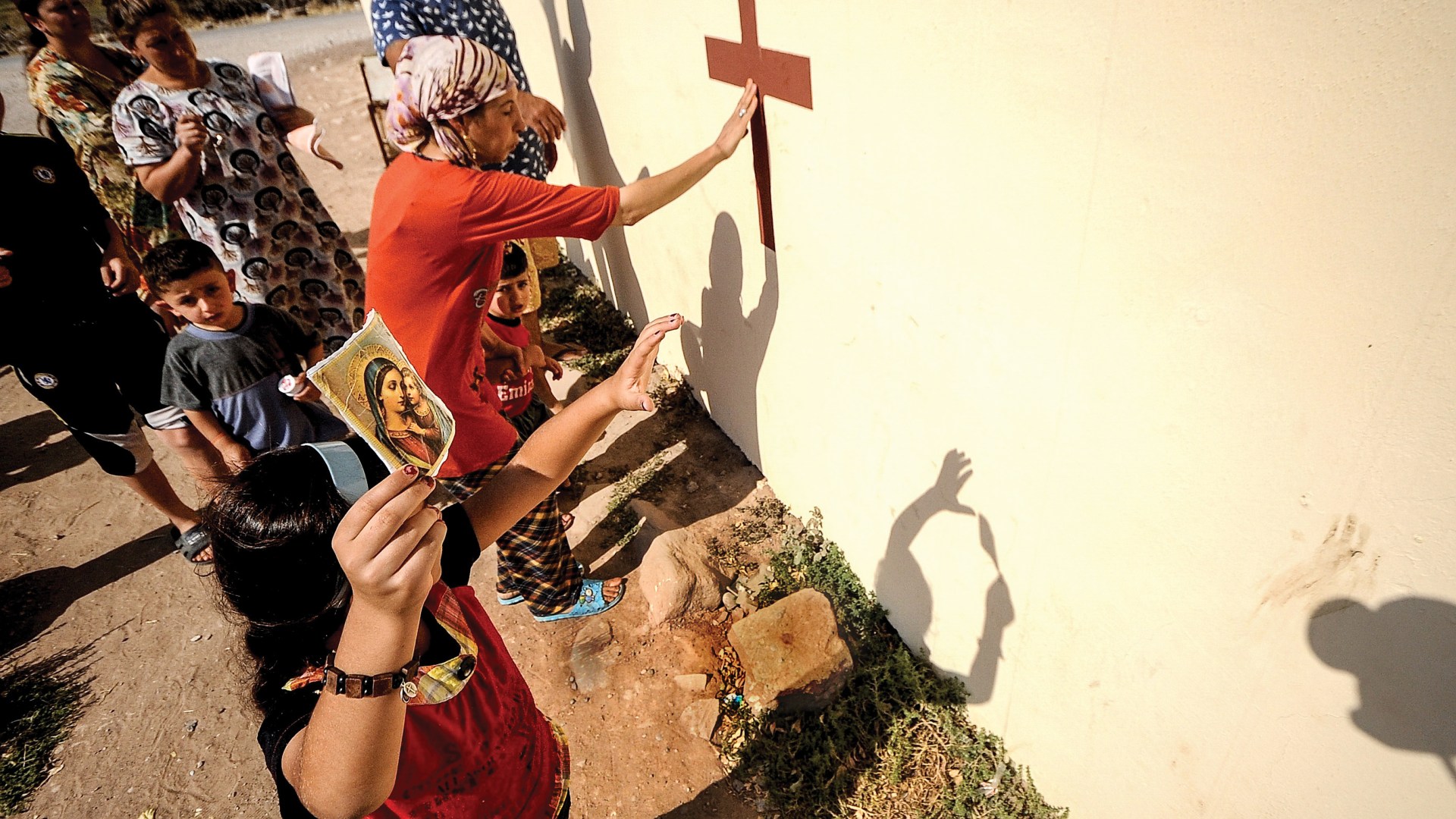
It’s important to keep this in mind as we encounter anti-Christian cruelty, with depressing regularity, in today’s headlines. This summer, the world awoke to discover a jihadist army, styling itself the Islamic State (also known as ISIS), brutally seizing power across Iraq and Syria. In conquered territories, ISIS has proclaimed a new caliphate and introduced a draconian brand of Islamic law. Christians—along with dissenting Muslims and obscure religious minorities like the Yazidis—confront a terrifying choice: Leave home, convert to Islam, or die a martyr.
ISIS must be stopped. That much is certain. But how? By whom? To what extent? All are prudential questions that must be answered by those closest to the situation. Yet as we advance this case, we ought to refrain from making Christian suffering the clinching factor, as in These monsters massacre Christians, and something has to be done. Raise your hand if you’ve never entertained that thought. No need to scold yourself. Yet consider how it starts us down a problematic path.
Trouble is, the “something” needed to strangle ISIS is shaping up to be military force. President Obama ordered air strikes to help refugees escape the coming slaughter. It may turn out that nothing short of full-fledged assault will dislodge ISIS. Safeguarding American national security and averting humanitarian disaster may require wiping ISIS off the map.
But that’s a far cry from wanting this particular enemy vanquished because—and only or mainly because—it oppresses Christians. The U.S. oath of enlistment requires soldiers to defend the Constitution against enemies, foreign and domestic. We might dream about heroic soldiers sweeping into town and stomping all over the bad guys. But they haven’t signed up to stand between persecuted Christians and their persecutors.
Partiality toward Christians, however natural, shouldn’t disproportionately influence American foreign policy judgments. We need to remember what the military is, and isn’t, for.
A recent multifaith petition, spearheaded by the Catholic conservative Robert George, strikes a proper balance. The statement (endorsed by evangelicals, including Russell Moore, Eric Metaxas, and Jim Daly) calls for defeating ISIS, but without giving off the slightest whiff of faith-based special pleading.
It’s not hard to envision a future of spiraling danger for Christians in the Middle East. And if the situation for Christians grows more precarious, the temptation to enlist American soldiers as avenging angels may intensify. Here’s the sobering reality: As a global church, we will have to prepare ourselves to witness thousands of our brothers and sisters face extermination or exile, even as it lies within America’s power to militarily save the day. That’s a nightmarish thought, and it sounds cold-hearted even to suggest it. But even our own Messiah declined to summon angels to save his skin.
There’s something natural and right about praying for justice to rain down and scorch the evil (look at the Psalms!). But let’s not be selective about who counts as an enemy. Whenever any group, religious or not, finds itself at the dangerous end of rifles and swords, we are looking at the evil of injustice. And before the kingdom of God arrives, we are called to stop injustice wherever it assails the oppressed.
Maybe that means wielding military force against groups like ISIS, and maybe it doesn’t. Either way, let’s guard against the subtle temptation to desire one course of action when Christians are in the cross hairs, and another when they aren’t.
MATT REYNOLDS is CT associate editor of books.