





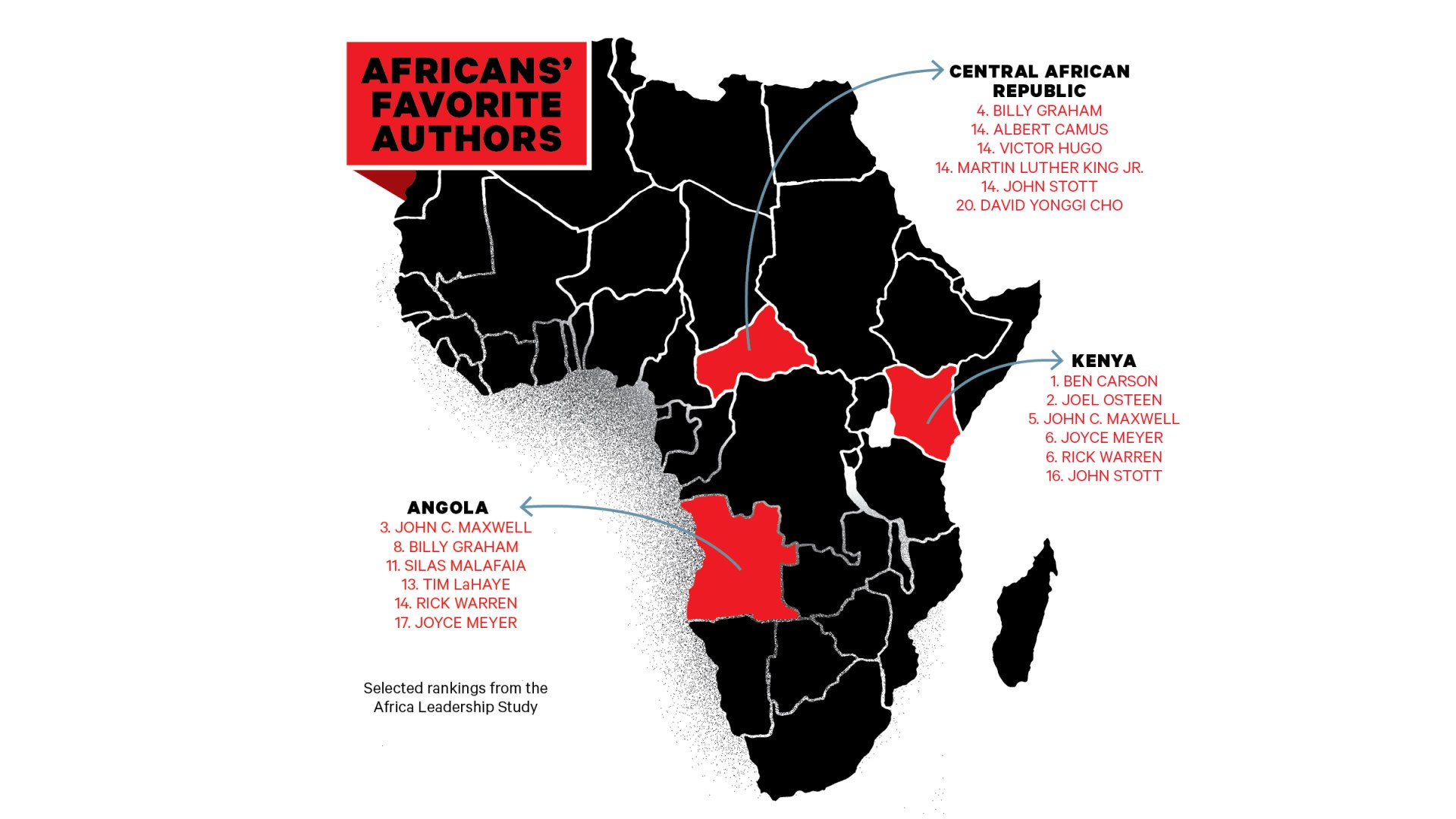

Want to learn from an African Christian leader? There’s Augustine, Cyprian, and many other African theologians from the church’s first centuries. But you’re unlikely to find a living author in your library or bookstore.
Now, a new study, polling more than 8,000 Christians in four languages across three countries, has found that African Christians aren’t reading African Christians, either.
In the Africa Leadership Study, a quarter of Central Africans, a third of Angolans, and half of Kenyans named a preacher or pastor as their favorite author. Majorities in Angola and Kenya named authors whose writings were explicitly Christian. High percentages also named African writers.
However, “overlap between the two was low, with relatively few respondents identifying favorite authors [who] were both African and Christian,” said Robert Priest, a professor of international studies at Trinity Evangelical Divinity School, who presented the findings to the American Society of Missiology.
The lack of prominent indigenous authors was also evidenced by the library holdings of five major Christian higher education institutions in Kenya, where only one African Christian (John Mbiti) ranked among the top 15 authors with the largest presence on the shelves. Kenyan Christian bookstores had a significantly different top 15, but only one African author (Dag Heward-Mills) cracked their lists. Other commercial booksellers and street vendors didn’t have any African Christian authors among their top 15.
Demand is one major reason for the paucity. While 38 percent of the world’s evangelicals are in sub-Saharan Africa, many “see products, including books, from the West as superior and are willing to buy them,” said Francis Bukachi, executive director of Hope Alive Initiatives in Ghana.
Pieter Kwant, program director of literature for Langham Partnership International, agrees. “We’ve had a theological stream running ‘from the West to the rest,’ including all our books,” he said. But, he added, “the questions that are being asked in the majority world are not being answered by the West.”
For instance, says Bukachi, issues like female genital mutilation, wife inheritance, polygamy, honoring ancestors, and nepotism are rarely covered by Western Christian authors.
Priest’s study found that Africans read about as much as Americans do: One-third read six or more books last year. But writing is not a priority for many African Christian leaders, who “prefer to communicate orally,” said Bukachi.
Samuel Waje Kunhiyop, general secretary of the widespread African denomination Evangelical Church Winning All, agrees, and says the lack of local authors doesn't mean Africans aren't discipling Africans: “What most influences life and conduct is oral communication. Believers still depend on their pastors to tell them what is right and wrong.”
Priest said that certain evangelical missionary groups may have propagated the idea that preaching fulfills “kingdom purposes” better than writing. And a struggling publishing industry throughout Africa doesn’t inspire confidence in African Christian leaders. “Because the marketing and distribution side is weak, authors don’t have the foggiest idea where their writings are going to go or whether people will read them,” he said.
African Christians who do wish to write are given little opportunity because of the serious economic challenges facing African publishers.
Just as Western aid can undercut local textiles, so can constant book donations kill emerging markets for local publishers and bookstores. Edward Elliott, founder and chairman of Oasis International, said, “The problem with Bibles and books being given away is they compete with the local person trying to start a Christian bookstore in an already difficult situation.”
Elliott said, “African authors are half expected to write books and receive no royalties at all, let alone something up front to feed their family while they’re writing. For a publishing industry to be healthy, authors need to know that they’re going to get something if they’re going to write a book.”
Social and institutional obligations also present challenges. “If you’re a professor in Africa, you don’t have the same support as you do in the United States. You don’t have the sabbatical structure in seminaries in Africa,” said Priest. Kwant added, “The average professor in the West is more likely to withdraw into an ivory tower, whereas professors in Africa are far more in demand by the people around them.”
African Christians are still teaching and learning from other African Christians, says Francis Omondi, canon of All Saints Cathedral in Kampala, Uganda. “[But] most of the reflections, experiences, and learning over the years are not captured or documented,” he said. “Therefore relevant and contextual knowledge is not being retained in the community.”







