
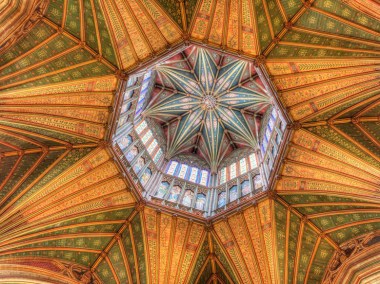
1. Cathedrals required massive amounts of building materials. To build just one tower of Ely Cathedral in England took more than 800,000 pounds of wood and lead. Every cathedral required thousands of trees, and in France, people complained about the great oak forests being leveled to supply lumber.
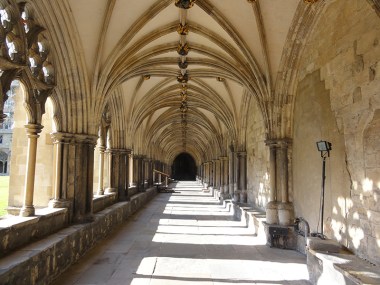
2. Building materials were often brought in from far away. Lumber, sometimes in pieces 60 feet long, might come from Scandinavia. The best limestone came from France. When Norwich Cathedral was built in England, the cost of shipping the stone from 300 miles away was twice as much as the cost of the stone itself. The vault of a cathedral is often more than 150 feet above the floor. To construct it, builders worked on a new invention, scaffolding. When the Cathedral of Santa Maria del Fiore was built in Florence, temporary restaurants and wine shops were built in the dome so workers would not have to make the exhausting trip down and up again.
3. A cathedral under construction attracted hundreds or thousands of workers. So that masons could work all winter, a lodge was built near the site—the origin of today’s “masonic lodges.”
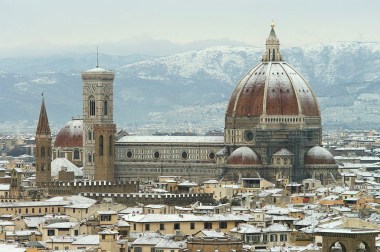
4. European cathedrals always face east. That way, the priest at the main altar can pray toward Jerusalem, the Holy Land.
5. Cathedral spires were tall, thin, and extremely heavy because they were covered with sheets of lead. As a result, it was not unusual for a spire or bell tower to collapse, as one did in 1239 during a service at Lincoln Cathedral in England. A prayer used at Lincoln thereafter went, “Deare Lord, support our roof this night, that it may in no wise fall upon us and styfle us. Amen.”
6. Stained glass took countless hours to create. Workers melted sand, lime, and potash; blew the molten glass into a cylinder; cut open and flattened that; cut the glass by using a hot iron and cold water; shaped smaller pieces with a pointed rod called a grozing iron; spread paint on the glass and then heated the glass so the paint would melt into it.
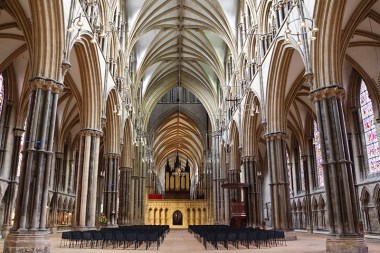
7. Though a stained-glass window might be 60 feet high, no single piece in it would be larger than eight inches wide or high.
8. Elaborately carved gargoyles served a purpose: as rain spouts to carry water away from the walls. Although usually carved in the shape of demons or monsters, gargoyles were sometimes carved to look suspiciously like the local bishop.
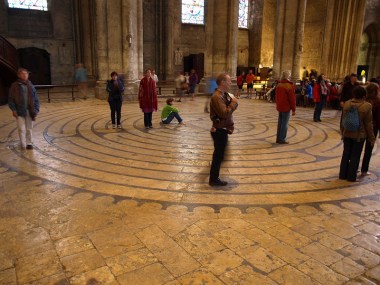
9. Cathedral floors were decorated with patterned tiles. Often they included a giant labyrinth for people to walk through. The labyrinth at Chartres Cathedral in France is more than 50 feet across.
10. Cathedrals were enormously expensive. To pay for them, bishops asked royalty for gifts, held trade fairs, put saints’ relics on display (which people paid to see), or sold indulgences.
11. Rouen Cathedral’s southwest tower is known as the “Tower of Butter” because it was paid for by selling indulgences that allowed people to eat butter during Lent.
12. Cathedrals included numerous sculptures. Chartres Cathedral, for example, has more than 2,000.
 OLYMPUS DIGITAL CAMERA
13. Cathedrals often took more than a hundred years to build. People who began one knew they would never live to see it finished. Often the cathedral’s dedication was celebrated by their grandchildren.
14. Cathedrals dwarfed their surrounding cities or towns. A mid-sized medieval town might have 5,000 people—and a cathedral like Chartres Cathedral in France could hold them all.
15. Because cathedrals took so long to build, many bishops spent their entire tenure holding church services in the middle of a huge construction site.
16. A cathedral is not simply a grand church building but a church of any size that holds the cathedra, the throne of the bishop.
17. Medieval architects sometimes built life-sized models for parts of a cathedral, making, for example, a huge wooden window frame and presenting it to masons to build it in stone.
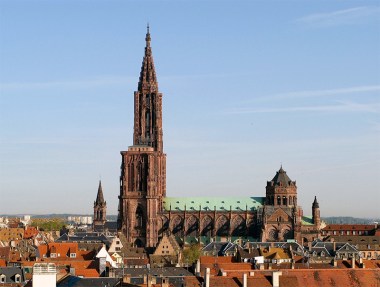
18. Though built centuries ago, cathedrals are still among the largest buildings in the world. The spire of Strasbourg Cathedral in France reaches as high as a 45-story skyscraper; the cathedral stood as the tallest building in Europe until the Eiffel Tower was built last century.
19. To lift the heavy carved stones to the top of a cathedral, workers used winches, windlasses, and a “great wheel.” The great wheel was a wooden wheel big enough for one or two men to stand inside; when they walked, the wheel turned an axle that wound up rope.
20. Despite the effort it took to build just one cathedral, Christians built 500 cathedrals in Europe in just 400 years.
Kevin Miller is associate rector of the Church of the Resurrection, Wheaton, Illinois. This article was originally published in Christian History magazine.