





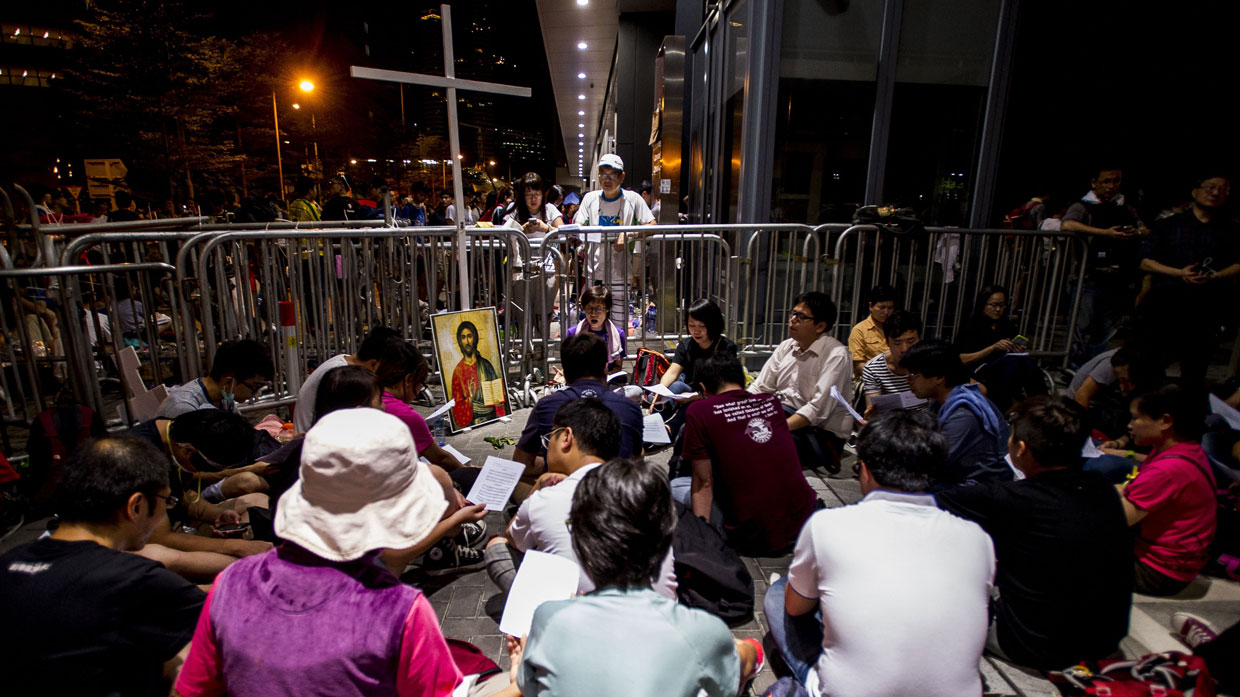
Chinese Christians are playing a leading role in protests that have seen tens of thousands of people shut down the streets of Hong Kong.
Protestors are angered by Beijing’s decision to control the list of candidates for the island city’s top leader in its first free election, slated for 2017.
Some of the top leaders of the protests are Christians, including the teenage leader of the main student group and two of the three Occupy Central leaders. Cardinal Joseph Zen, 82, said he will spend his nights with the protestors until “we are either dispersed or arrested.”
Churches are also playing a role, supporting the protests with food and shelter. Though several of Hong Kong’s major churches have publicly taken a neutral stance, others are providing first aid, snacks, or refuge to protestors. Christian symbols are highly visible, as demonstrators form prayer groups, carry crosses, and openly read their Bibles.
While the Hong Kong protestors are demanding democracy, “there is an undercurrent of another, much older tension: between Christianity and Communist China,” noted the Wall Street Journal. (Former Hong Kong resident Dorcas Cheng-Tozun explains that tension to CT readers over at Her.meneutics.)
Christian churches have been sprouting in Hong Kong since the British took control in 1841. About 43 percent of the island’s 7.2 million people claim a religion—about 320,000 of them are Protestant Christians.
“Christians in Hong Kong, they see that economic development has not brought more religious tolerance in China,” Joseph Cheng, a political-science professor at City University of Hong Kong, told UCA News. “So despite economic development, despite improvement in living standards and opening to the external world, tolerance of Christianity especially has not been improving; in fact, in the recent two years persecution has strengthened.”
For their part, Chinese officials have grown increasingly wary of churches as their influence on the mainland grows. The government has physically removed crosses from dozens of church buildings and reduced a brand-new $3.2 million church to rubble. One Chinese pastor told the Guardian that party officials often use the dismissive expression yang jiao, or “foreign teaching,” to refer to Christianity.
It makes sense that party officials would be wary of Christianity, according to China Source, since the religion came to China in the wake of European ships full of opium. The colonial period in China (from about 1839 to 1949) was a time of deep shame, China Source’s Mark Totman writes.
“This period of humiliation also saw a sharp increase in foreign missionary activity in China as well as a significant increase in the number of Chinese believers,” he said. “To the Chinese government (and many Chinese) foreign intrusion and the Christian faith came to be seen as basically inseparable—two sides of the same coin, as it were.”
The expansion of the church may be adding pressure to that distrust. The steady growth of Christians means China is on pace to outnumber Christians in any other country in 15 years, according to the London Daily Telegraph.
That growth may signal to officials that Christians and their churches are now “key constituents” who can play a significant role in society, but can also pose a real and powerful threat to the country’s atheism and Marxist ideology, according to the Lausanne Movement's Thomas Harvey, Paul Huoshui, and David Ro. That uncertainty is reflected in the government’s response—to tear down crosses but not shut down services.
An all-out campaign against Christians is unlikely, because of Christianity’s growing power within the country and international pressure, they wrote.
But growing tensions are likely, especially when an expanding church ignites fears of the potential weakening of party power, Loyola University professor Carsten Vala said in a Brookings Institute panel. (Foreign Policy looks at whether "Christians make good rebels.")
“Maybe one way to understand Chinese Christianity and the relationship with the party state is to think in terms of different levels,” he said. “There's a party center and there's an ideology about the fear of Christianity, and then there's the local reality where local officials get to know church leaders and they find them very useful to do good works.”
Chinese Christians can make an impact socially, as individuals, as long as they don't become too high profile, he said. “When they become too prominent, that is when the party state is more likely to step in and to crack down.”
CT often covers China, including the recent cross removal or demolition of some churches, the complex reasons behind the high-profile demolition of Wenzhou's Sanjiang Church, and interviews with ChinaAid’s Bob Fu and China Source’s Brent Fulton on China’s intentions toward the church.
CT also noted the proposal of a multimillion-dollar megachurch planned for—and then halted—in the hometown of the ancient Chinese philosopher Confucius.







