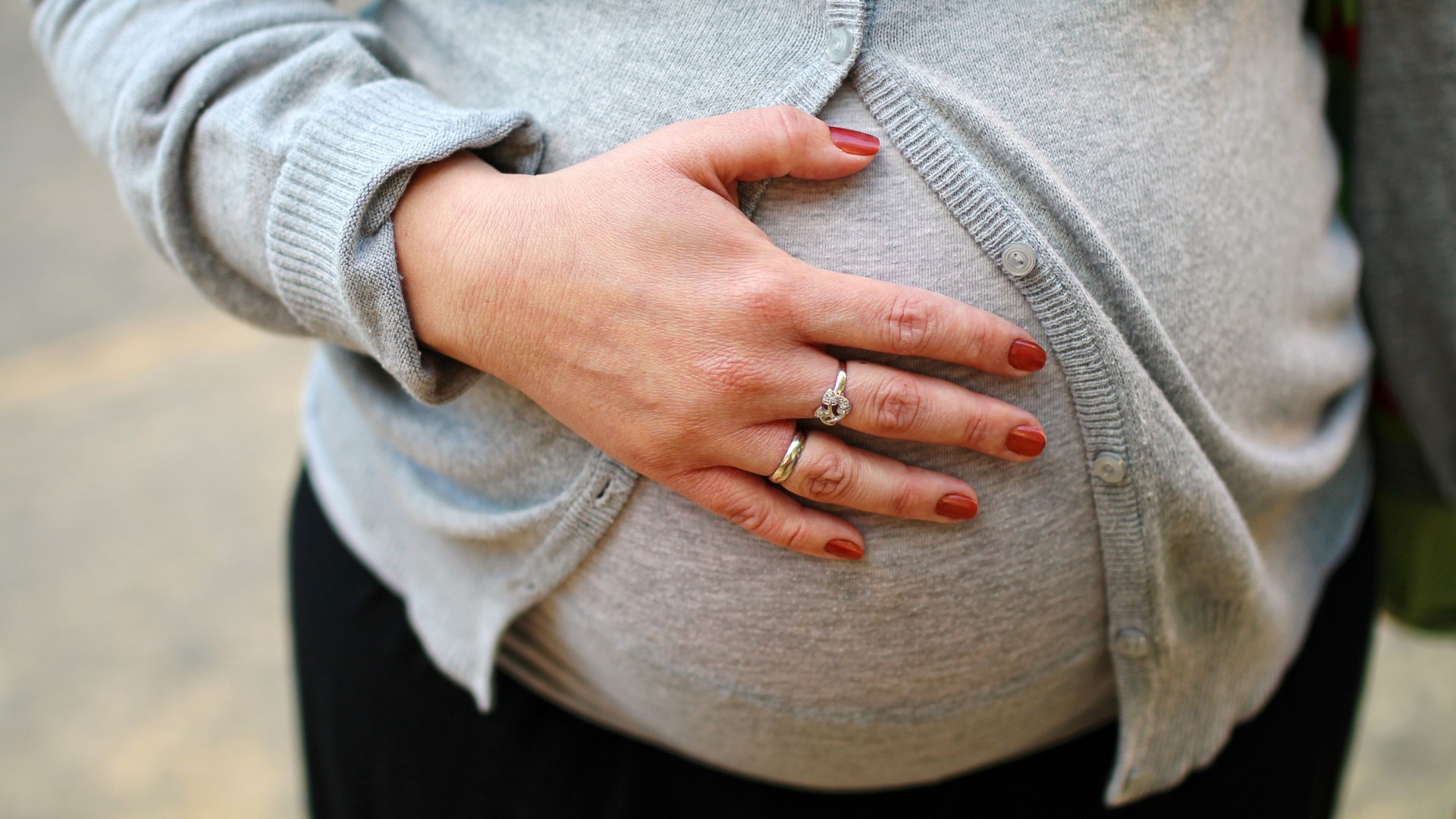

Before I had children, I thought pregnant women were adorable. Their faces glowed; their bellies rounded out trendy maternity wear. I dreamed of one day donning a baby belly, as if it were the latest accessory.
Then I became pregnant, and I didn’t feel cute at all. I felt only large.
Naturally petite, my weight never fluctuated much as an adult. I prided myself on my positive body image, but pregnancy revealed that self-esteem can be easily stripped away. As soon as my weight began to rise, my confidence plummeted.
My body has since expanded and contracted twice to make room for two little boys. Each time, I reveled in the miracle of a tiny life growing inside me, in awe of the delicate flutters that grew into kicks and rolls. But each pregnancy also tested my notions of beauty and of the body. In a culture where thin reigns supreme, where “skinny pregnancy” is an aspiration, and where Hollywood touts actresses’ impressive postbaby bodies, it’s easy for women to see their weight gain and belly fat as problems, even during pregnancy.
When I became pregnant the first time, I grieved the changes that my body endured. My body will forever bear the marks and scars of bringing life into the world. But I have come to realize that those scars place me in good company.
This month, Christians all over the world celebrate the death and resurrection of our Savior, Jesus Christ. On Good Friday, we mourn his crucifixion. On Easter Sunday, we rejoice at his victory over the grave. Yet we don’t yet celebrate Jesus’ complete physical restoration. Even after he rose from the dead, Jesus bore the wounds of his execution, openly showing them to his disciples (John 20).
The bodily resurrection is one of the great mysteries of our faith. Scripture passages such as 1 Corinthians 15 and 2 Corinthians 5 promise us that we will receive “heavenly bodies.” Revelation 21:4 assures us we will be free from pain. We do not know much beyond that, making Jesus’ scars a curious remnant of his earthly life. Why did his wounds remain even after his resurrection?
Celebrated 19th-century preacher Charles Spurgeon set out to understand the reason for Christ’s abiding wounds. He wrote:
Beloved, these are to Jesus what they are to us; they are his ornaments, his royal jewels, his fair array. He does not care for the splendor and pomp of kings. The thorny crown is his diadem.
Spurgeon goes on to say that Christ’s wounds are also his trophies,
the trophies of his love. Have you never seen a soldier with a gash across his forehead or in his cheek? Why every soldier will tell you the wound in battle is no disfigurement—it is his honor. “If,” said he, “I received a wound when I was retreating, a wound in the back, that were to my disgrace, if I have received a wound in a victory, then it is an honorable thing to be wounded.”
Here Spurgeon introduces a new way of seeing wounds. Although some scars remind us of pain or regret, other scars take on a kind of beauty. Jesus’ wounds gave us life and set us free. They are among the latter type of scars. As Isaiah 53:5 puts it, “by his wounds we are healed.”
After giving birth to my first son, I experienced this new way of seeing my scars. My husband surprised me when he confessed that, postpregnancy, he was more attracted to me than ever. My hips had widened and my belly softened, but the changes were the ornaments and trophies of bearing his sons. To him, my scars were beautiful.
My body will forever bear the marks of bringing life into the world. But I have come to realize that those scars place me in good company.
My husband’s perspective reminded me that the postbaby body is not a thing women need to be ashamed of. Rather, it is a signpost of the ever-greater loveliness of the postresurrection Christ. Conversely, Jesus’ scars can inform the way we view women’s bodies, an important witness in a culture like ours. Rather than try to overlook or fix pregnancy’s changes, Christians can celebrate the beauty of a body whose physical sacrifice bore new life.
Jesus’ scars also remind us that God can redeem all wounds, no matter the cause. Whether your scars are the result of something good or something terrible, God can take your afflictions and turn them into life.
I am still learning to embrace this perspective. Rather than strive after the ideal postpregnancy body, I hope I can glory in the body that gave my sons life. After all, these scars and marks echo a much greater beauty, of the One who laid himself down so that we may have life eternal.
Sharon Hodde Miller is a wife, mom, writer, and speaker. She blogs at SheWorships.com and tweets at @SHoddeMiller.