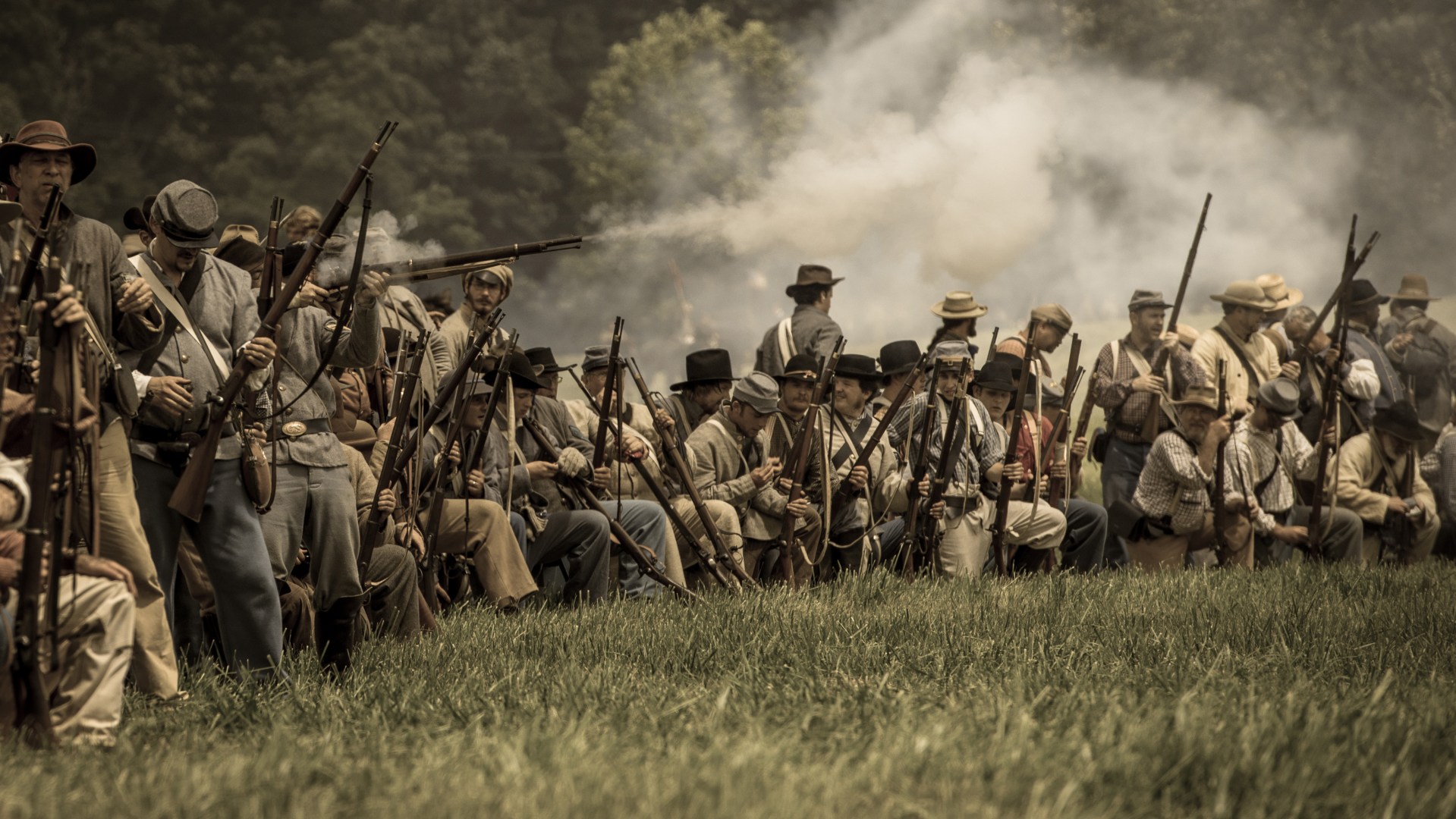

Americans have written more than 70,000 books about the Civil War—1 for every 19 hours since Robert E. Lee surrendered to Ulysses S. Grant. We are awed by its sheer magnitude, staggered by its appalling human cost, and inspired by its looming heroes. According to James McPherson, a leading Civil War authority and retired Princeton historian, these factors help to explain why the war fascinates us, but not how it continues to shape us a century and a half later.

The War That Forged a Nation: Why the Civil War Still Matters
Oxford University Press, USA
232 pages
The War That Forged a Nation: Why the Civil War Still Matters (Oxford University Press) brings together a dozen of McPherson’s essays about the conflict. They range widely, investigating the morality of the war, President Lincoln’s effectiveness as commander in chief, and the cultural impact of such unprecedented death and destruction, among other topics.
But McPherson’s most provocative writing explicitly addresses the war’s enduring relevance. He emphasizes three basic factors. The first involves what caused it. “Many of the issues over which the Civil War was fought still resonate today,” he observes. These include “matters of race and citizenship; regional rivalries; [and] the relative powers and responsibilities of federal, state, and local governments.”
Equally striking are the war’s consequences. The United States as we know it was conceived not during the American Revolution but in the crucible of the Civil War. The struggle prompted an expansion of the role of government, transformed the US financial system, dramatically expanded the role of the federal court system, and—in the creation of the Freedmen’s Bureau—introduced the first major social service agency.
Finally, the conflict initiated a lasting constitutional shift embodied in amendments abolishing slavery, guaranteeing equal protection under the law, and recognizing voting rights for black Americans. Although a century would pass before anything like substantial progress was made, these amendments both reflected and accelerated changing popular attitudes toward government. Whereas 11 of the first 12 amendments had limited the federal government’s power, those ratified in the war’s wake dramatically expanded it. If the patriots of 1776 had seen government as a threat to liberty, the Civil War convinced many to view government as an agent for protecting it. These two perspectives continue in tension to this day.
Religion, however, is strangely absent from McPherson’s analysis. In recent years, a spate of provocative works has underscored religion’s centrality to the conflict. Historians such as Mark Noll and George C. Rable have linked the struggle to an underlying theological crisis, demonstrating how Americans in both the North and South made sense of the war in providential terms. They argue that popular religious zeal helped propel the conflict from a limited to a total war.
Above all, scholars agree that the war dramatically bolstered America’s civil religion, one that confused loyalty to country with the cause of Christ. But I can’t help wondering whether McPherson recognizes this phenomenon. At times he uncritically adopts the language of civil religion—speaking of battlefields as “hallowed ground,” for example. And he is flat-out wrong in describing the Gettysburg Address as secular. To the contrary, Lincoln’s speech is relentlessly religious, although in a way that conflates sacred and secular.
In words now enshrined in marble on the Washington Mall, Lincoln invited Americans to situate the Civil War in a larger story of redemption. The body being redeemed, however, was not God’s church but the United States. The author of redemption was not the Lord but “we the people.” This is the religion of patriotism at its poetic best. Reminding (and warning) us of its allure is surely another way of illuminating how the Civil War “still matters.”
Robert Tracy McKenzie teaches history at Wheaton College. He is the author of The First Thanksgiving: What the Real Story Tells Us about Loving God and Learning from History (IVP Academic).