
Ron Sider’s many books—about poverty, politics, and global justice—emphasize some of the most difficult and easily overlooked ethical obligations of following Christ. In Nonviolent Action: What Christian Ethics Demands But Most Christians Have Never Really Tried (Brazos Press), the author of the now-classic Rich Christians in an Age of Hunger makes the biblical case for pursuing peaceful alternatives to conflict. Here, Sider chooses 5 books on how nonviolence really works.
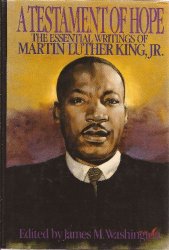
A Testament of Hope Edited by James M. Washington
Martin Luther King Jr. is the most famous and successful Christian proponent (and practitioner) of nonviolent action. The civil rights movement changed US history—ending legal segregation in the South, prompting historic legislation, bringing new opportunity for African Americans, and slowly reducing racism. In powerful books and eloquent speeches, King argued that loving the racist while resisting his oppression was the only way to make racism and oppression disappear. Washington’s anthology is the easiest way to access King’s vision.

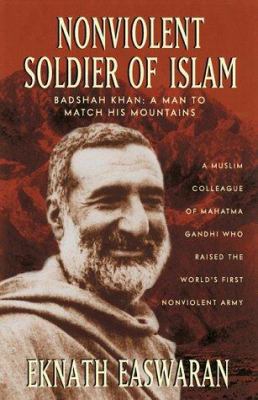
Nonviolent Soldier of Islam Eknath Easwaran
Badshah Khan raised history’s first nonviolent army: at least 80,000 Muslim “Red Shirts” with officers, uniforms, and a flag. Trained in Gandhian techniques of nonviolence, they played a crucial role in India’s independence. Khan’s Red Shirts were Pathans hailing from India’s northwest frontier, a violent area (and ethnic group) that gave rise to the Taliban. As Khan’s biographer explains, if he “could raise a nonviolent army of people so steeped in violence as the Pathans, there is no country on earth where it cannot be done.”
Why Civil Resistance Works Erica Chenoweth and Maria J. Stephan
Chenoweth and Stephan, former fellows at Harvard’s Kennedy School of Government, argue that nonviolent action works better than violence in promoting freedom and justice worldwide. In this book, they look at all 323 known cases of major armed and unarmed insurrections from 1900 to 2006. Based on their sophisticated statistical analysis, they conclude that “nonviolent resistance campaigns were nearly twice as likely to achieve full or partial success as their violent counterparts.”
Just Peacemaking Glen H. Stassen (2nd ed.)
Stassen, who taught ethics at Fuller Seminary, was at the forefront of a long-standing conversation between pacifist Christians and those embracing just war. These ethicists understood that, even as they disagreed about the use of military force, they should work together to find nonviolent ways to promote peace. In Just Peacemaking, Stassen discusses and advocates ten nonviolent strategies vindicated by recent history.
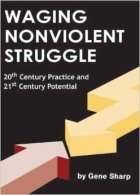
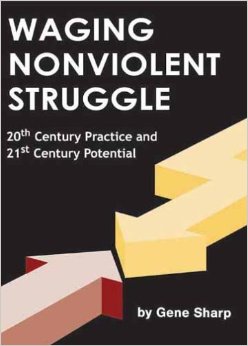
Waging Nonviolent Struggle Gene Sharp
For decades, Sharp has been the foremost scholar on nonviolent strategies for addressing injustice and oppression. His three-volume The Politics of Nonviolent Action (1973) offered an articulate analysis of the theory and tactics of nonviolent action. Activists from every continent have studied his writings, sought his advice, and worked to implement his ideas. Waging Nonviolent Struggle provides an accessible overview of Sharp’s scholarship and a history of two dozen important nonviolent campaigns.