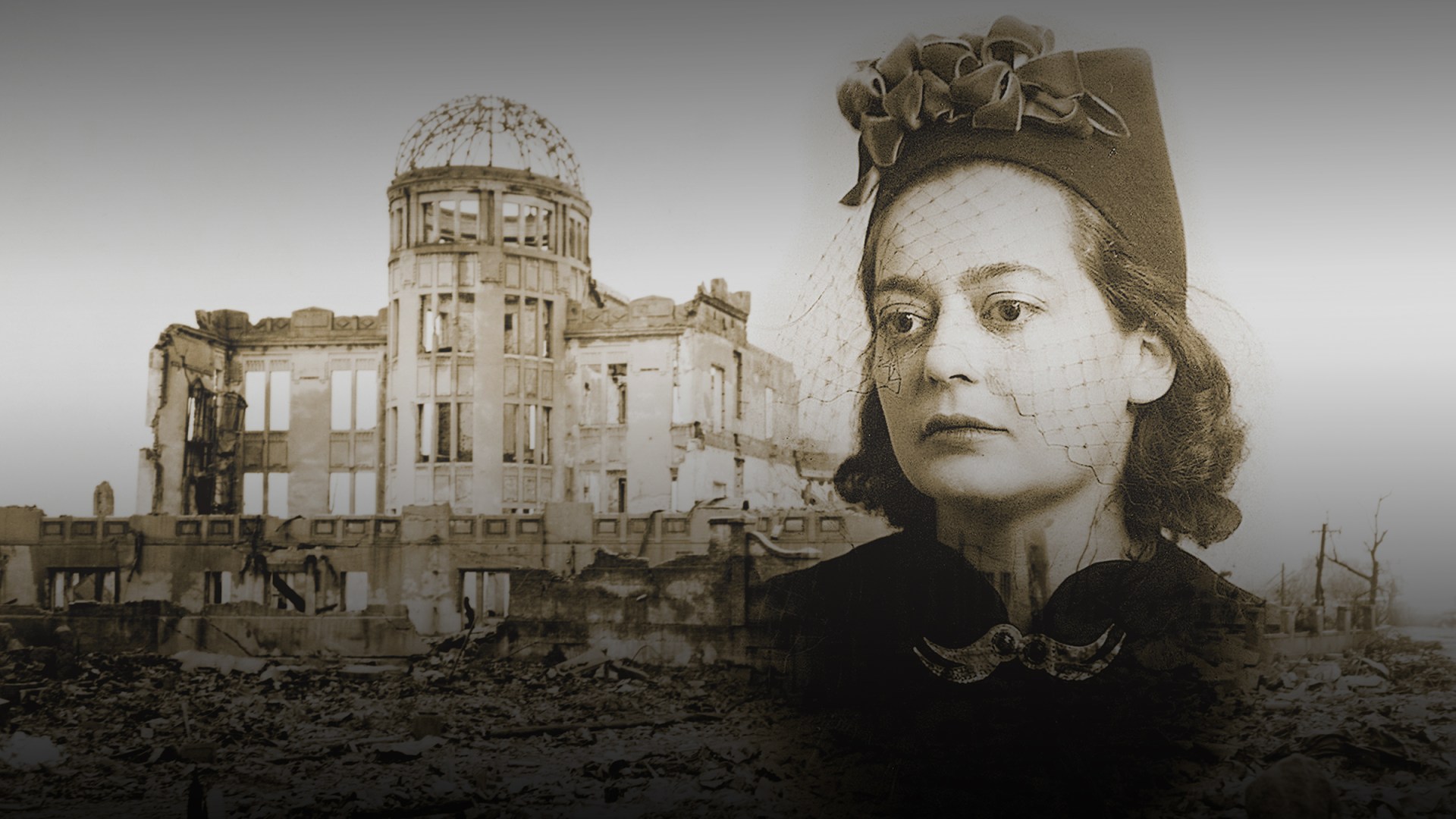

When the United States bombed Hiroshima and Nagasaki 70 years ago this month, Joy Davidman—best known today as the wife of C. S. Lewis—was in a vulnerable way. Nearly six months pregnant with her second son, she lived in Ossining, New York, with her toddler and her husband, the troubled novelist William (Bill) Lindsay Gresham. Jewish-born and Bronx-raised, Joy had been an atheist since childhood and became a card-carrying member of the Communist Party in her early 20s. But motherhood and a move to the suburbs had isolated her from comrades, setting her adrift from the Party and abruptly ending what had been a successful career in New York City as an award winning poet, editor, and film critic for the Communist magazine New Masses.
When the atomic bombs fell in August of 1945, forcing the fact of mortality, Joy suddenly realized that civilization could be instantly obliterated. She was bringing a second child into a world where, she wrote in one poem, “ashes that were babies / blew among the bamboo trees.” Science might not be society’s salvation, as she had long believed; instead, it might be the world’s damnation.
With the destruction in Japan, wrote Time magazine days later, echoing her shaken worldview, “[Humankind] had won the most Promethean of its conquests over nature, and had put into the hands of common man the fire and force of the sun itself. In an instant, without warning, the present had become the unthinkable future. Was there hope in that future, and if so, where did hope lie?” Horror, anxiety, and existential despair clamped onto Joy’s psyche.
During the months that followed, atomic dread, postpartum depression, and an unstable husband left Joy physically and mentally exhausted. One weekday in the spring of 1946, the phone rang. It was Bill, calling from his Manhattan office in a panic. “[I’m] having a nervous breakdown,” he told her. His mind was going. He felt paralyzed. He couldn’t stay where he was and he couldn’t bring himself to come home. Then he hung up.
Joy clutched the phone. Bill had a history of suicide attempts. She immediately tried calling him back; he did not answer. After many more phone calls, she contemplated racing into Manhattan and searching on foot. But even if she could get someone to watch the children, where would she go once she reached Grand Central Station? And what if Bill called again while she wasn’t home? What if the father of her children never returned? “By nightfall there was nothing left to do but wait and see if he turned up, alive or dead. I put the babies to sleep and waited.”
Joy’s philosophy had always been “rigid and admitted no thought of God, of religion, of anything outside of dialectic materialism.” A self-assured woman who believed she had all the answers, she was now forced to admit helplessness. “I was not, after all, ‘the master of my fate’ and ‘the captain of my soul.’” Joy had never in her life allowed for defeat. “There is only one final beauty, to be on your feet, and only one ultimate ugliness, to fall to your knees,” she once wrote.
But alone in her room that night, all that changed. “All my defenses—the walls of arrogance and cocksureness and self-love behind which I had hid from God—went down momentarily. And God came in.”
Joy later described that experience: “There was a Person with me in the room . . . a Person so real that all my previous life was by comparison mere shadow play. . . . My perception of God lasted perhaps half a minute. . . . When it was over I found myself on my knees, praying. I think I must have been the world’s most astonished atheist.” It was a moment of grace.
Bill did return, although those missing hours remain a mystery. Normal life resumed. Yet Joy felt blindsided by her experience. All her life she had taken atheism for granted; then the bomb exploded her worldview. “It’s always the unforeseen that happens,” she commented, “as it happened with a bang at Hiroshima.”
Joy now felt shockingly certain that there was a God. Still, she wanted to understand; she didn’t want to repeat with religion the mistake she’d made with atheism. “I had learned my lesson, and this time I looked before I leaped; I studied religions.” Joy commenced a quest that would consume her for the next three years, what Bill called “an unsystematic but intense course of study and debate—history, philosophy, formal logic, the scriptures of half a dozen nations, the Bible itself and its modern interpretation.” This study led her, inevitably, to C. S. Lewis—first as his reader, then as his valued “pen-friend,” and finally, in what would become one of the 20th century’s greatest literary love stories, as his most unlikely wife.
Abigail Santamaria is the author of Joy: Poet, Seeker, and the Woman Who Captivated C. S. Lewis, newly released from Houghton Mifflin Harcourt.