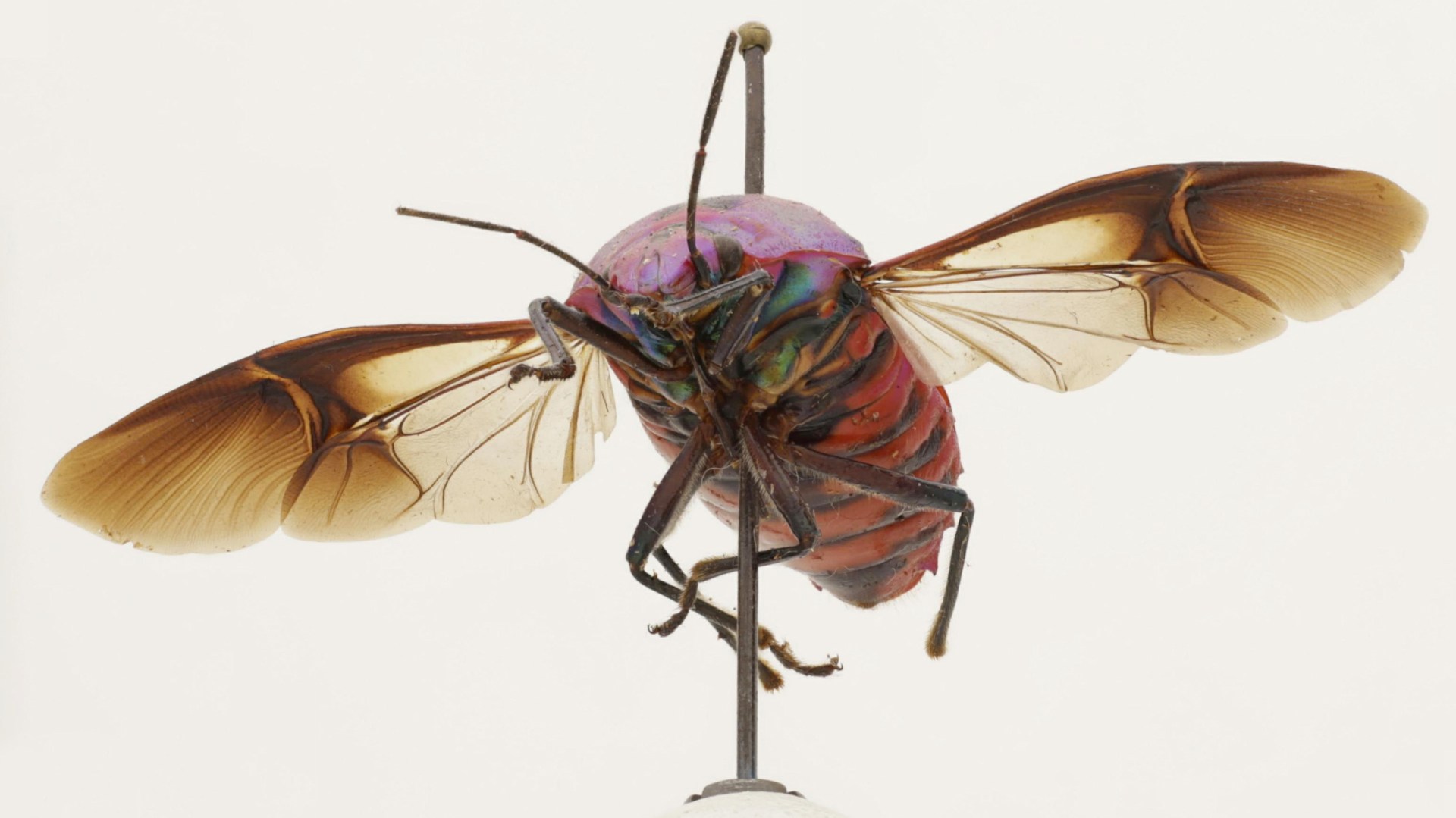

The Google Maps of Dead Bugs
Our new assistant editor, Mariah, says she doesn’t normally like to meditate on zoomed-in photographs of dead bugs. (“Hairy feelers, shiny compound eyeballs. I would skip those spreads in National Geographic.”) But this massive project at the Berlin Museum of Natural History might actually change her mind. As The New York Times reported last month, there are a lot of efforts to put museum collections online. But no one else is compiling three- to five-thousand high-definition images of a single beetle.
The Mystery of Minnesota’s Missing River
At Judge C. R. Magney State Park in far northeastern Minnesota, one half of a river disappears every day. Really. At Devil’s Kettle (also known as Pothole Falls), the Brule River splits in two: one half does what waterfalls usually do and plunges 50 feet into a nice pool. The other half plunges into a pit. Geologists don’t know where the water ends up or why the hole exists in the first place, since the type of rock in the area isn’t at all conducive to forming underground channels. (You might want to wait to investigate until deer hunting season ends on November 22.)
Church Architecture Panoramas
When Apple launched panoramic photos for iOS6, it unleashed a million clickbaity slideshows of shots gone horribly wrong. Photographer Richard Silver (who uses a Nikon D800 with a super-wide 14-24 mm lens) shows how a panorama can go right—and what we miss when we forget to look up. His portraits of incredible church architecture are from all over the globe: Krakow, Johannesburg, Havana, Beijing, Mumbai—even Reykjavik, Iceland. “Some people tell me the images look like the inside of a boat, an insect’s body, or like turtles,” he told Wired. “I only see the absolute beauty of the churches themselves.”
Thermonuclear Art
This ultra-HD video of the sun gives us a chance to see what we miss when we can’t look up. (YouTube has HD, 4K, and other resolutions.) Media specialists at NASA’s Solar Dynamics Observatory put in about 300 hours of work to create this video, which adds color coding to each distinct wavelength of invisible ultraviolet light emitted. It’s a chance to visualize the splendor of the star that is our sun—without frying your retinas.