Last year, the American Library Association (ALA) fielded 275 formal challenges to materials in schools and libraries—a record low.
Making the top 10 list of challenges for the first time: the Bible.
The reason: “religious viewpoint.”
But the ideological grounds for the religious book’s appearance on the 2015 Most Challenged List likely doesn’t tell the whole story, says James LaRue, who directs the ALA’s Office for Intellectual Freedom (OIF).
“You have people who feel that if a school library buys a copy of the Bible, it’s a violation of church and state,” LaRue told the Associated Press. “And sometimes there’s a retaliatory action, where a religious group has objected to a book and a parent might respond by objecting to the Bible.”
Three out of five Americans believe that religious liberty is on the decline, according to a recent LifeWay Research study. At the same time, two out of five Americans think Christians complain too much about how they’re treated.
The number of ALA complaints last year was down from 311 in 2014 and 307 in 2013. The ALA generally tallies between 300 to 600 challenges a year.
The Qur‘an has also received challenges, though fewer than the Bible, noted LaRue, whose office organizes the annual Banned Books Week. Overall, challenges based on “religious viewpoint” have declined.
Just because the Bible is challenged doesn’t mean that the ALA recommends its removal. The Bible “does not violate the separation of church and state as long as the library does not endorse or promote the views included” in it, the OIF states in its guidelines.
This isn’t the Bible’s first brush with banishment.
“The Bible has been criticized, challenged, and banned by individuals, groups, and governments through centuries of persecution,” Bible Gateway general manager Rachel Barach told CT.
Perhaps the most famous censorship was in China, which led to years of missionaries sneaking in suitcases full of Bibles. (The need for continued smuggling is up for debate.) Meanwhile, in Malaysia 300 Bibles were seized two years ago for using “Allah” for God, and Brunei banned Christians from using 19 religious words.
The Bible has significance beyond religion, Andrew Hood, director of communications at the American Bible Society, told CT.
"The Bible—the most-translated and best-selling book of all time—has informed centuries of literature, government, philosophy and social behavior,” he said. “To exclude it from public libraries and schools would be to diminish access to the most influential book of all time."
While five books on the ALA’s list cite “religious viewpoint” as a reason why they made the list, the Bible is the only book where that is the only reason cited. The majority of listed reasons reference sex, be it sexually explicit content, homosexuality, or sex education.
The ALA notes that it does not “claim comprehensiveness,” but instead bases its list “upon anecdotal data derived from media stories and voluntary reports sent to OIF.” This year’s list is drawn from 275 challenges, which consist of “a formal, written complaint, filed with a library or school requesting that materials be removed because of content or appropriateness.” (Read its full methodology.)
About 3 out of 10 Americans (28%) say that certain books should be banned, up from 2 out of 10 in 2011 (18%), according to a 2015 Harris poll. Harris found that 13 percent of American adults felt the Bible should not be available in school libraries, while 11 percent said the same in 2011.
[Update: Bible Gateway offers some “perspective” on the ALA study.]
Here are the AFA’s top 10 most frequently challenged books of 2015:
Looking for Alaska, by John Green Reasons: Offensive language, sexually explicit, and unsuited for age group.
Fifty Shades of Grey, by E. L. James Reasons: Sexually explicit, unsuited to age group, and other (“poorly written,” “concerns that a group of teenagers will want to try it”).
I Am Jazz, by Jessica Herthel and Jazz Jennings Reasons: Inaccurate, homosexuality, sex education, religious viewpoint, and unsuited for age group.
Beyond Magenta: Transgender Teens Speak Out, by Susan Kuklin Reasons: Anti-family, offensive language, homosexuality, sex education, political viewpoint, religious viewpoint, unsuited for age group, and other (“wants to remove from collection to ward off complaints”).
The Curious Incident of the Dog in the Night-Time, by Mark Haddon Reasons: Offensive language, religious viewpoint, unsuited for age group, and other (“profanity and atheism”).
The Holy Bible Reasons: Religious viewpoint.
Fun Home, by Alison Bechdel. Reasons: Violence and other (“graphic images”). (Read Karen Swallow Prior’s take here.)
Habibi, by Craig Thompson Reasons: Nudity, sexually explicit, and unsuited for age group.
Nasreen’s Secret School: A True Story from Afghanistan, by Jeanette Winter Reasons: Religious viewpoint, unsuited to age group, and violence.
Two Boys Kissing, by David Levithan Reasons: Homosexuality and other (“condones public displays of affection”).
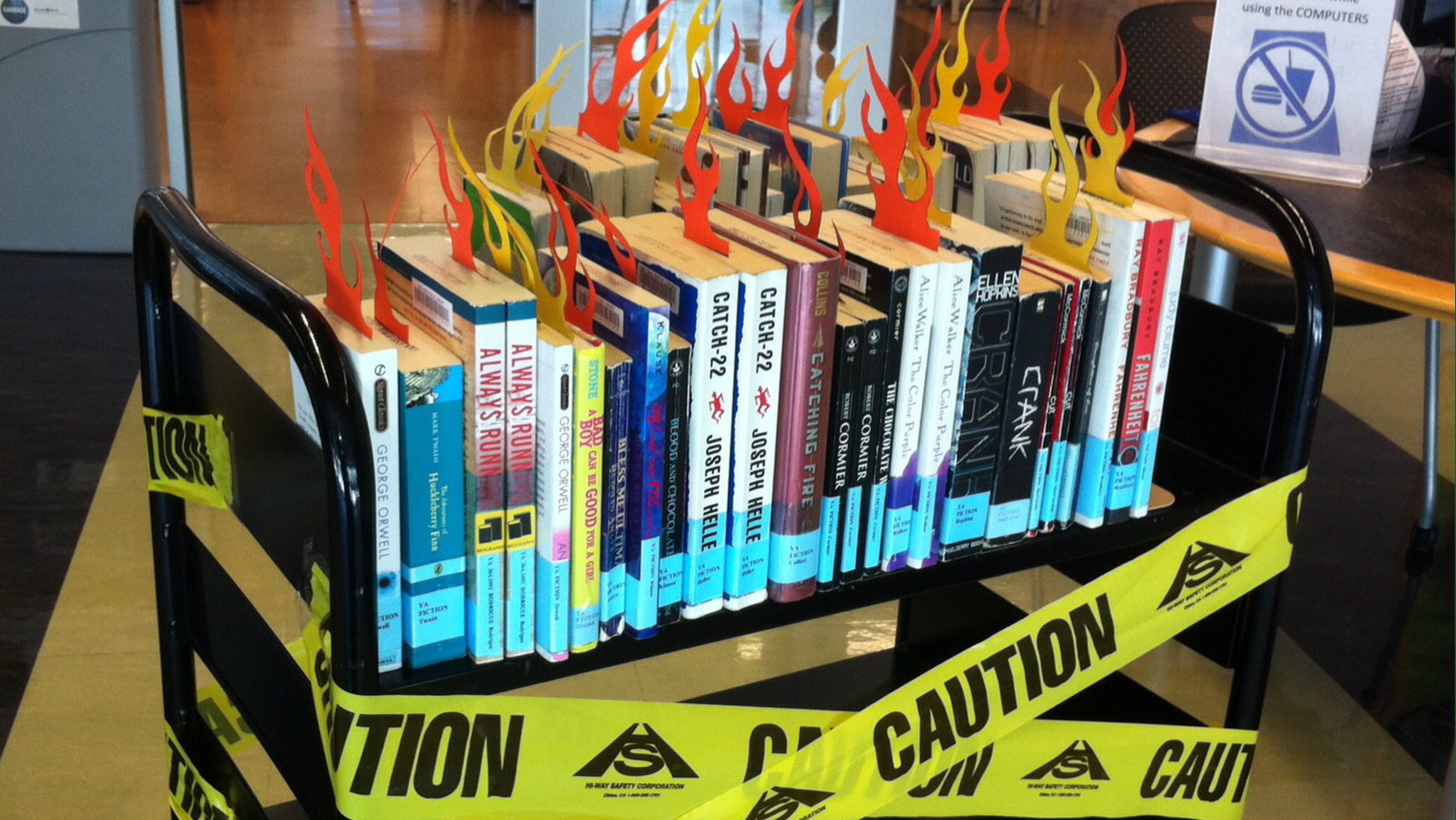
[Image courtesy of San Jose Library – Flickr]