The American pastime of church shopping finally has some solid stats: how many Christians do it (and how often), why they left their last church, and why they picked their current one.
The Pew Research Center's new study, which categorizes respondents according to their denomination, also looked at who is attending church more often and whether their reasons are more theological or practical.
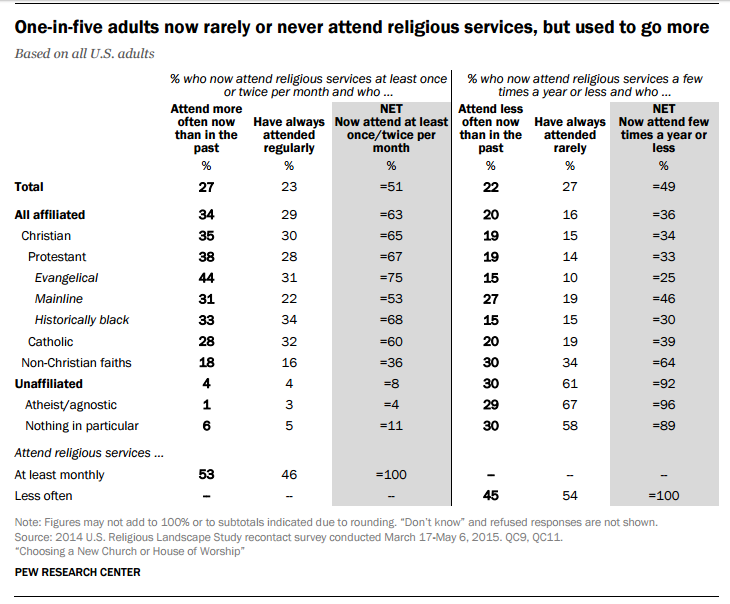
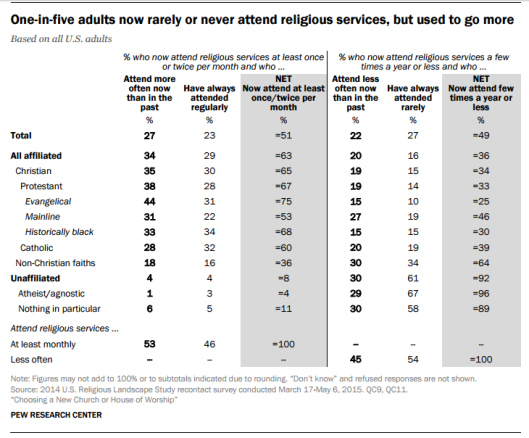
Overall, more than two out of five churchgoing evangelicals say they are attending worship services more often than they used to.
Of the 75 percent of evangelicals who attend church at least once a month, 44 percent said they’re going more often than they did before. About a third said they’ve always attended regularly (31%).
Evangelicals are a little more likely to attend regularly than historically black Protestants, two-thirds of whom identify as evangelical. About two-thirds of historically black Protestants attend church at least monthly (68%); of those, half have always attended regularly (34% overall) and half are going more often now (33% overall).
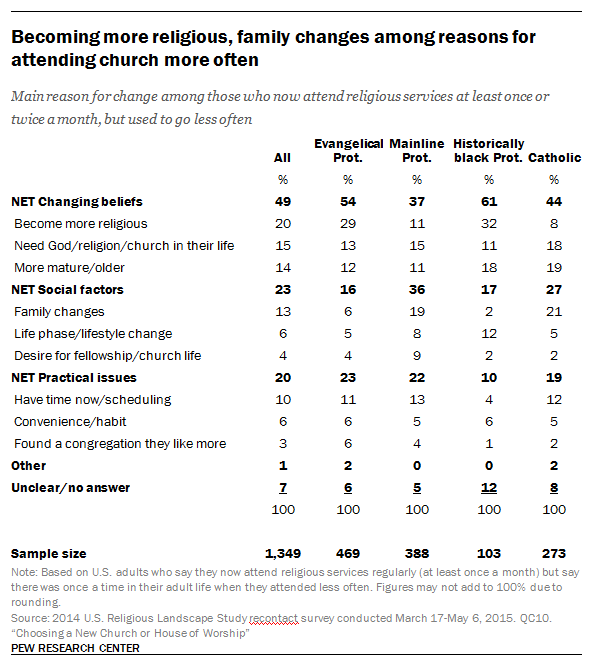
The biggest reason evangelicals are attending more often is a change in their beliefs (54%), Pew told CT. Those who have increased their attendance reported that it’s because they’re becoming more religious (29%), realizing they need God or church in their lives (13%), or becoming older or more mature (12%).
About a quarter of evangelicals said they attend more now for practical reasons—because they have the time in their schedule (11%) or found a congregation they like (6%). Still others began attending more often for social reasons, like starting a family or wanting the fellowship of a church family.
Historically black Protestants were more likely than evangelicals to be attending more often because of changing beliefs (61%), about as likely to have increased their attendance because of social factors (17%), and far less likely to have increased their attendance because of practical issues (10%).

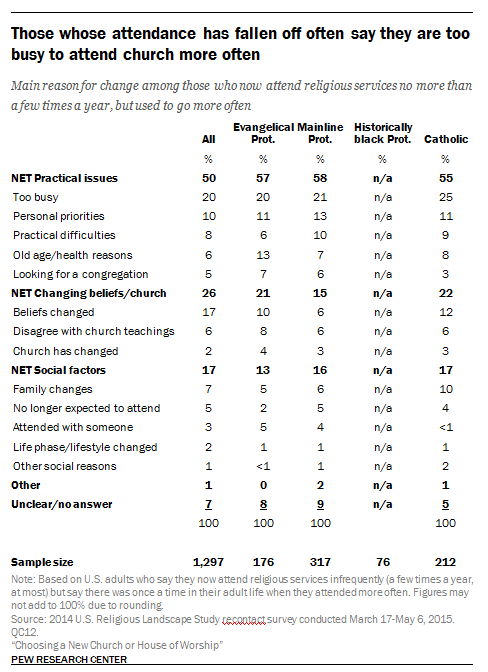
Of those who attend only a few times a year, 15 percent of both evangelicals and historically black Protestants said they’re attending less often than they did previously.
The majority of evangelicals said their lack of attendance was due to practical issues (57%), like being too busy (20%) or too ill (13%). Fewer are pulled away by social factors like family changes (5%) or no longer attending with someone (5%).
About one in five of those who attend less frequently said it was because their beliefs changed (10%), they disagreed with church teachings (8%), or their church has changed (4%).

In fact, disagreements with pastors or other congregants caused 18 percent of evangelicals to look for a new church, according to the study. While that was slightly more than the number of those who left because they got married or divorced (16%), it was less than those who left because they moved (49%).
Overall, 67 percent of evangelicals have looked for a new congregation. Fewer historically black Protestants have searched for a new church home (46%), whether because they were moving (29%), had disagreements with pastors or other church members (11%), or changed their marital status (7%).
“Of the country’s largest religious traditions, evangelical Protestants are among the most likely to say they have looked for a new congregation,” Pew wrote. “For Catholics, this may reflect that choosing a new congregation (after a move, for example) can be as straightforward as determining which Catholic parish they reside in, removing the need for a more extensive search. Members of the historically black Protestant tradition move to new communities less often than other Protestants, which may be one reason they also are less likely to have ever looked for a new congregation.”
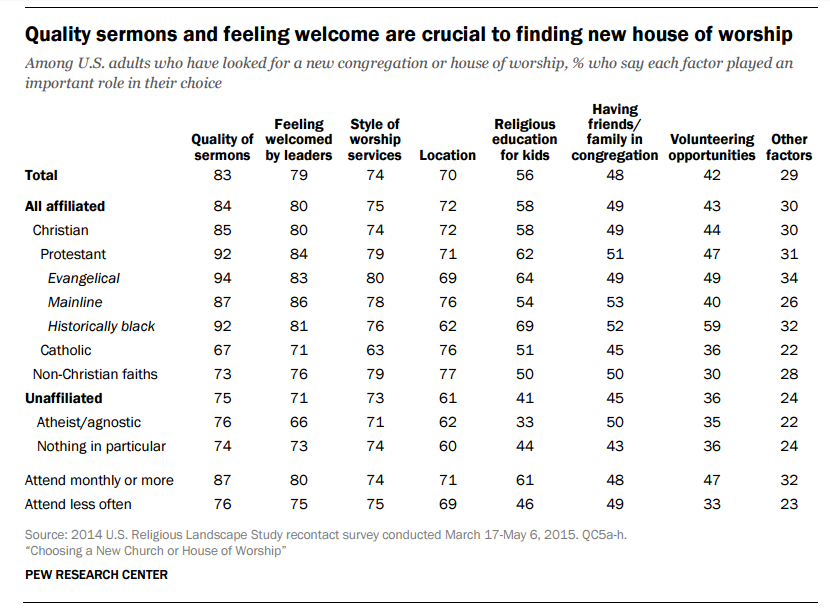
When evaluating a new church, top-quality sermons are the most important thing both evangelicals (94%) and historically black Protestants (92%) are looking for. They also want to feel welcomed by leaders (82%).
Evangelicals put slightly more emphasis than historically black Protestants in the style of worship services (80% vs. 76%) and location (69% vs. 62%).
Historically black Protestants, on the other hand, were more likely than evangelicals to value opportunities to volunteer (59% vs. 49%), religious education for children (69% vs. 64%), and having family or friends in the congregation (52% vs. 49%).

About 9 out of 10 evangelicals and historically black Protestants attended a worship service at a prospective church before making the switch, while about 7 out of 10 talked to members of the congregation, friends, or colleagues about their decision. Evangelicals were a little more likely than historically black Protestants to talk with a minister about switching (64% vs. 58%) or to look online for information (36% vs. 30%).
Evangelicals were more open than historically black Protestants to considering a different denomination (47% vs. 31%), who were more likely to consider only new churches within the same denomination (66% vs. 49%).
Most respondents said that finding a new place to worship was easy, though it was easier for evangelicals (69% said it was very or somewhat easy, compared to 59% of historically black Protestants). Evangelicals also looked more often—about 4 in 10 have looked for a new church home within the last five years, compared to 3 in 10 historically black Protestants. More than half of historically black Protestants have never looked for a new church home (54%), compared to a third of evangelicals (33%).
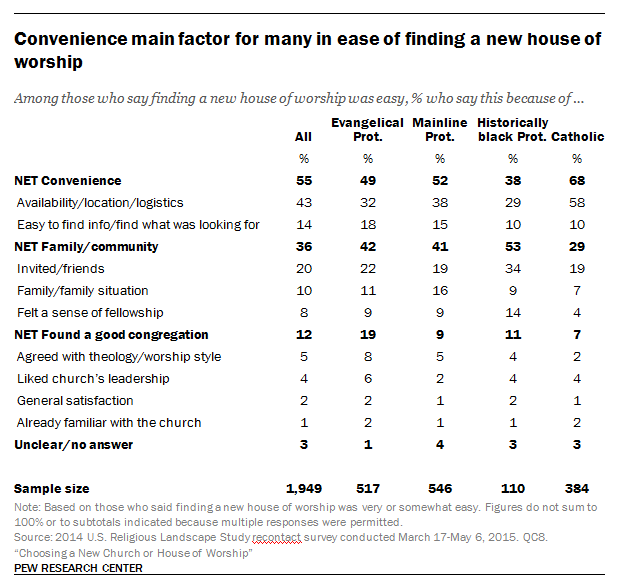
Half of evangelicals said finding their new church was easy because it was convenient (49%) or because they felt at home there (42%). Historically black Protestants were less likely to say their new church was convenient (38%) but more likely to say they found a good community there (53%).

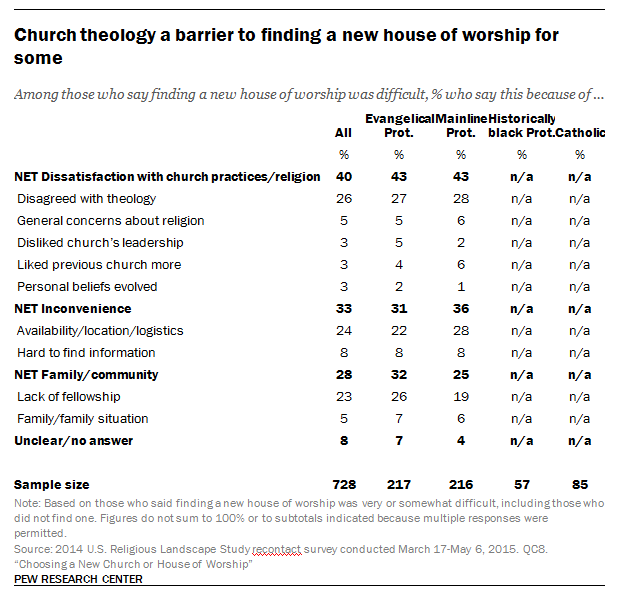
Evangelicals who had a hard time finding a new church said it was because they disagreed with the theology of the places they tried out (27%) or because the location or logistics were inconvenient (22%). A quarter said that prospective churches lacked fellowship (26%).

Finding a church to attend regularly is a good move for your mental health and happiness, two new studies show. People who go to church feel happier both on Sunday and throughout the week, and gain both meaning and good coping skills, University of Wisconsin-Madison researchers found.
[Editor's note: Out of a sample of 5,000 Americans, Pew surveyed 1,043 members of evangelical churches and 335 members of historically black Protestant churches. Within these two groups, 67 percent of evangelicals and 46 percent of black Protestants have looked for a new congregation.]