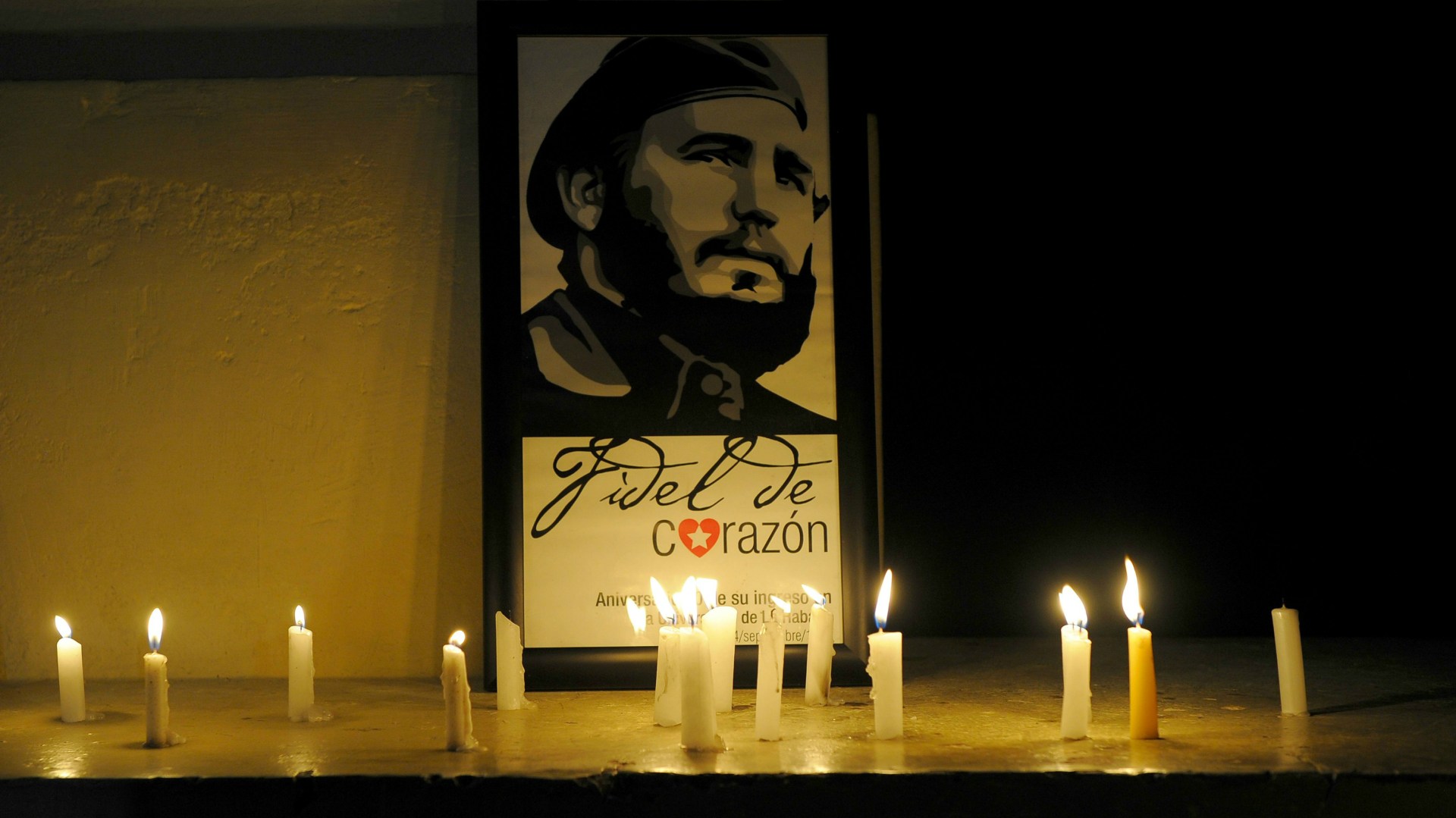
The remains of Fidel Castro are being displayed in Havana as part of Cuba’s nine days of official mourning for the deceased dictator. Many world leaders will not attend the funeral next week for the man who raised literacy rates but kept a rigid grasp on civil rights.
For Cuban Christians, his death isn’t likely to be a sea change in how the island nation’s Communist government approaches religion.
Like most Cubans, Castro himself was raised Catholic, educated by Jesuit priests as a child. He rejected his faith during the 1959 revolution, after the church rejected his movement toward atheism and socialism. Priests were killed and deported, while Christians (and other groups) were discriminated against and banned from joining the Communist Party.
But Castro—and his brother, current ruler Raúl—softened with time. Some credit the Catholic Church and its popes with influencing Cuba’s slow turn from Marxism.
They were also good for religious holidays. Pope John Paul II visited the country in 1998; the next day, Castro reinstated Christmas. In 2012, Pope Benedict visited; soon after, the government allowed Good Friday observances.
This year, Cuba was the site of a historic step toward religious reconciliation: Pope Francis sat down with Russian Orthodox Patriarch Kirill in Havana in the first meeting between Roman Catholic and Eastern Orthodox heavyweights since the Christian church split into West and East in 1054.
Even though Castro’s last writings recalled the stories of Adam and Eve, Noah and the ark, and God’s provision of manna, the level of his faith remains a mystery, reported Crux.
Despite the tension between church and state in Cuba, Christianity there has been undergoing an improbable and impressive revival. It sparked around the time that the Soviet Union’s collapse left Cuba scrambling to right itself. The period of crippling economic depression in the 1990s also began a time of church growth and evangelism.
The Assemblies of God has grown to more than 3,000 churches, while the Eastern Baptists have more than 1,200. Seminaries are racing to keep up with the pastor shortage.
As CT reported on the 50th anniversary of Fidel’s revolution:
Since the 1959 Revolution, Castro's Communist government has placed numerous restrictions on religious expression in Cuba—a reality illustrated by most sources' requests for anonymity. Yet the Cuban church is thriving despite its limitations, and its leaders ask that their church not be used as a geopolitical pawn.
"We are part of the body of Christ in the world, yet people see us only with political eyes," said one leading Cuban evangelical. "To those people we say: 'Come and see.' "
…
Many evangelicals said their greatest desire is not for more political and economic freedom, but for active faith. "Of course I want more freedom, but I wouldn't want it to come at the expense of our current passion for the gospel," said a leading Cuban evangelical.
"Perhaps God is limiting our freedom to teach us," said an Eastern Baptist leader. "To strengthen the church so that when more freedoms are granted to us, we will be better prepared to serve."
But even though the United States eased trade restrictions with Cuba last year, Fidel’s brother Raúl still operates effectively as a dictator. And the leash is still short for Protestant churches.
Between January and July this year, Christian Solidarity Worldwide (CSW) recorded more than 1,600 religious freedom abuses, perpetrated primarily by the Cuban government and its Office of Religious Affairs.
Four large churches linked to the apostolic movement have been demolished this year, and their sound equipment stolen. Pastors—and in some cases, church members—have been detained during the attacks, presumably to stop them from protesting.
According to CSW, about 2,000 Assemblies of God churches were declared illegal and marked for seizure by the government in 2015; 1,400 of them are in the expropriation process. Meanwhile, Maranatha Baptist Church was told in December 2015 that it could build a new church for its 800 members; so far permits have not been granted.
“CSW received regular reports of moderate to severe harassment of religious leaders throughout the first half of 2016,” the report stated. “Government officials and state security agents continued to intimidate, threaten and physically harass pastors and their families.”
Still, Christianity continues to flourish. More than 5 percent of the country is now Protestant; about 60 percent identify as Catholic.
“The church before was asking, ‘How do we survive?’” an evangelical leader in Pinar del Rio told CT in 2009. “Now the church is asking, ‘How do we multiply?’”
CT traveled to Cuba last year to investigate why, with the embargo eased and travel restrictions relaxed, church leaders worry that Americans might dampen Cuban churches’ zeal.