





In this series
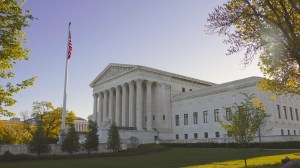

In its biggest religious freedom case of the year, the US Supreme Court ruled Monday in favor of a conservative Lutheran congregation seeking a state grant for improving its playground. New Justice Neil Gorsuch sided with the majority in the 7–2 vote.
The landmark decision in Trinity Lutheran Church v. Comer addresses the religious freedom principles at the core of the First Amendment and potentially paves the way for certain government funding for religious institutions (such as school choice vouchers), an issue the court hasn’t ruled on since 2000.
“The express discrimination against religious exercise here is not the denial of a grant, but rather the refusal to allow the Church—solely because it is a church—to compete with secular organizations for a grant,” wrote Chief Justice John Roberts, in the court’s opinion, from which Justices Sonya Sotomayor and Ruth Bader Ginsburg dissented. “In this case, there is no dispute that Trinity Lutheran is put to the choice between being a church and receiving a government benefit. The rule is simple: No churches need apply.”
The case was about more than the playground resurfacing grant in question—especially since Missouri’s state government had already amended the program to include religious groups. Instead, the Trinity Lutheran playground dispute pitted religious freedom against the separation of church and state.
“It's a strong win for equal participation of religion, and free religious choice, in government benefits,” said Thomas Berg, a church-state expert at the University of St. Thomas law school in Minneapolis. “This is the first time the court has held that a religious organization, indeed a church, must be included on equal terms in a general program of government funding.”
Trinity Lutheran argued that Missouri was violating the free exercise clause of the First Amendment (“no law … prohibiting the free exercise of religion”) by declaring the church’s preschool ineligible for a grant program—which helped cover the cost of safer playground surfaces made of recycled tires—just because the school was affiliated with the church.
On the other side, the Missouri Department of Natural Resources deployed the establishment clause of the First Amendment (“no law respecting the establishment of religion”) to defend its decision not to provide aid directly to a church, even if used for a secular purpose. This prohibition has been codified in Missouri and 30 other states under laws known as “Blaine Amendments.” Missouri’s bars state funds from going “directly or indirectly, in aid of any church, sect, or denomination of religion.”
While Roberts wrote that the consequences of Missouri’s rejection were likely “a few extra scraped knees,” he considered the discriminatory policy “odious to our Constitution all the same.” He defended the rights of religious institutions to get their fair share of public benefits.
By siding with the church, the Supreme Court sets a precedent against a strict interpretation of state-level Blaine Amendments, thereby shifting the prospects for religious institutions’ involvement in public programs.
“States in many instances can reasonably choose not to fund churches,” wrote Columbia Law School professor Philip Hamburger for First Things. “But when the Blaine Amendments narrowly single out ‘sectarian’ institutions, or when, as in Missouri, they categorically exclude all ecclesiastically affiliated institutions, they reveal theologically driven discrimination.”
The majority of the court recognized the religious discrimination taking place, with Roberts opining:
It is true the Department has not criminalized the way Trinity Lutheran worships or told the church that it cannot subscribe to a certain view of the gospel. But, as the department itself acknowledges, the free exercise clause protects against “indirect coercion or penalties on the free exercise of religion, not just outright prohibitions.”
It’s a major win for religious freedom advocates eager for protection for their institutions, and the kind of decision many evangelicals prayed for when Gorsuch was picked for the nation’s highest court. The Supreme Court, concerned of a tie vote without the late Justice Antonin Scalia, agreed to take the case in January but waited to hear it until April, once Gorsuch was on the bench.
“This case will have profound implications for years to come,” said Russell Moore, president of the Ethics and Religious Liberty Commission of the Southern Baptist Convention. “The court did the right thing because it recognized the difference between a government supporting a religion and a government treating all people fairly, including religious people.”
Gorsuch, along with Justice Clarence Thomas, concurred with Robert’s opinion, but went even further in defending religious freedom. He took issue with the implication that the ruling might only apply to the playground because of its secular purpose, writing:
The Court leaves open the possibility a useful distinction might be drawn between laws that discriminate on the basis of religious status and religious use. … Respectfully, I harbor doubts about the stability of such a line.
Does a religious man say grace before dinner? Or does a man begin his meal in a religious manner? Is it a religious group that built the playground? Or did a group build the playground so it might be used to advance a religious mission? The distinction blurs in much the same way the line between acts and omissions can blur when stared at too long, leaving us to ask (for example) whether the man who drowns by awaiting the incoming tide does so by act (coming upon the sea) or omission (allowing the sea to come upon him). Often enough the same facts can be described both ways. Neither do I see why the First Amendment’s Free Exercise Clause should care. After all, that Clause guarantees the free exercise of religion, not just the right to inward belief (or status).
The Trinity Lutheran decision came on the final opinion day of the term.
The Baptist Joint Committee for Religious Liberty (BJC) was among the groups opposing the ruling. “By treating a state ban on aid to churches as a mark of discrimination, the court’s decision upends precedent and adds confusion to the law,” said Holly Holman, BJC general counsel.
The Religion & Politics journal summarizes earlier rulings on this issue, which the Chief Justice relied on in the court’s opinion:
The Supreme Court hasn’t ruled on the question of direct aid to churches since 2000, when a plurality held in Mitchell v. Helms that the government can provide aid to religious schools—in that case, library materials and computer equipment—as long as that aid is non-religious and granted equally to non-religious groups. But the court stopped short of permitting cash aid to churches. …
The 2004 ruling in Locke v. Davey … found there is “room for play in the joints” between the two religion clauses. In that case, the court upheld a Washington state scholarship program that excluded students pursuing a degree in “devotional theology.” Although the state could have included those students, it didn’t violate the free exercise clause by excluding them, the justices found. “There are some state actions permitted by the establishment clause but not required by the free exercise clause,” Justice William Rehnquist wrote in the court’s opinion.
Today’s ruling is also seen as a victory for the school choice movement. Though voucher programs are not explicitly mentioned in the decision nor in oral arguments, the Trinity Lutheran case involves some of the same arguments that critics use against voucher funding: that the establishment clause prevents governments from giving money to churches, and that it’s impossible to separate such funding from advancing a religious cause.
Gorsuch and Thomas, in their concurring decisions, advocate for the kind of broader protections that would justify vouchers to religious schools, Harvard professor Martin West told Politico. But it will take another case for the court to officially overturn Blaine Amendments and secure a precedent for vouchers, he said.







