





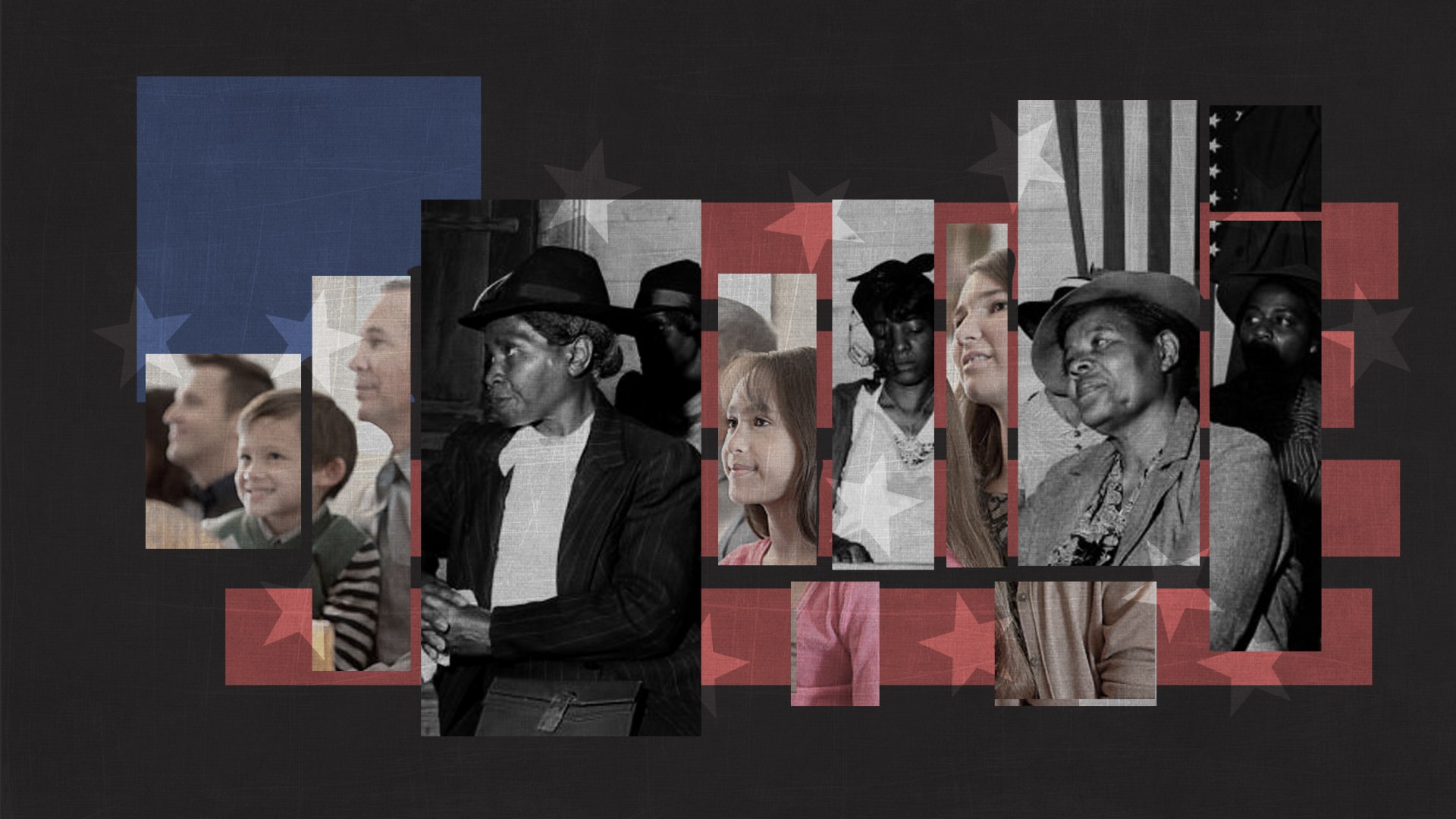
At the climax of the 1992 classic A Few Good Men, Colonel Nathan Jessup (Jack Nicholson) famously screams, “You can’t handle the truth!” Responding to questions from Lieutenant Daniel Kaffee (Tom Cruise) about a military cover-up, he confirms his role in the scandal but maintains that the public would rather not know the ugly and gory details of his job. In The Color of Compromise, Jemar Tisby (president of the black Christian collective The Witness) adopts the posture of Lt. Kaffee, demanding that American Christians learn and teach the hard truth about the church’s complicity in racial injustice.

For far too long, some in the church have assumed the defiant pose of Col. Jessup. Because this history is so painful to remember, many believers would rather bury it. Others, confronted with the church’s inadequate response, shift attention to a multiracial cast of heroic figures—like William Wilberforce, Francis Grimke, or Martin Luther King Jr.—whose contributions paint the church in a better light.
Of course, as Tisby points out, that these exemplars were small in number and greatly abused by fellow Christians for speaking against racial bigotry. And admirable as they are, they can’t be allowed to obscure the underlying truth: Many white Christians actively participated in racism, and many more sat idly by as it infected every inch of American life. Brutal racial injustice would not have persisted as long as it did, Tisby writes, without “the relative silence, if not outright support, of one of the most significant institutions in America—the Christian church.”
The Path of Least Resistance
The Color of Compromise corrects the record by surveying key points in American history where the tide of racial oppression could have been turned back—or at least minimized—had the church stood against it. Instead, as Tisby demonstrates, Christians chose again and again to propagate the American racial caste system.
The book begins in the colonial era, examining debates about whether evangelizing and baptizing slaves would confer freedom upon an enslaved person. According to Church of England tradition, Christian brothers and sisters could not enslave one another. But the Anglicans of the Virginia General Assembly broke decisively with this tradition by condemning their black brothers and sisters to perpetual slavery. Enslaved Christians, Tisby writes, were “encouraged to be content with their spiritual liberation and obedient as slaves.”
During the Civil War, pastors like J. W. Tucker likened the Southern cause of defending slavery to “the cause of God, the cause of Christ, of humanity. It is a conflict of truth with error—of Bible with Northern infidelity—of pure Christianity with Northern fanaticism.” Tisby forcefully demonstrates that much of the American church “saw no contradiction between the brutalities of bondage” and the true gospel of Jesus Christ.
There is no segment of American Christianity—evangelical, Catholic, Baptist, or mainline; Southern, Northern, or Midwestern—that escapes Tisby’s penetrating historical analysis. “Compromised Christianity transcends regions,” he writes, and “bigotry obeys no boundaries.” He covers the period leading up to the Civil War, when disputes over slavery prompted the Methodists, Baptists, and Presbyterians to split into Northern and Southern factions. He introduces readers to the first African American Catholic priest, who had to attend seminary in Rome because no American seminary would take him. Tisby also pushes back on the notion that racism was present mainly among theologically conservative Christians in the South, pointing to race riots in East St. Louis, a black Episcopal church denied admission to the regional diocese in New York City, and residential segregation across the Midwest.
Interestingly, Tisby argues that the racism involved in resistance to residential integration in the North was aided by “churches, who not only failed to inhibit white flight but actually became co-conspirators and accomplices in the action.” He cites research on seven Dutch Reformed churches in certain Chicago neighborhoods that relocated to suburbs with higher populations of white people over the course of the 1960s and ’70s.
The Color of Compromise succeeds because it highlights both the obvious and more subtle ways the American church reinforced the racial caste system. In most instances, there are no smoking guns, no burning crosses or outright declarations of African American inferiority. What you find instead is a persistent privileging of comfort, culture, and wealth over the full equality and humanity of African Americans. Tisby makes clear that too many white Christian leaders chose the path of least resistance, which only had the effect of strengthening white supremacy.
Tisby examines the words and actions of the great evangelist Billy Graham, who embodied some of these ambiguities. Graham forthrightly supported fully integrated revivals, but he also claimed membership at First Baptist Church of Dallas, then pastored by W. A. Criswell, who was often critical of efforts to end segregation. Tisby also faults him for his statements on urban unrest, which often emphasized law and order above public-policy efforts to cure structural ills.
While The Color of Compromise focuses on the sins and failures of white Christians, the history it recounts is no less relevant to African Americans, for the stories of the black and white churches in America are inextricably linked. “Without racism in the white church,” Tisby writes, “there would be no black church.” One cannot understand the black theology of suffering and joy without knowing something about the horrific experiences that birthed it. There’s the story, for instance, of Luther and Mary Holbert, who were lynched on a Sunday afternoon on the grounds of a black church. Or the story of Richard Allen and Absalom Jones, two pioneers of the African Methodist Episcopal Church, who were forcibly removed from their interracial Methodist church after taking seats designated for white parishioners.
Tisby also includes inspiring stories that ought to be better remembered. Citing African American Christians who fought courageously against racism, like Allen, Henry McNeal Turner, Olaudah Equiano, and Fannie Lou Hamer, he observes that “Christianity has been an engine for black progress even as others co-opted the faith to buttress white supremacy.”
Godly Sorrow and True Reconciliation
Tisby’s purpose for telling the truth about the church’s complicity in racism is not to reopen old wounds. He wants to bring about a godly sorrow that leads to repentance and reform, preparing the ground for “robust, consistent, honest reconciliation” between black and white believers. He quotes Martin Luther King Jr., who said, “There can be no deep disappointment where there is not deep love.”
The Color of Compromise will be a bitter pill for some who “can’t handle the truth,” but Tisby recognizes that reconciliation can’t proceed without a truthful shared story about our past. As Archbishop Desmond Tutu once said, “True reconciliation exposes the awfulness, the abuse, the hurt, the truth.”
The book includes some provocative solutions, like paying reparations to the descendants of slavery and removing Confederate monuments. Although some might dismiss such measures as impractical, Tisby hopes these “radical solutions will begin to seem more reasonable” after absorbing the weight of the history he traces. But even if we won’t agree on every remedy he proposes, hopefully we can unite around his call for a church that reckons honestly with its past, repents of its sins, and witnesses boldly to the truth that Christ, through his atoning blood, “has made the two groups one and has destroyed the barrier, the dividing wall of hostility” (Eph. 2:14).
Kathryn Freeman is director of public policy for the Texas Baptist Christian Life Commission.







