I grew up with idealistic missionary parents who wanted more than punch-a-clock and pay-the-mortgage normalcy. They pursued a ministry life abroad, but after I was diagnosed with leukemia as a child, we were left stateside and struggling financially. We moved a lot—Hawaii, then Nepal, then back to Hawaii, then New Mexico.

For most of my teen years, we lived in Albuquerque, and during that time, I began to resent the ways God allowed us to suffer. I began to think God was cruel, a scarce and mean God who looked the other way when we were in need. My parents gave me space and didn’t force me to go to church with them, but I knew they prayed that I would come to know Christ. My dad would often say, “I believe God has a call on your life, Alia.” But I wanted nothing to do with faith.
Everything changed in the middle of my junior year. My parents got another ministry job offer and moved us back to Hawaii.
When we arrived in Pahoa, my dad surveyed the house the ministry had provided for us. It was unlivable. The house had no plumbing and no interior walls, only a concrete slab pooling with puddles of mosquito-infested water. Heavy green mold scaled the cement ruins and the jungle loomed around the house, unruly vines breaking through shattered windowpanes. No one had flown to the Big Island to inspect the house or property for years, and it had become uninhabitable.
We lived in Nepal in the early ’80s in a dung-style hut, so we’d never be accused of being high maintenance, but this was ridiculous. The ministry agreed to pay half the rent for livable accommodations. But even a month after we moved in, we had no furniture and couldn’t afford to get any now that we had to pay partial rent. We had two lawn chairs in the living room and a futon pad on the ground. Despite our situation, my parents decided to stay and see what God would provide for us.
The rain in Pahoa fell in constant sheets, pounding on our metal roof like an assault. And I took it as just that: a personal attack. I sat on our back porch—a slab of concrete with a tin covering—listening to the rain pinging like rapid gunfire while I dragged hard on my cigarette. This was my personal hell.
Reconciling these years of poverty and pain with a loving and merciful God seemed impossible. I could not believe in a God who continually abandoned us. I hurt everywhere. I fit nowhere. Home wasn’t a place I could feel.
And yet, I met God there one night. Or God met me.
It had been raining for 42 days straight when I considered taking my own life. I had no transportation, no license, and no hopes of getting one anytime soon. I was miles away from civilization and as sober as I’d ever been.
In Albuquerque, I had learned to silence the torment I felt inside. I didn’t know I had bipolar disorder; I just knew there were times my skin tingled with restlessness, my limbs seemed possessed, and my feet tapped out a Morse code. I felt invincible, immortal, immune to hunger and thirst and the incessant demands to slow down, to sleep, to recharge. My mind was a colony of secrets and schemes. But it’s an unfortunate law of the universe that what goes up must come down.
That night in Hawaii, blind with tears, I started ransacking the bathroom medicine cabinet and rifling through drawers. I decided it was time to quiet that steady hum once and for all. I wanted the shadows to disappear and the voices to stop, and I believed that death was the only way.
My hand shook as I picked up the flimsy disposable razor. I held it over my skin, trying to build up the courage to make the deep cut. I had flirted with death before, but just enough to blow my hair back, just enough to make me feel the tiniest bit alive. In that moment of desperation, I cried out to God: I never asked to be born! I never asked for any of this!
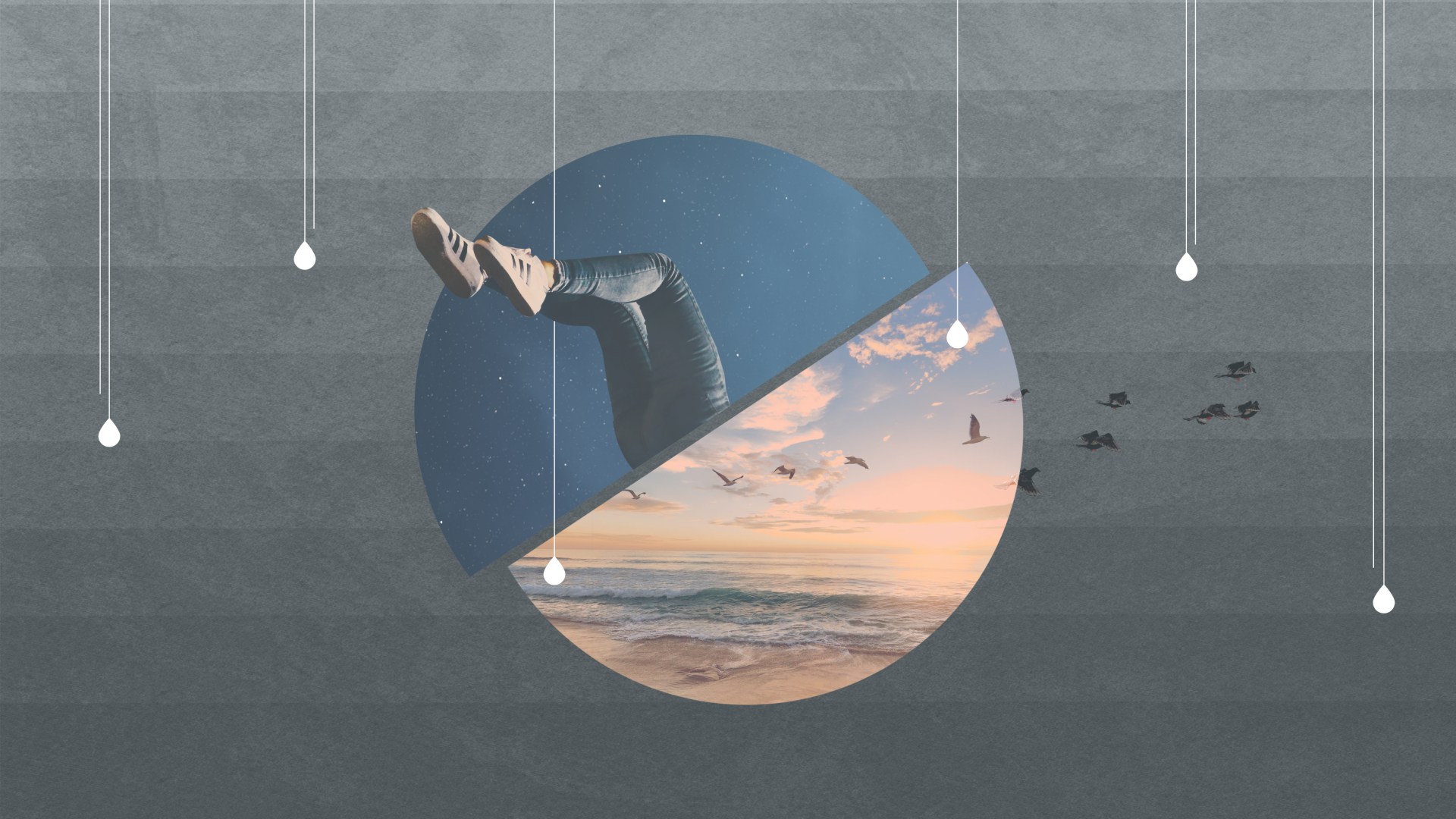
Never did I imagine that God would answer me. But he did. I found myself silenced, barefoot and open palmed, splayed like an offering across the floor. I was ready to take my own life and instead found myself laid out by God—physically knocked to the floor and flooded with a peace that to this day, I cannot fully describe. I felt the resuscitation of grace.
After that night, however, I began to make excuses. Maybe God reveals himself to desperate girls on chipped linoleum floors in the middle of a monsoon and says, “You belong to me. I have loved you with an everlasting love. You are mine.” But that was all too much for me to fathom. I wanted something to explain away the very real and terrible possibility that God existed and that he wanted something from me. I thought perhaps it was my body’s response to all the stress hormones and my legs had just given out. But even with all of my justifications, I couldn’t deny that I felt something I had never felt before. I felt God.
My parents had given me a Bible I never used and instead wedged under a tiny garage-sale table in my room to make the legs even. I pulled it out and began to read it at night behind my locked door. I didn’t want my parents to know. I didn’t want my dad to say, “I knew God had a call on your life, Alia Joy.” I didn’t want any spiritual I-told-you-so.
My bed was a rolled-out length of eggshell foam—the kind you put on a real mattress (should you actually have a mattress)—and not thick enough to keep my hips from falling asleep and aching through the night. As I read my Bible, I was confronted with questions and fears. I’d lie in the dark with God and whisper prayers into the void, hoping someone was there answering me back. Like Jacob wrestling with God through the night, this grappling changed my identity and renamed me.
In the Book of Genesis, when Jacob first prays for protection and deliverance from Esau, he prays to the God of his father Abraham and his father Isaac. After he wrestles with God and his prayers are answered, Jacob erects an altar with his new name, Israel. He names it El-Elohe-Israel, which means “God, the God of Israel.”
When I wrestled with God, he brought me to that same place of weakness. This weakness didn’t leave me more vulnerable before my enemies, real or imagined. Instead, it taught me that, even though we all walk with unsteady feet, we can rely on the God of our fathers and more than that, on the God who reveals himself directly to us, a God unmasked, a God who lets us grab hold of him in the darkness. In these times of wrestling, we might find ourselves transformed. We might feel the touch of God dislocating our hip as dawn breaks. God might take us to the ground.
I am not healed in the ways one might imagine. I still have bipolar disorder. Sometimes I still struggle with suicidal ideation. I take antipsychotic meds and antidepressants to help keep me alive. These, too, are ways that God meets me on the mat, meets me in the darkness, and lets me grab hold of him.
To this day, I carry the bruises of those restless nights, of a too-thin mat and a paralysis so severe I could only be laid at the feet of Jesus. Sometimes I remember that whisper-thin foam of my bed and the ache in my hips as I wrestled with God. I think of my parents choosing to stay in Hawaii and wait on the Lord. I thank God for their obedience, for helping bear witness to the goodness of God in that horrible rental where I first believed.
I came back to life in that home that wasn’t a home. It was the place where I met Jesus and the place where I learned that I’d always been called.
Alia Joy is a speaker and writer who lives in Oregon with her family. Her blog, AliaJoy.com, offers insight into her life, family, and faith journey. This essay was adapted from Glorious Weakness: Discovering God in All We Lack by Alia Joy, copyright March 2019. Used by permission from Baker Books, a division of Baker Publisher Group.