





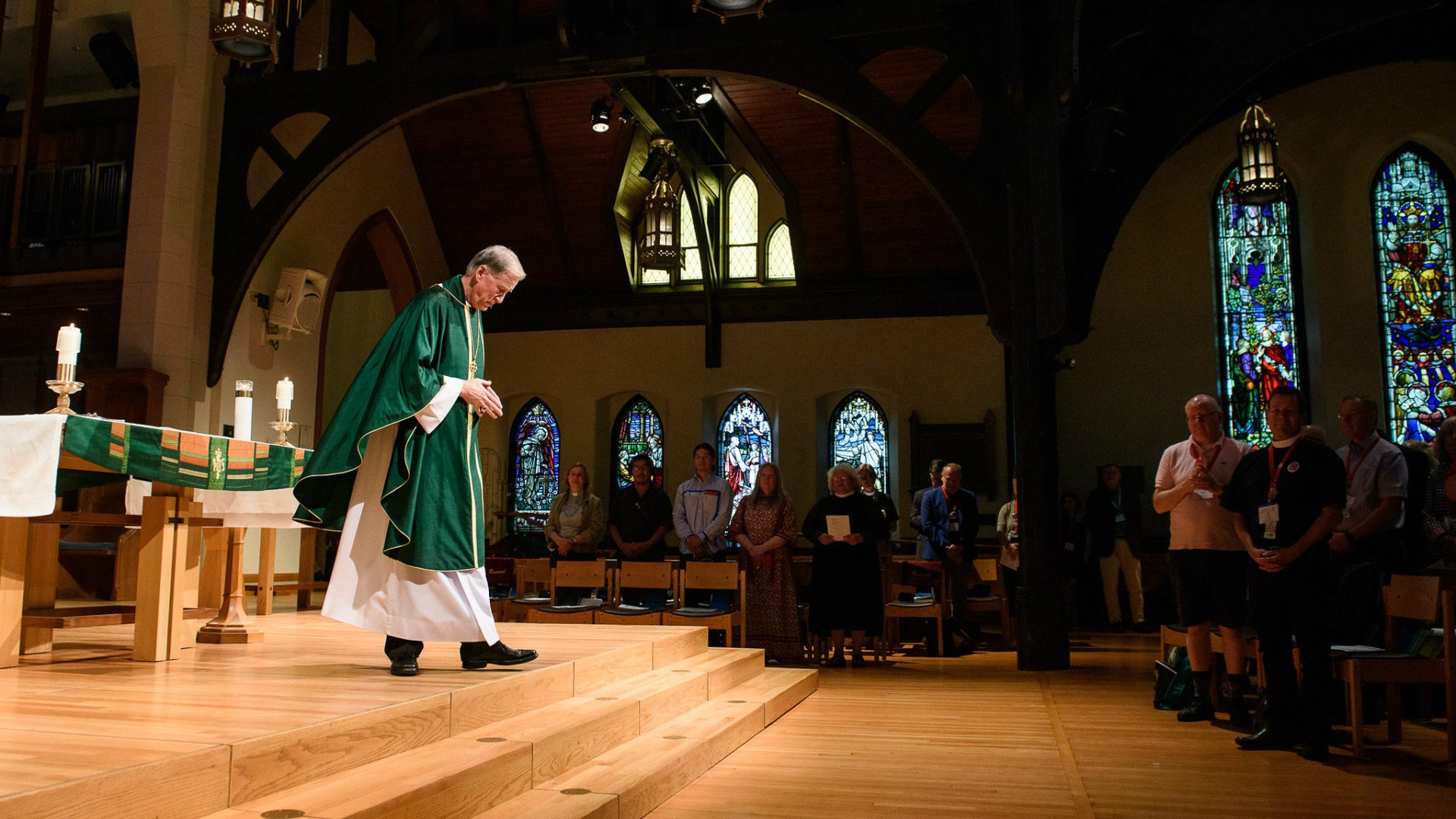
Though the Anglican Church in Canada last week failed to amend its canon to sanction same-sex marriages, in the wake of the narrow vote, dioceses have opted to continue with them anyway.
The amendment, first passed in 2016, required a two-thirds majority vote among lay delegates, clergy, and bishops at two triennial general synods in a row. While it met the threshold among lay and clergy (80.9% and 73.2%) during this year’s synod, the bishops’ vote last Friday fell just short of two-thirds (62.2%).
On Monday, Archbishop Fred Hiltz, the Primate of Canada, read a statement to the delegation saying the bishops “are not of one mind” on the issue, but that “we are walking together in a way which leaves room for individual dioceses and jurisdictions of our church to proceed with same-sex marriage,” according to Anglican Planet.
The initial rejection came as a blow to the majority of Canadian Anglicans, who support same-sex marriage, which has been legal in the country since 2005. But after Monday’s announcement, several bishops indicated that they would be taking advantage of the “local option,” which permits dioceses to follow their “contexts and convictions” on this issue, the CBC wrote.
The conservative minority in the Anglican Church in Canada has raised concerns over the decision to permit same-sex ceremonies despite the failed vote.
“In a church that affirms the ‘One, Holy, Catholic and Apostolic Church’ I can’t make sense of what local option means in this context or in the global Church,” Bishop Joey Royal, a suffragan bishop of the Arctic, told Anglican Planet.
“This is something that has not yet been fully acknowledged despite repeated pleas from all across the Communion to not proceed with same-sex marriage. The truth is we’ve unleashed a monster and no one—not conservatives, not liberals—can predict how this will all play out in the coming years.”
It’s been 15 years since the denomination first passed a measure to “affirm the integrity and sanctity of committed adult same-sex relationships.”
Susan Bell, bishop of the diocese of Niagara, which will continue to marry same-sex couples, told the CBC the narrow vote offered a “realistic portrayal of where the Anglican Church of Canada is right now.”
The amendment would have officially declared that the church’s marriage canon applies “to all persons who are duly qualified by civil law to enter into marriage” and would use “parties to marriage” instead of gendered terminology.
Among the bishops, 23 voted in favor, 14 against, and 2 abstained—close enough to draw scrutiny over who opposed the measure. Some had suggested indigenous leaders (who make up a dozen of 43 total bishops) were more likely to vote against.
“There’s an assumption there that all Indigenous bishops, for instance, voted against the marriage canon change. That’s not true at all,” National Indigenous Anglican Archbishop Mark MacDonald said in the Anglican Journal. “We are concerned about the implications of that kind of scapegoating, and we’re trying to deal with it as gently and serenely as possible.” (At the general synod, MacDonald was given the title of archbishop following a historic vote to establish a self-determining indigenous church within the denomination, and the church also issued an apology for mistreatment of indigenous people.)
Though the amendment didn’t pass, Anglicans opposed to same-sex marriage see little to celebrate, given how divided their church has become on the issue.
“We strive for unity and mutual understanding as Christians because all of us together have a mission to proclaim the gospel and make disciples of all people,” Cole Hartin, assistant curate at St. Luke’s in Saint John, New Brunswick, wrote for The Living Church. “Our fractiousness not only consumes time and energy, but diverts us from the mission God has given to all of us.”
The issue has been a tough one for Canadian evangelicals. Last summer, the Supreme Court of Canada ruled against Trinity Western University’s planned law school for a student covenant that confined sex to traditional marriage; after a five-year legal fight, the school dropped the requirement.
CT reported on research that indicated that Canada’s Anglican churches and mainline congregations with conservative theology were growing faster than their liberal counterparts; the Anglican Church of Canada is the second most popular Protestant denomination in the country after the United Church of Canada, though both have experienced declines over the past two decades.
“As we seek to move forward in this time of great change within the Church, we must remember that ultimately the Church is God’s,” wrote Hartin. “Our hope is not in our planning or strategies but in God who is making all things new. We must respect the way the Church is ordered, even as we groan with all creation, eagerly awaiting our adoption and the redemption of our bodies. We live in faith, looking forward in hope.”







