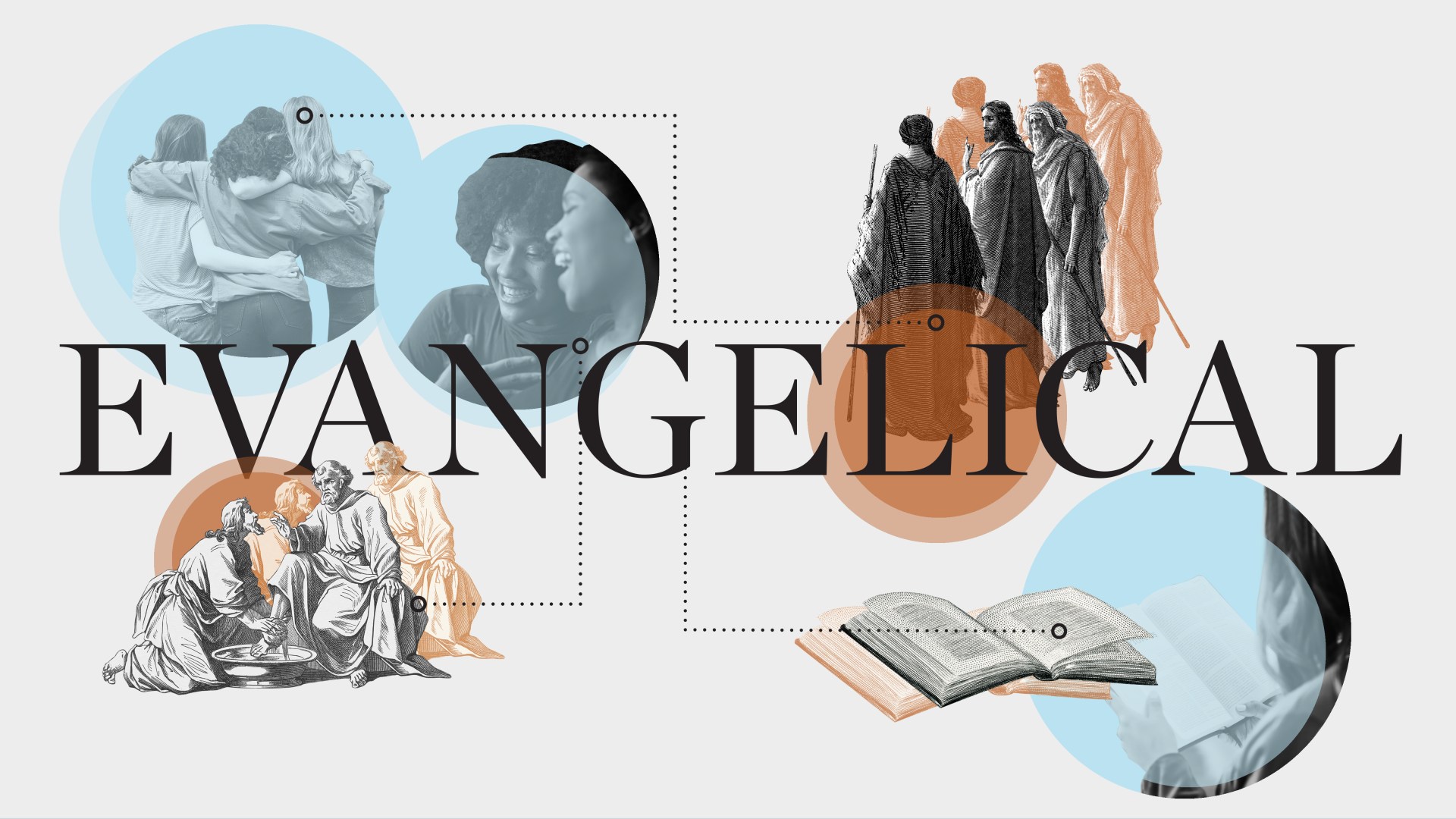
What does it mean to be evangelical? The term, without a doubt, is widely misunderstood and frequently misrepresented. In recent years, the term evangelical has become highly politicized, invoked to describe a voting bloc or as a blanket label for those with conservative or, perhaps, fundamentalist views. Meanwhile, some from within the movement have dropped the label or left evangelicalism entirely, coining the monicker exvangelical.
Since its inception, Christianity Today has been distinctly evangelical, bringing together a broad readership of Christians from across the denominational spectrum who find common ground in their shared faith in Christ, commitment to orthodoxy, and passion for proclaiming the gospel. Throughout the decades, CT has discussed what it means to be evangelical (such as in this 1965 cover story). In recent years, the conversation has continued with renewed vigor. What is really at the heart of evangelical identity? Here’s a sampling of articles from the past few years that dig deeper into what it means to be an evangelical Christian today.
In “Evangelical Distinctives in the 21st Century,” Mark Galli (CT’s recently retired editor in chief) launched a series of articles meant to “articulate what we [at Christianity Today] mean by evangelicalism—and more importantly, why we continue to think that evangelicals are a people whom God still uses mightily to reform his church and touch the world with the grace and hope of the gospel.” (You can read more of Galli’s columns on evangelical distinctives here.)

In “What Is Evangelicalism?” Bruce Hindmarsh, professor of spiritual theology at Regent College, puts forth four central characteristics of authentic evangelicalism: conversionism, crucicentrism, biblicism, and activism.

Some of today’s confusion around the term evangelical stems from how it is applied. Is it a matter of self-identification? Is it based on denominational affiliation? In “Defining Evangelicals in an Election Year,” Leith Anderson and Ed Stetzer make the case that evangelicals ought to be defined by their beliefs. Here Anderson and Stetzer discuss four core beliefs identified by the National Association of Evangelicals and Lifeway Research.

“Is it time to abandon the label evangelical?” Ron Sider asks. In “History Shows Us Why Being Evangelical Matters,” Sider traces evangelicalism’s development from the Reformation through revivalist movements to the present, noting areas of neglect and conflict that have led to some of the negative associations with the word evangelical today. Here, Sider puts forth a view of evangelicalism that embraces “justice while holding to central doctrines of the faith.”

In “Black and Evangelical,” Brandon Washington addresses some of the complicated baggage of evangelicalism, particularly in regard to race and culture. Washington addresses the view “that [evangelicalism] has been shaped by the dominant culture” and that the movement often divorces the gospel from social ethics. Yet Washington believes “preserving my theological identity obliges me to redeem the term and unpack the movement’s baggage.”

In “Why I Almost Left Evangelicalism,” Craig Keener describes his struggle with evangelical identity: “It was evangelical subculture—not evangelical faith—that I was feeling increasingly alienated from.” This sense of alienation coincided with healing that Keener experienced through the welcome and ministry of black Christian friends. “Today, I understand that evangelicalism—a movement that by definition must be centered on the evangel, or ‘gospel’—is a global movement that spans many cultures,” Keener writes.

In “The Unlikely Crackup of Evangelicalism,” Richard Mouw addresses the frustration voiced by some Christian leaders and academics who feel they “can no longer identify with a grassroots evangelicalism that has become regrettably ‘politicized’ these days.” Mouw posits that a forward-thinking strategy that holds on to the best of aspects of evangelicalism’s legacy is of greater importance than whether or not one retains “evangelical” as a label.

In “One Does Not Simply Leave Evangelicalism,” CT responds to the desire of some Christians to distance themselves from the term evangelical. “We get it. We’re frustrated, too,” writes CT’s editorial director Ted Olsen. But here Olsen urges readers, “Don’t stop calling yourself ‘evangelical’ because you’re frustrated with the polls” and cautions them against the “impulse to break with other Christians because you disagree with them.”

A notable distinctive of evangelicalism is our regard for and interaction with Scripture. In “God’s Letter to Us,” Mark Galli expounds upon evangelicals’ engagement with the Bible and their view of it as “absolutely authoritative and trustworthy.”

In “How Evangelical Scholars Treat Scripture,” Old Testament scholars Daniel I. Block and Richard L. Schultz address the same issue—evangelicals’ regard for and interaction with Scripture—from an academic perspective. Here Block and Schultz outline seven “marks of a distinctly evangelical hermeneutic” among biblical scholars.

“When we call ourselves ‘evangelical,’ we can do so with the richness of this broader history behind us. And yet we must clearly define ourselves lest others do it in ways we would not prefer,” writes Anthony L. Blair. In “A Better Way to Be Evangelical,” Blair casts a vision for living gospel-shaped lives that confidently, lovingly, and winsomely confess Christ.