A new survey reports more than a quarter of white evangelical Protestants believe a QAnon conspiracy theory that purports former President Donald Trump is secretly battling a cabal of pedophile Democrats, and roughly half express support for the debunked claim that antifa was responsible for the recent insurrection at the US Capitol.
Experts say the data point to a widening ideological divide not only between white evangelicals and other religious groups in the country, but also between white evangelical Republicans and other members of their own party.
The survey, which was conducted in late January by the conservative American Enterprise Institute, reported 29 percent of Republicans and 27 percent of white evangelicals—the most of any religious group—believe the widely debunked QAnon conspiracy theory is completely or mostly accurate.
QAnon has infiltrated other faith groups as well, with 15 percent of white mainline Protestants, 18 percent of white Catholics, 12 percent of non-Christians, 11 percent of Hispanic Catholics and 7 percent of black Protestants saying they believe it.
In addition, large subsets of each group—ranging from 37 percent of non-Christians to 50 percent of Hispanic Catholics—said they “weren’t sure” whether the theory was true.
According to Daniel Cox, director of AEI’s Survey Center on American Life, the report suggests conspiracy theories enjoy a surprising amount of support in general, but white evangelicals appear to be particularly primed to embrace them.
“There’s this really dramatic fissure,” he said.
There was also significant support among white evangelicals for the claim that members of antifa, or anti-fascist activists, were “mostly responsible” for the attack on the US Capitol—a discredited claim repeated by former Trump lawyer Rudy Giuliani and Franklin Graham. FBI officials have said there is “no indication” antifa played a role in the insurrection.
Even so, the story has had staying power in the minds of many Americans, including 49 percent of white evangelical Protestants who said the antifa claim was completely or mostly true. So did 36 percent of white Catholics, 35 percent of Hispanic Catholics, 33 percent of white mainline Protestants, 25 percent of Black Protestants and 19 percent of non-Christians.
Among the religiously unaffiliated, 22 percent also expressed belief in the theory.
Asked to explain why white evangelicals appear disproportionately likely to embrace conspiracy theories, Cox noted that, as a group, they do not fit a stereotype of conspiracy theorists as people disconnected from social interaction. Instead, most retain strong connections to various social groups.
But white evangelicals stand out in a different way: The vast majority say some or a lot of their family members (81%) or friends (82%) voted for Trump in the 2020 election—more than any other religious group.
“People who do strongly believe in these things are not more disconnected—they are more politically segregated,” Cox said.
The resulting social echo chamber, he argued, allows conspiracy theories to spread unchecked.
“That kind of environment is really important when it comes to embracing this kind of thinking,” he said. “You’re seeing people embrace this sort of conspiratorial thinking, and everyone in their social circle is like, ‘Yeah, that sounds right to me,’ versus someone saying, ‘You know, we should look at this credulously.’”
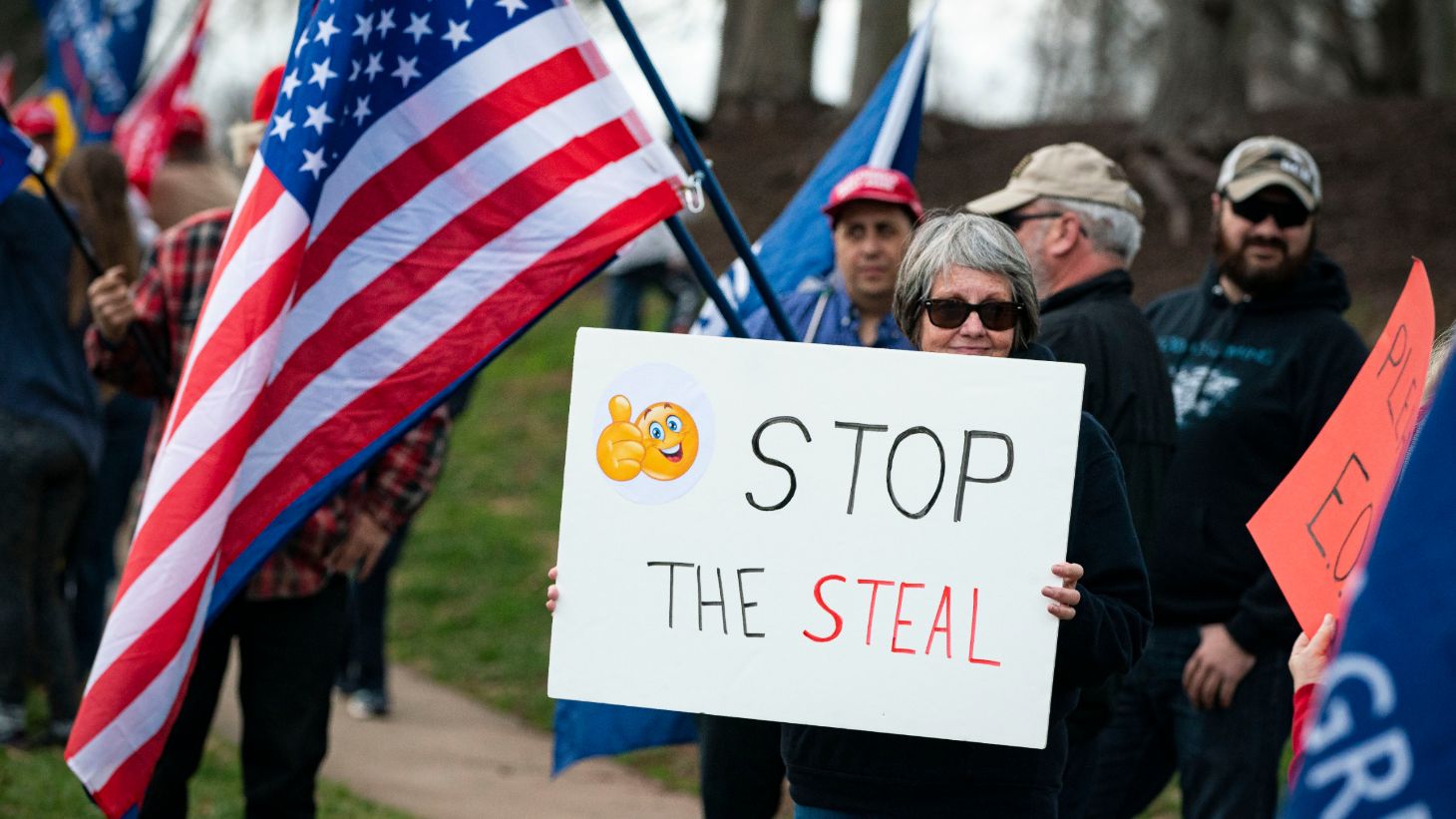
White evangelicals express robust support for other conspiracy theories as well. Close to two-thirds (62%) believe there was widespread voter fraud in the 2020 election—despite numerous experts and courts at all levels refuting such claims—and roughly the same percentage (63%) believe President Joe Biden’s victory was “not legitimate.”
A majority (55%) also said they believed it was mostly or completely accurate to say “a group of unelected government officials in Washington, D.C., referred to as the ‘Deep State’ (has) been working to undermine the Trump administration.”
Cox said forthcoming data will highlight the ideological distinctiveness of white evangelicals even among people who identify as Republicans or who lean toward the party, signaling an “increasingly important divide in the GOP among people who identify as evangelical Christian and those who do not.”
“If you’re a Republican but identify as an evangelical Christian, you’re far more likely to believe in voter fraud in 2020 election,” he said. “You’re far more likely to believe that Biden’s win was not legitimate. You’re more likely to believe in the QAnon conspiracy. You’re more likely to believe in the ‘Deep State.’”
White evangelicals also stood apart from other religious groups when asked about the potential for violent action: 41 percent completely or somewhat agreed with the statement “if elected leaders will not protect America, the people must do it themselves even if it requires taking violent actions.”