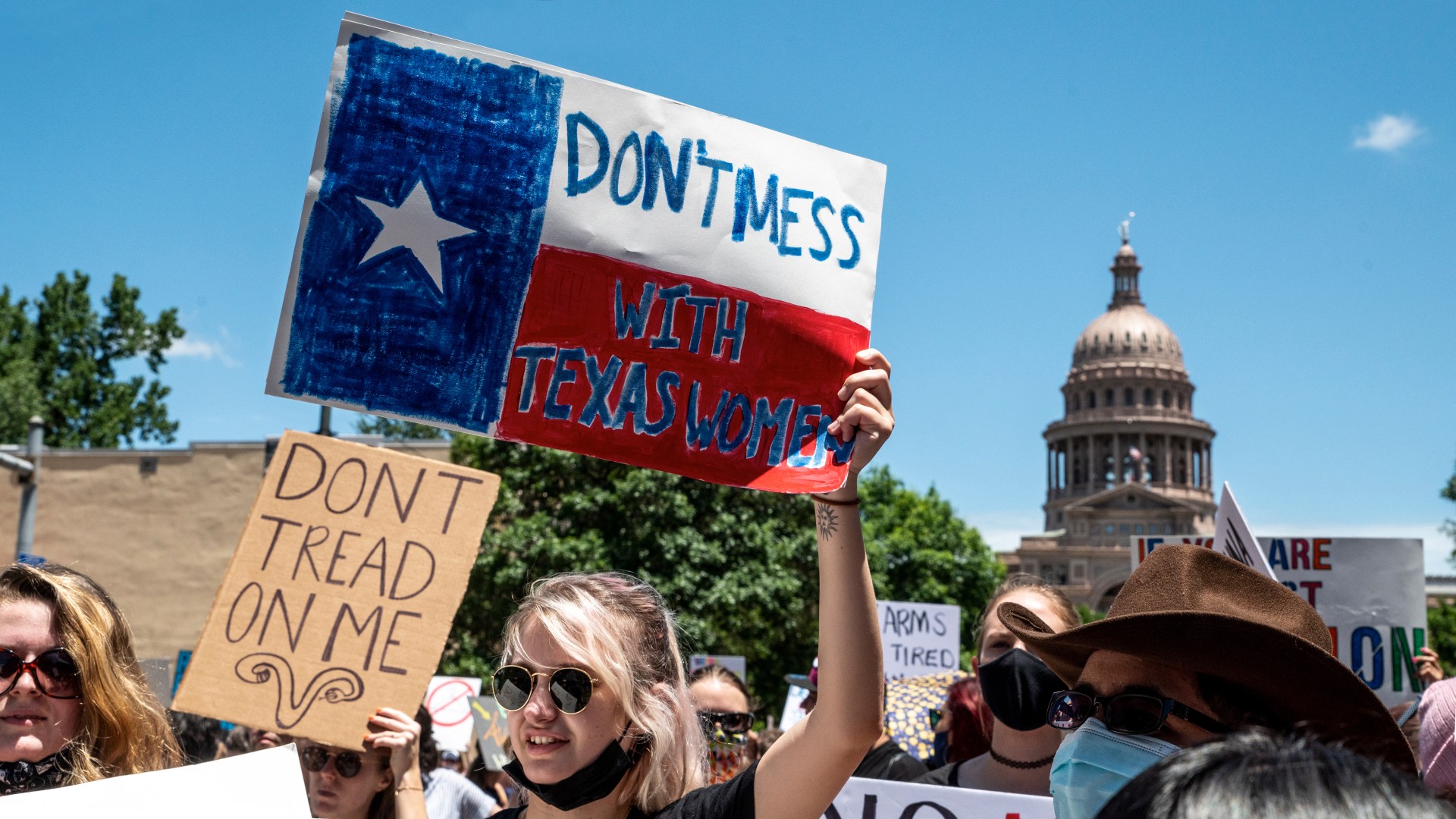
Many people counted down until midnight last night, waiting not for a New Year but for the possibility of a post–Roe v. Wade America. That’s because, due to a legal technicality, the Supreme Court of the United States had until then to overturn a new Texas abortion law before it went into effect on September 1.
The fact that the Supreme Court didn’t intervene has some Christians wondering: Is Roe now effectively gone?
The reason this case, in particular, is of such intense interest to both sides of the abortion debate is because the law in question, Senate Bill 8, seems to effectively ban abortion after about six weeks of pregnancy. Unlike the Mississippi law that will come before the Court this year, this law is different. It is not enforced by the state but rather by private persons who can sue anyone involved in an abortion—except the woman seeking the procedure.
Still, because a law seeming to prohibit abortion is now technically on the books, some have wondered if this means the almost fifty-year era of Roe v. Wade is at its end. And the answer to that is probably not—at least not yet.
Though it’s hard to discern the motives of nine justices, it is well within the realm of possibility that the Court’s decision to stay silent was not a way of undoing Roe but rather a means of not making such a decision before the Mississippi Dobbs case.
Dobbs v. Jackson Women’s Health Organization pertains to the State of Mississippi’s law banning most abortions after fifteen weeks from conception. If the law is upheld, it would directly challenge Roe’s framework of an almost unlimited right to abortion, especially before fetal viability (as defined by the Court). That case does not carry the same legal ambiguities as the Texas one and very well could decide the status of Roe, one way or the other.
Nonetheless, this moment could be a test run for pro-life Christians—and their legal opponents—showing what to expect when such a decision does come down from the Court, possibly even next summer. Under the current Roe structure, of course, very few meaningful restrictions on abortion can stand. Thus, the overturning or even the redefining of Roe is a necessary precondition for any legal turning of the tide on abortion.
But just because a repeal of Roe v. Wade is a necessary step for a pro-life victory does not mean that a repeal itself would overturn abortion.
If in the Dobbs case the Court were to overturn Roe, the laws of the states would return to their pre-Roe status quo: each state governing its own laws about abortion. This means that states such as New York and California and Illinois would have virtually unrestricted abortion, even as some states such as Texas or Mississippi could restrict it. That means the abortion debate would not have ended but, in many ways, would have just begun—state by state.
In some ways, even with Roe gone, there would be no time travel back to the days of 1972 with respect to abortion. In many ways, that’s good news for the pro-life community. After all, in the days leading up to and immediately after Roe, the pro-life witness was relatively small and disorganized. With very few exceptions, it was mostly led by Roman Catholics.
Some, such as Randall Balmer, have argued that evangelical lack of concern for abortion signified that race—not the protection of vulnerable life—was the real motive for the rise of the Moral Majority and other evangelical, socially conservative movements. Others, though, would argue that few evangelicals had really seen abortion on the scale we have seen since Roe and therefore didn’t have enough information to motivate them.
So much has changed since 1973 that a post-Roe America would hardly make our nation pro-life overnight. Opinion polls on abortion—which show the pro-choice side more popular but not dominant over the pro-life view—don’t really tell us what the popular landscape would be once the debate moves from abstract to real.
For example, a 2021 poll asking “Was the Afghanistan War a good idea?” would be drastically different from one asking the same question in 2001, right after a terrorist attack on the United States, or in 2031, if our country initiates a military draft to combat a resurgent al-Qaeda. Abstract opinions are easier for most people than situations in which they see the immediate stakes.
What has also changed since 1973 is technology. Yes, ultrasound and other advances enable us to view inside the womb, to see that the life there is not an undefined blob of tissue but a very human neighbor with a heartbeat and a face. But the technology works the other way as well—with abortion increasingly a chemical (or pill-form) reality rather than a clinical one, and thus much less easily regulated by the state.
Roe is not gone—yet. And even if and when it does fall, pro-life Christians will have a task ahead that will be more difficult and more potentially meaningful than what we have seen so far.
We will be seeking to persuade not only judges and justices or even just legislatures but also all of our neighbors of a vision where human life is defined not by power or usefulness but by intrinsic dignity. That will require those of us who are pro-life to be consistent in that vision and willing to break with our tribes and parties when they see human beings as dispensable or invisible.
Nothing much happened as of midnight August 31, but maybe that moment can remind us that it is time to prepare for the morning, whenever it comes.
Russell Moore is a public theologian and the director of the Public Theology Project at Christianity Today.