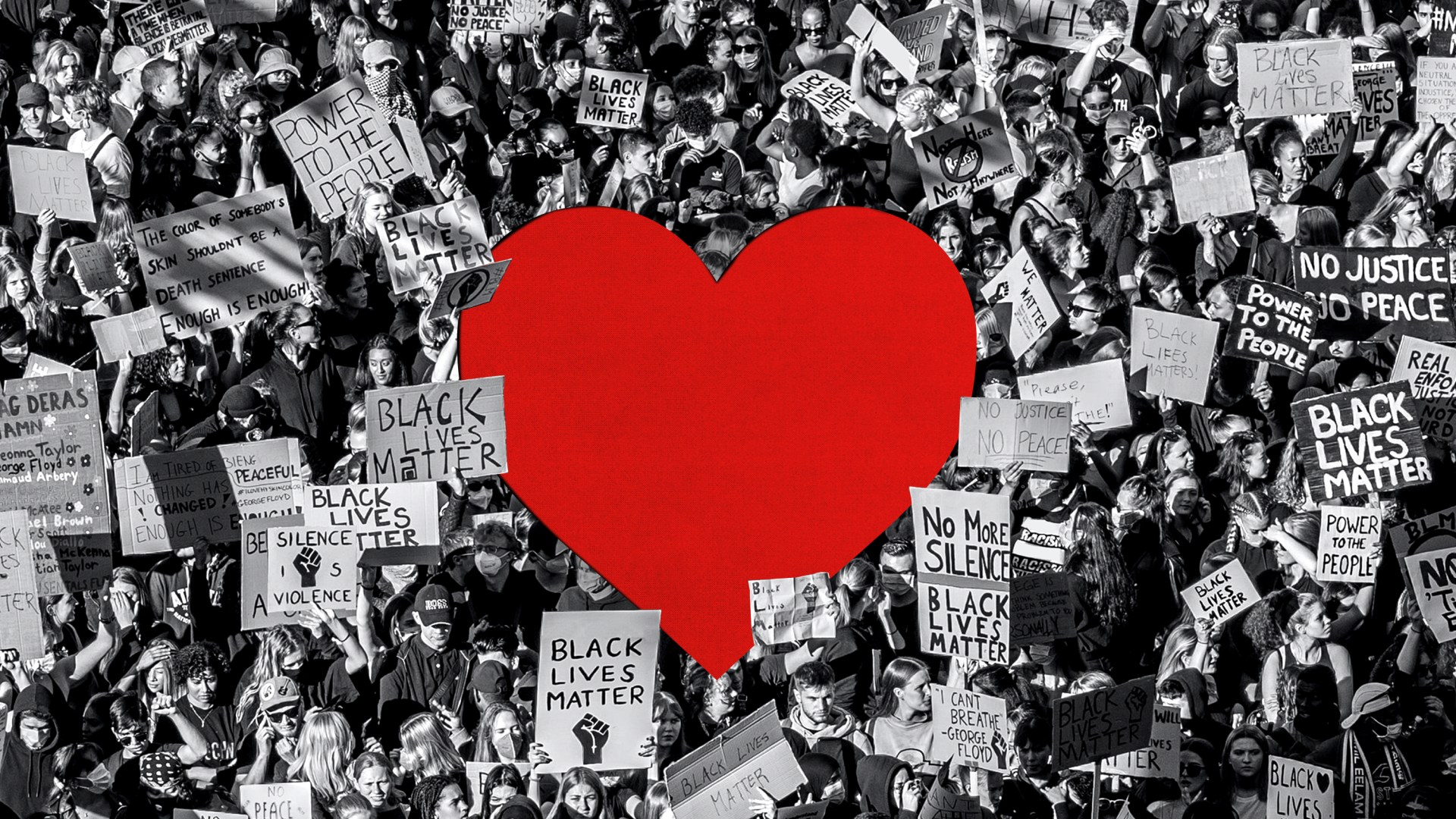
In the August heat of 1965, widespread violence and bloodshed tore through the Watts area of Los Angeles. There were more than 30 deaths. Most of those were perpetrated by the police. There was fire and looting and vandalism.

At the invitation of Black social groups, civil rights leader Martin Luther King Jr. entered Watts. He later described the protests that followed as “disorganized,” though that was a major oversimplification.
“However, a mere condemnation of violence is empty without understanding the daily violence that our society inflicts upon many of its members,” he said. “The violence of poverty and humiliation hurts as intensely as the violence of the club.”
King wrote about his interaction with a couple of young men in the wake of the weeklong eruption that destroyed many Black businesses that had been the heart of the community.
“We won!” King remembers hearing one exclaim.
He looked at the rubble. The ash. The broken buildings. He tallied the dead bodies.
“What does winning look like?” he asked the youth.
The devastation people are experiencing today is like a wall so high none of us can see the sunlight anymore. Businesses are crumbling. Churches are dividing. A pandemic is raging.
“What does winning look like?” King and those with him asked the youth in Watts. And it is a question we must also ask ourselves today.
Today, America as a country is at war with itself. And we aren’t just at war with people of other races, and we aren’t just at war with Christianity; our divide seems to be a tribalism so strong that it is separating people of the same family and origin.
We are living in a country where Americans feel their political affiliation is their greatest form of identity attachment, more than their race or religion, and yet how that political affiliation plays out in their real-life thoughts, attitudes, opinions, and beliefs is not at all a solitary decision. Our groups are shaping us.
For better or for worse, the social group you identify with will make you look more like Jesus or less like Jesus. And one day we will all have to stand before Jesus and be accountable for how we lived here. Did we sow community? Did we create chaos? Did we will the good for the other?
Scripture says, “They are from the world and therefore speak from the viewpoint of the world, and the world listens to them” (1 John 4:5). This single verse almost answers the question Martin Luther King Jr. must have asked himself implicitly before writing his book. “Where are we from?” is typically asked before “Where do we go from here?”
I believe, especially after reading King’s speech “Beyond Vietnam: A Time to Break Silence,” that he would point us as a nation to 1 John 4:7–8: “Dear friends, let us love one another, for love comes from God. Everyone who loves has been born of God and knows God. Whoever does not love does not know God, because God is love.”
The symbol of the Christian is the cross. It is to pick up the burden of our fellow human beings and walk toward the dusty, long road that leads us to the redemptive work that is found within the kingdom of God.
It is a cross that belongs to all nations. It is a cross that has no dominant language. It is a cross that does not belong to a country or a political party or a denomination. The cross belongs to the King of the world on whom all authority has been given both in heaven and on earth (Matt. 28:18). The cross belongs to Christ. And Christ is the unifier of us all.
Heather Thompson Day is an associate professor of communication at Andrews University. Seth Day has served as a pastor and campus chaplain.
This essay was excerpted from I’ll See You Tomorrow: Building Relational Resilience When You Want to Quit by Heather Thompson Day and Seth Day. Copyright 2022 by Heather Thompson Day and Seth Day. Used with permission from Thomas Nelson.