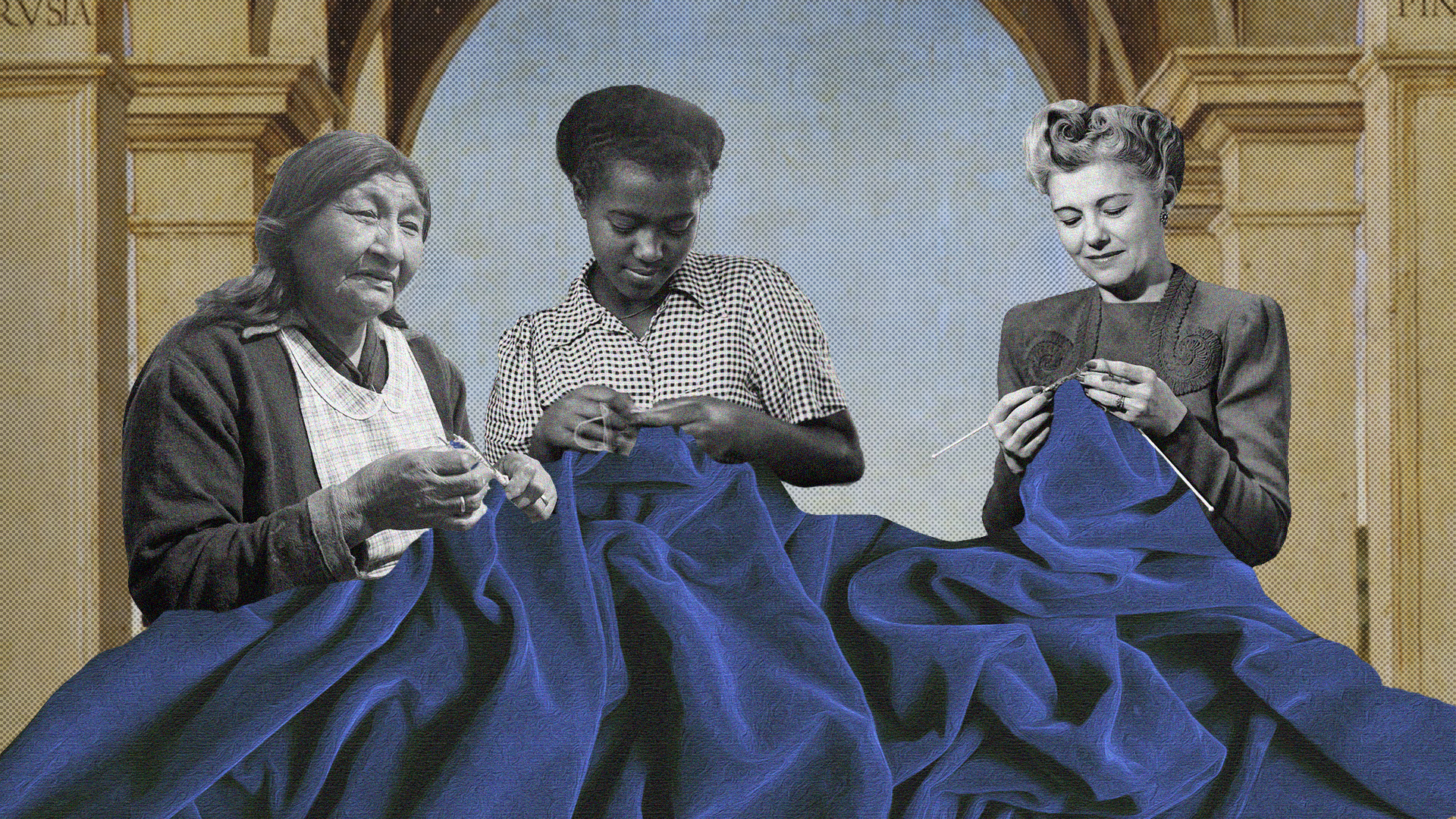
As an angsty young adult and an inexperienced young mother in my 20s and 30s, I used to mock when women’s ministry events featured crafting activities. But now I want to apologize to all the church mothers for poking fun at the knitting, painting, and scrapbooking they wisely incorporated into the community calendar.
If you had asked me a decade ago to consider using an adult coloring book, I would have rolled my eyes. Is this what we think of women? Are we bred to sit still and color prettily? I used to think something like cross-stitching was a waste of time, a slight to women’s mental capabilities, and maybe even an attempt to keep us in our place.
But after several years as a Bible teacher, ministry leader, author, and pastor’s wife, I can now see the value of “crafting for Christ.” While it would be a problem if crafting were the sole activity a church offered for its female disciples, I have come to find that it is a valid way (one of many) for women to connect with God and each other.
I still may not choose a watercolor breakout session at a retreat, but I’m beginning to understand that crafts are not silly; they’re soothing. They’re not solutions to trauma, but they can be opportunities to pursue healing.
In fact, trauma and licensed professional counselors often recommend these kinds of grounding activities for their benefits to our mental health. Even First Lady Michelle Obama has taken up knitting to work through her anxieties. Why? Because they all know the benefits of artistic expression.

On this side of my 40s—after losing my dad to death by suicide, living through a global pandemic, and seeing our polarized country split at the seams—I am ready to embrace all the coloring and calligraphy.
Crafting can be a healthy method of coping with life—which is part of spiritual formation. Working with our hands and doing so in community can lower our anxiety, quiet our minds, open our hearts, and give us calming peace. And bonus: It’s fun.
This got me thinking about several biblical examples of God-fearing people who used their hands in similar ways.
I wonder if Noah’s ark building helped him process the consuming corruption of his generation—along with the justified yet terrifying judgment of God to destroy the wicked by flooding the earth. Did it help Noah to have something to work on every day as he anticipated God’s consequences for sin? Was it gratifying to see his three-story ark take shape as the culture around him was falling apart because of its evil (Gen. 6)?
Maybe Moses’ mother’s basket coating helped her process the fear and grief of having to send away her three-month-old baby to save his life. I imagine making his mini ark would have been a welcome opportunity to “do something” in a time of profound helplessness. Did she pray to Yahweh with every dip into the tar? I wonder if she ever weaved or repaired other baskets and if she thought of Moses and his miraculous rescue every time (Ex. 2:1–10).
Moses’ mom is not the only skilled craftsman in the Book of Exodus. Much of the rest of the book details the Lord’s instructions for God’s people to be all-hands-on-deck for the building of the tabernacle. The Scriptures make a point to say the Lord gave the skilled workers the ability to create all the items required for the tabernacle, tent of meeting, and ark of the covenant, as well as the sacred garments for the priests (Ex. 25–31). It must have been tedious but gratifying work to fulfill the Lord’s requests and create the place to commune with God and his people.
Bezalel was one of the skilled craftsmen from the tribe of Judah that was filled with the Spirit of God, granting him the ability to create intricate designs using materials like gold, silver, bronze, stones, and wood. Did Bezalel feel more connected to God as he looked around to observe his own handiwork (Ex. 31)?
Perhaps the physically demanding labor of piling up heavy stones of remembrance helped Joshua and his people tangibly celebrate God’s faithfulness toward them. Like Stonehenge, these memorial works of art were built to last for hundreds of years—so that future generations of Israelites could testify to God’s powerful help in times of trouble (Josh. 4).
While it might be a bit of a stretch to call building an ark, stacking rocks, and coating a basket crafting, Scripture is full of examples of God’s people involving their hands in their spiritual formation. Their tactile participation shaped their faith as much as their projects.
Our church mothers knew we wouldn’t be the only ones to benefit when we craft—the recipients of our creations gain too. Crafting isn’t just for the person creating; it almost always involves supporting others.
My friend Andrea Gibson, a women’s minister and crafting educator, always creates a purpose behind each craft. Whether the members of her church are bagging baking ingredients to support working moms, knitting blankets for cancer patients, or quilting for the homeless shelter, their crafts serve a godly purpose.
Rebecca Carrell, another friend of mine, is a professor at Dallas Seminary and an exceptional communicator. She took up knitting during the leadership team meetings at church and intentionally used that time to pray over the recipients of her work.
These modern women remind me of Dorcas or Tabitha in the New Testament, a resurrected disciple of Christ, who made robes and clothes for widows (Acts 9:36–41). Dorcas’s textile craftsmanship blessed so many needy women in her community, but I wonder if it also served another purpose: Did it quiet her overstimulated mind or help her focus her attention instead of letting her mind race?
One of the most accurate descriptions of Jesus’ vocation is that of a “constructive craftsman,” like his father before him. For most of his life, he supported himself and his family financially by working with materials like wood and stone to build, shape, and construct.
But I wonder if he continued his craft in some way during his three years of preaching and healing. Did Jesus ever turn to a physical project during stressful times of ministry? Was there ever a time when he busied himself grinding stone or nailing wood as he prepared for the Cross?
We can’t know for sure, but it is worth remembering that Jesus spent much of his time on earth as a humble craftsman who worked with his hands.
If crafting was good enough for Jesus, it’s good enough for us. Church mothers, knit on.
Kat Armstrong is a Bible teacher and the author of No More Holding Back, The In-Between Place, and a six-book Bible study series, the Storyline Project. She will also be the host of a new CT Media podcast entitled Holy Curiosity, which launches in January 2024.