At the time, 1980 did not seem like a great year to launch a new professional sports franchise. Interest rates were high. The Iranian hostage crisis dominated national attention. A presidential election loomed. There was a general feeling of pessimism and uncertainty for many Americans.
But Norm Sonju had a vision—inspired by God, perhaps, but also from data and market analysis that showed Dallas had untapped potential as a National Basketball Association (NBA) city.
For two years, Sonju had worked to make his dream a reality. Now, in 1980, when his plans looked like they might be crumbling, he turned to two Bible verses he had learned from his mother as a child: “Call to me and I will answer you and tell you great and unsearchable things you do not know” (Jer. 33:3), and “Neither height nor depth, nor anything else in all creation, will be able to separate us from the love of God that is in Christ Jesus our Lord” (Rom. 8:39).
“The truth of God’s Word made such a difference in my attitude in those hectic days of starting the franchise,” Sonju would write a decade later. “I knew that God was in control even when things looked hopeless.”
Sonju’s Christian faith was more than a source of comfort. It was the central force behind his efforts to bring the NBA to Dallas, fueling his hopes for what the team could become and providing the point of connection with the owner who had the money to animate his vision.
These days, Christian athletes seem to be everywhere in professional sports: kneeling in prayer, pointing to the sky, writing Scripture on their shoes, thanking God from the podium and in front of television cameras.
But the origin of the Dallas Mavericks was not just an effort to create and build an NBA franchise that included Christian players. It was also an effort guided by Christian values.

The son of Norwegian immigrants, Sonju grew up in Chicago before enrolling at Grinnell College in Iowa. Though he played on the basketball team, his role as a bench player indicated that pro sports were not in his future—at least as an athlete.
After graduating in 1960, Sonju made his way back home. He earned an MBA from the University of Chicago, got involved with Campus Crusade for Christ (now known as Cru), and took a role as an executive with ServiceMaster, a company founded by Marion Wade and shaped by an evangelical ethos centered on “service to the master.”
As Sonju learned how to infuse his faith with his role as an executive, his love for basketball continued. He developed friendships with NBA players Don Nelson and Paul Neumann, and with legendary basketball coach and pioneering civil rights advocate John McLendon.
He also befriended two NBA executives who shared his evangelical faith: Jerry Colangelo, who worked for the Chicago Bulls from 1966 to 1968 before departing to lead the Phoenix Suns, and Pat Williams, who served as the Bulls’ general manager from 1969 to 1973 before moving on to a long career with Atlanta, Philadelphia, and Orlando.
These connections put Sonju on the inside of two emerging sports institutions. First was a growing evangelical subculture in sports, the “Christian athlete movement,” a network of ministries like the Fellowship of Christian Athletes, Athletes in Action, Pro Athletes Outreach, and Baseball Chapel that established team chapels, Bible studies, and off-season retreats in college and pro sports.
Second was the NBA. Although professional basketball trailed behind baseball and football in popularity throughout the 1970s—limited, in part, by a racial backlash from white fans who complained about a league in which over 70 percent of the players were African Americans—the potential for growth was present. In 1977, when Sonju was hired to run the Buffalo Braves (thanks to Colangelo’s recommendation), he was uniquely positioned to merge his passions for Jesus, basketball, and business.
“I find the teachings of the Scriptures applicable every day in business, even basketball,” he told reporters during his first year on the job.
Sonju spent that year overseeing Buffalo’s move to a new city. When the team ended up in San Diego, changing their name to the Clippers, Sonju did not join them. In the search process, he fell in love with Dallas’s potential as an NBA market. Sonju settled in the city in 1978 with the goal of bringing an expansion franchise to the city.
To get a team in Dallas, however, Sonju needed money. He found it in Donald J. Carter.
The son of Mary Crowley, an evangelical businesswoman who built Home Interior and Gifts into a direct-sales empire and served on the board of Billy Graham’s association, Carter made his fortune by investing in and managing his mother’s business. He followed his mother’s Southern Baptist faith too, attending Dallas’s First Baptist Church and supporting evangelical ministries.
He had no interest in basketball until he was introduced to Sonju by his pastor, W. A. Criswell. At first, Carter was suspicious. Sonju was efficient and practical, a buttoned-up business executive trained in the latest corporate strategies. Carter, whose ten-gallon cowboy hat became a fixture at Mavericks games, was more of a risk-taker with an intuitive mindset, attributing his success more to his heart than his head.
Carter often framed these differences in regional terms. “He’s a Yankee,” Carter said of Sonju. “You can’t make a real down-home person out of a Yankee overnight.” Yet the two bonded over their shared goal: to build an NBA team shaped by their evangelical faith and cultural values.
It was a vision that had political resonance. White evangelical voters at the time were mobilizing around Ronald Reagan’s presidential campaign, inspired by his support for conservative family values and his description of the United States as a “shining city on a hill” for the world to follow.
Sonju and Carter saw their team, too, as a model for others to emulate.
“What an example we could set for the NBA and our country if we had a brand-new, clean model that worked just right,” Sonju told Sports Illustrated. “Dallas is football country, but it’s also Bible Belt country. We can win the respect of the people with wholesomeness and goodness and respect for God and country.”
In April 1980, the NBA awarded the duo their franchise. In October 1980, two weeks before Reagan’s election, the team began to play.
As Sonju and Carter embarked on their project, they spoke of putting together a “team full of Roger Staubachs.” The star quarterback for the Dallas Cowboys, though a Catholic, was a strong supporter of the Fellowship of Christian Athletes and a prominent cultural symbol representing conservative moral values.
But while baseball and football had developed a cohesive network of outspoken Christian athletes like Staubach, the NBA lagged behind. There were Christians in the league, but they were not organized as part of a movement, and evangelical sports ministries did not have a strong presence. This was due in part to the disconnect between a predominantly Black league and a Christian athlete movement led primarily by white evangelicals.
Recognizing that he could not simply fill out a roster with Christian players, Sonju thought strategically. He was especially excited about his first player acquisition after the expansion draft: the signing of Ralph Drollinger. The seven-footer had been a back-up center for UCLA in the 1970s before turning down opportunities in the NBA to play for Athletes in Action (AIA), an evangelistic basketball team sponsored by Campus Crusade for Christ.
In 1980, however, Drollinger decided the time had come to make his move to the NBA. Sonju outbid other teams with a guaranteed contract of $400,000. He knew Drollinger would not be a star player, but he thought the center could be a leader within the team while helping to galvanize the evangelical movement in the league.
Drollinger would later recall that the Mavericks “told me they were going to be the first Christian team in the NBA.” A young reporter in Dallas named Skip Bayless also took note, wondering if “you had to be a born-again Boy Scout” to join the Mavericks roster. “These guys can speak at First Baptist, but can they play?” he asked.
In Drollinger’s case, the answer was no. His NBA career lasted six games and featured more personal fouls than points scored. He also turned out to be a liability instead of a leader within the locker room. “It was one of the worst mistakes of my career,” Sonju later said, and a reminder that born-again players did not necessarily lead to on-court success. (In the 1990s, Drollinger went on to become a controversial right-wing political activist. Drollinger later disputed this characterization in a May 3 email.) In fact, in the team’s very first game, it was Abdul Jeelani, a Muslim player, who scored the first points in franchise history.
Still, there were other ways to shape the team’s culture and to present an image linked with evangelical Christianity. Sonju hired former AIA staff members like Paul Phipps to work in the front office, recruited girls from a local chapter of Campus Crusade for Christ to serve as ushers, and led Bible studies for his staff. He invited Dallas pastor Tony Evans—early in his long and influential career in ministry—to serve as a team chaplain.
Sonju also implemented a pre-game ritual unique to Dallas. Instead of the national anthem, Sonju had “God Bless America” played at home games, and he insisted that players stand at attention during the song, “arms straight, no gum chewing,” presenting an image, in his mind, of unity and respect.
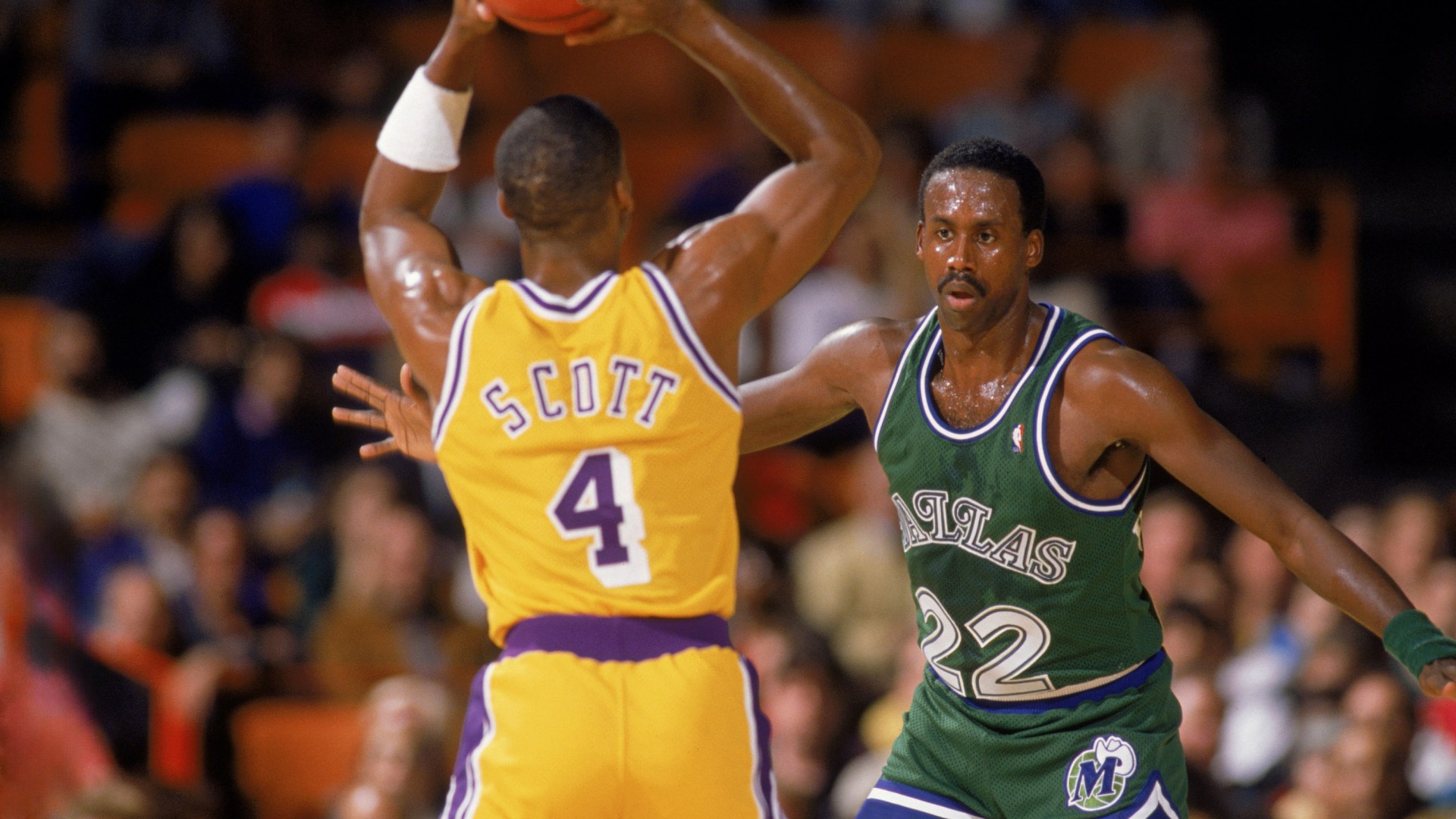
With their focus on building a positive culture and cultivating a family-friendly environment, Sonju and Carter found a winning formula that attracted fans. Led by players like Rolando Blackman, Mark Aguirre, and Derek Harper, the Mavericks’ record gradually improved each year, culminating in five straight playoff appearances between 1983 and 1988.
“I think the reason that franchise has done so well,” former staff member Paul Phipps said in 1984, “is because they had a lot of people who wanted to honor God in what they did. And God honored their effort.”
But while some Dallas locals took to calling the team the “First Baptist Mavs,” and a local magazine described the Mavericks as “the most Christian-influenced organization in pro sports,” the team’s religious reputation did not receive widespread national attention.
In an era dominated by the Lakers’ Magic Johnson, the Celtics’ Larry Bird, and the rise of Michael Jordan, Dallas could not break through on the big stage. By 1996, when Carter sold the team and Sonju retired, Dallas had not become the NBA “city on a hill” that they had envisioned.
But their efforts were not in vain. As Carter and Sonju brought their personal Christian faith into the work of building an NBA franchise, however imperfectly, they learned to adapt to the pluralistic culture of sports. And by creating a shared Dallas cultural institution for fans of all faith traditions to enjoy, they offered a testimony and witness of its own.
Paul Putz is assistant director of the Faith & Sports Institute at Baylor’s Truett Seminary and author of the forthcoming book The Spirit of the Game: American Christianity and Big-Time Sports.