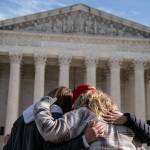
The United States Supreme Court ruled Friday that parents of public-school children in Montgomery County, Maryland, have a right to opt their kids out of classroom reading times with books the school board labels as LGBTQ inclusive.
These books were introduced as part of a new curriculum in 2022 that included more than 20 new inclusivity books for pre-K through eighth-grade students. They promote storylines that teach gender is more a construct than a biological fact.
Some examples of books that may be read to students include Pride Puppy about a dog lost at a Pride parade or Uncle Bobby’s Wedding in which Bobby’s niece is confused by her uncle’s marriage to a man, but her mother “corrects” her.
The school board’s opt-out option for students was discontinued a year after the curriculum was introduced, leading a coalition of more than 300 Christian, Muslim and Jewish parents to file a lawsuit known as Mahmoud v. Taylor. Tamer Mahmoud, the petitioner in the case, is a Muslim Montgomery County parent, while the defendant in the case is Thomas Taylor, Montgomery County superintendent.
The coalition of parents claimed the board reversed decades of policy when it withdrew a previous commitment to tell parents when such curricula would be included and to allow parents to opt their children out of instruction at those times.
The school board said allowing parents to opt out became too burdensome and that discontinuing the practice was not a violation of the parents’ religious freedom. This argument prevailed in two lower courts.


The Supreme Court’s 6-3 decision conversely sided with the parents, granting them a preliminary injunction and restoring their right to opt their children out of these storybook times.
The decision states that the school board’s introduction of the inclusivity books, their decision to withhold notice from parents and then forbid opting out of the program “substantially interferes with the religious development of petitioners’ children.”
The decision agreed with the argument of the parents that the school board’s policies “unconstitutionally burden their religious exercise.” It recognized that one of the most important religious acts for people of faith is the religious education of their children, and this practice of religious education receives a “generous” amount of constitutional protection.
The High Court rejected school board’s description of the books as merely “exposure to objectionable ideas” or as lessons in “mutual respect.”
The Court said the storybooks “unmistakably convey a particular viewpoint about same-sex marriage and gender.” The books are designed to present certain values and beliefs as things to be celebrated, and certain contrary values and beliefs as things to be rejected.
Additionally, the Board specifically encouraged teachers to reinforce this viewpoint and to reprimand any students who disagree.
The Court further rejected the school board’s assertion that parents are free to place their children in a private school or educate them at home if they disapprove of what is being taught.
The decision explains public education is a public benefit, and the government cannot “condition its availability.”
The opinion of the Court was delivered by Justice Alito. Justice Sotomayor filed a dissenting opinion and was joined by Justices Kagan and Jackson.


“I’m encouraged by the Court’s ruling today to protect the rights of parents to raise their children according to their deeply held convictions, even as they are educated in public schools,” said Brent Leatherwood, president of the Southern Baptist Ethics & Religious Liberty Commission (ERLC).
“As the primary teachers of their home, parents should have the right to opt their children out of curriculum that actively undermines their religious convictions regarding marriage, family, gender, and sexuality. Religious families should be accommodated so that parents do not have to worry that their children will be indoctrinated in an educational setting.”
ERLC was among 10 faith groups siding with the parents in an amicus brief submitted in March … Other faith groups joining the ERLC in the brief include The Church of Jesus Christ of Latter-day Saints, the U.S. Conference of Catholic Bishops, the General Conference of Seventh-day Adventists, the Anglican Church in North America and the Jewish Coalition for Religious Liberty.
Also supporting the parents in amicus briefs were US Acting Solicitor General Sarah M. Harris, attorneys general from 26 states, 66 members of Congress, 35 members of the Maryland Legislature, as well as legal scholars, historians and others.

Oral arguments in the case were held April 22. In the hearing spanning more than two hours, the liberal justices considered the question of whether removing unwanted books in the school system was a local issue while Alito spotlighted a concern that the books contain a “clear” message that some may agree with but many religious people definitively do not agree with.
Leatherwood identified after the oral arguments that the conservative wing of justices seemed skeptical of the school board’s arguments, ultimately leading to the High Court’s majority decision backing the parents.
“Schools are for education — not indoctrination,” Leatherwood said. “The case before the court is a straightforward one. Parents, as the primary stewards of their children, have a right to shield their children from radical gender ideology material that burdens their religious exercise.”