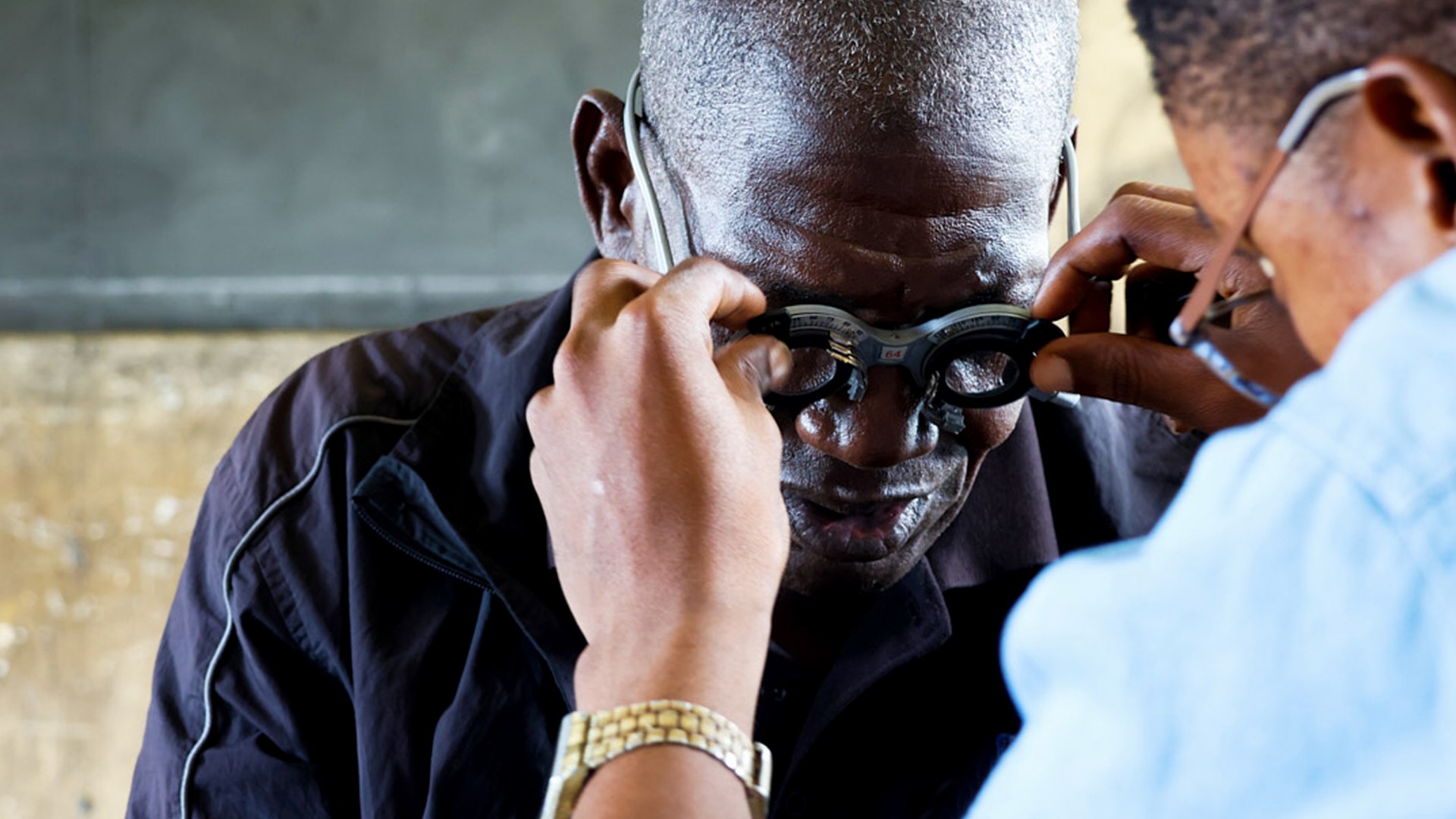
When a friend pointed out a white spot in Onjefu Agbo’s eye, he knew he’d have to pay for treatment himself. Barely able to see out of his left eye, Agbo sought care at several facilities that couldn’t identify the problem before doctors at Meserat Defar Eye Clinic in Ikeja, Lagos state, Nigeria, diagnosed him with an advanced cataract.
They recommended a surgery costing 75,000 naira (about $49 USD). Agbo earned only 15,000 naira (about $10 USD) monthly at the time: “I was at a loss on where to get that kind of money, having spent a lot to get the diagnosis.”
While visiting his parents in Jos, Plateau state, Agbo heard a radio ad about an annual outreach at Vom Christian Hospital offering the procedure for free. He traveled 30 minutes by public transportation to the hospital, where doctors conducted new tests, then removed Agbo’s cataract and implanted an artificial lens.
“Life would have been better if government facilities are as responsive as these faith-based organizations are,” he said.
Agbo was not unusual in finding it hard to get adequate medical attention in Nigeria. Public hospitals in Nigeria bustle like markets, with consulting areas so full waiting people have to stand. A 2022 study showed Nigeria’s emergency hospital bed capacity stood at 0.9 beds per 1,000 people, less than half the global average.
Within the broken infrastructure, less than 5 percent of Nigerians have public health insurance, and 70 percent pay for their health care out-of-pocket. According to the World Health Organization, Nigeria should have 237,000 doctors but only has 35,000 for a population of over 200 million. And like Kenya, Nigeria is hemorrhaging medical staff to emigration.
Christian hospitals and ministries are trying to fill health care gaps. An Evangelical Church of West Africa (ECWA) Evangel hospital in Jos—known locally as Jankwano, meaning “red roof”—offers free surgeries for patients with vesicovaginal fistula—a condition that’s rare among women in developed countries but is a public health concern in developing nations such as Nigeria.
Emmanuel Adewara—the senior pastor of First Baptist Church in Kubwa, Abuja—said his church organizes a medical outreach every July and has a sick bay for treating common ailments such as malaria and typhoid. When Nigerians can’t afford care, Adewara warned, some turn to dangerous practices.
Some turn to cheaper traditional herbal remedies, but without proper dosages they may complicate rather than heal what started as minor ailments. Others turn to pastoral prayer rather than going to the hospital.
“We believe in supernatural healing.” Adewara said. “We believe in divine health. We do all those as a church. But we still have great commitment to orthodox medicine, which we encourage people to do.”
Some Nigerians have also fallen back on faith healers, putting themselves at risk of exploitation. The country has seen several cases of fraudulent pastors bribing people to fake healings during services. Some HIV patients may have died after pastors told them to stop taking antiretroviral drugs.
Meanwhile, the death of former Nigerian president Muhammadu Buhari made headlines beyond usual obituary coverage because of the location of his passing: an elite hospital in the United Kingdom on July 13. The London Clinic—where Buhari died after falling ill during a routine visit—boasts private luxury rooms with dressing gowns and spa products.
All that did not help Buhari. It did help Abdulsalami Abubakar—the former military head of state who helped transition Nigeria from military to democratic rule in 1999—who admitted he once received treatment there. Both clergy and journalists, such as Onjefu Agbo, lamented that public officials and wealthy private citizens seek treatment abroad instead of improving Nigeria’s health care system.
An article in one scholarly journal, Health Policy and Planning, indicated that reforms achieved limited success because “senior politicians did not spend political capital to ensure fundamental institutional reforms.”
Reforms could have helped Adesuwa Osunde last year when a public hospital in Abuja couldn’t finish her three children’s eye and dental exams because there were too many patients.She took them back the next day, but by the time a doctor finished their exams and prescribed the right follow-up tests, the lab had closed for the day.
“These people don’t care about us. If they did, at least they would make hospitals work,” Osunde said. If reforms continue to lag, she worries next time could be worse: “What if there is an emergency?”