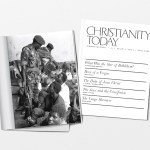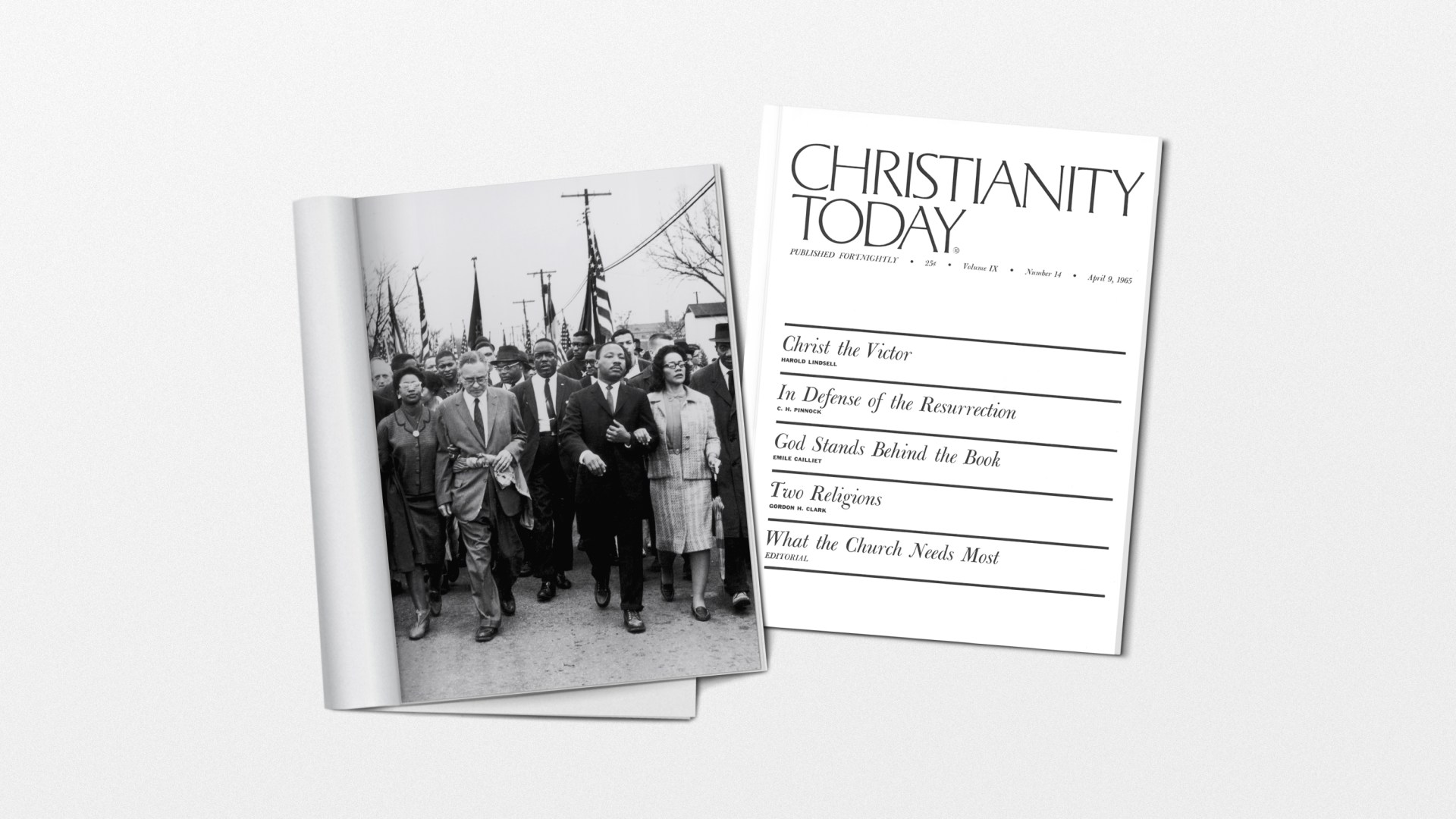
The passage of President Lyndon Johnson’s landmark civil rights bill did not end Black Americans’ struggle for civil rights. In 1965, Martin Luther King Jr. led a march from Selma to Montgomery, Alabama, to demand the right to vote. CT’s news editor reported from the scene:
It was a varied multitude—young and old, white and black, educated and uneducated, a few beatnik types, and ministers in clerical garb. … Some in the line carried American and U. N. flags. The overall spirit was cheerful; disaffection was not noticeable and the torrential rains on the third day elevated, rather than depressed, morale.
Among those in line was a one-legged young man on crutches, two nuns, a number of clergymen, and numerous women and children. … The group developed a warm feeling of friendship and unity. Meetings were held at the campsite in the evenings, and occasional hymns added a devotional tone.
A Negro Methodist minister said that the march represented the American melting pot. He saw it as an expression of concern for constitutional rights. The ultimate solution, he declared, lies in the grace of God. He recognized the historic manifestation of grace at the Cross, yet felt it was being silently proclaimed at the march. …
Theological conservatives participated in the march. … The extent of evangelical involvement is believed to have been without precedent in the current civil rights movement. Never before have conservative Protestants identified themselves so demonstratively with the Negro struggle for liberty.
The unifying factor in the midst of the theological and social diversity was clearly the constitutional issue—protest against abridgment of the right to vote and peaceable assembly to petition the government for redress of grievances.
King called for clergy across the country to join the march. CT surveyed religious leaders’ responses and reported the views of white ministers in Selma. The magazine noted the political issue was intense enough to divide churches and denominations.
The race problem in the United States, which promises little let-up in the months and years to come, may ultimately cause some major ecclesiastical realignments. It is already registering a serious impact. … This spring saw several such disputes erupt into open dissension. …
In Savannah, Georgia, the congregation of St. John’s Episcopal Church voted, 700 to 45, to withdraw from the Protestant Episcopal Church rather than admit Negroes to its regular worship services. Balloting was held at a meeting during which the Rev. Ernest Risley, rector, said he was renouncing the ministry. …
In Texas, Dr. K. Owen White resigned as pastor of the 3,600-member First Baptist Church of Houston to take an executive post with the Southern Baptist General Convention of California. Just prior to the announcement of his resignation, the congregation voted 206 to 182 not to accept Negro members. White, past president of the Southern Baptist Convention, said he was disappointed in the outcome of the vote but insisted that it was not a factor in his leaving.
Billy Graham went to Alabama in 1965 to hold an evangelism crusade. The event was integrated, but Graham made it clear he wasn’t going to focus on civil rights.
Graham announced at the outset that he had come, not to preach about racial problems, but to “preach the same Gospel I have preached all over the world.”
But he did indicate that outside his public meetings he wanted to talk with leaders of both races about the problems that have recently brought the state to the world’s attention. Graham told a reporter: “It is wrong for people in other parts of the country to point an accusing self-righteous finger at Alabama. To single out one state as a whipping boy often becomes just a diversion to direct attention from other areas where the problem is just as acute.”
Still some Alabamans accused him of coming “as President Johnson’s personal ambassador to soothe the feelings which Martin Luther King has ruffled.” …
Despite rampant rumors that preceded the opening meeting on Saturday night, April 24—including one of a bomb threat—Rip Hewes Stadium was half-filled with 5,500. The choir of 400 voices, about half Negro, sang with George Beverly Shea, and when Graham arose to speak all feelings of tension vanished as the presence of God was felt in the stadium. In response to the invitation, almost 250 of both races stood shoulder to shoulder in front of the platform to register decisions for Jesus Christ.
Christians were also concerned about changing sexual ethics in America. In 1965, CT published pieces on rising divorce rates, the “tide of obscenity,” and a syphilis epidemic in more than two dozen major metropolitan areas. Editor in chief Carl F. H. Henry said it was “A Time for Moral Indignation.”
What America’s present moral situation requires even more than laws and their enforcement is the arousal of a tidal wave of righteous moral indignation against a wanton exploitation of sex. There are signs that such an indignation is smoldering beneath the surface. Every American dedicated to common decency must become morally indignant and let this indignation burn righteously in an articulate protest against an exploitation of sex that is unparalleled in the history of the world. Never before in human civilization has sex been so pervasively prostituted to financial gain, for the technological possibilities were not present until our time. Public opinion is still a powerful force for public righteousness. It can outshout all the sounds of modern communication if it finds its voice and in moral indignation lifts it high.
The millions of Christians in America have a special duty. They know that when anything becomes a national idol, it is because God has first been displaced and his moral law set aside. The final resolution lies with God, who alone can give purity of heart. But until such a time, Christians are summoned to reflect his holy wrath against every unclean thing.
CT editors also commented on the philosophy of the popular pornographic magazine Playboy.
Now and then we read Playboy—not often, confessedly, but when Hugh Hefner, its editor, occasionally sends a copy hoping Christianity Today will debate his philosophy of sex. ….
The “new morality” asserts that love alone justifies intercourse and that, if two persons intend to marry, love is the only other precondition for sex relations. Christianity does not say “No” to sex; it says “Yes” on the basis of divine creation. But it says “No” to premarital sex on the basis of divine commandment. The Christian view is that sex relations are legitimate only within the marital institution. …
The Christian emphasis on personal love in the very nature of God and on Christ’s love for his bride carries an implicit protest against the discounting of agape in the sexual life of the modern world. Our confused generation has lost the profoundly Christian meaning both of monogamous marriage and of love.
The magazine informed readers of developments in liberal Protestant theology, including the death of theologian Albert Schweitzer, the success of an Anglican bishop’s book advocating “secular theology,” and the emergence of a group of Americans proclaiming the “death of God.”
Can it be that the “death of God” writers have fallen into the trap (so common to purveyors of intellectual abstractions) of assuming that most people see the same and the only reality that they themselves see?
If the “death of God” position is, as seems most plausible, that God has died because men no longer find him believable or useful, then it must follow that God never really lived except in the imaginations of men. Apparently, these men are saying, not that God has died, but that he never really had an independent existence. These theologians never say outright that there is no transcendent, independently existing God. Rather, the essence of their argument seems to be that we cannot know or comprehend God because of our limited perceptual, cognitive, and intellectual abilities. …
What if they had made different assumptions or accepted the validity of different kinds of data or asked different questions?
Evangelicals were worried about orthodox Christian scholarship. CT polled the members of the Evangelical Theological Society and found “wide gaps” in contemporary research.
The element missing in much evangelical theological writing is an air of exciting relevance. The problem is not that biblical theology is outdated; it is rather that some of its expositors seem out of touch with the frontiers of doubt in our day. Theology textbooks a half century old sometimes offer more solid content than the more recent tracts-for-the-times, but it is to the credit of some contemporary theologians that they preserve a spirit of theological excitement and fresh relevance. Evangelicals need to overcome any impression that they are merely retooling the past and repeating clichés. If Bible reading has undergone a revolution through the preparation of new translations in the idiom of the decade, the theology classroom in many conservative institutions needs to expound the enduring truths in the setting and language of the times. Unless we speak to our generation in a compelling idiom, meshing the great theological concerns with current modes of thought and critical problems of the day, we shall speak only to ourselves.
Internationally, CT reported on India and Pakistan’s war over Kashmir, checking on the Christians caught in the middle.
From Dr. Kenneth Scott, director of the Christian Medical College and Hospital in Ludhiana, India, came a cable: “Everyone fine. All remaining in Ludhiana. Psalm 68:19.” The Scripture cited reads, “Blessed be the Lord, who daily bears us up; God is our salvation.”
No missionary evacuations were reported. Korula Jacobs, secretary of the National Christian Council in India, said that more than sixty American missionaries were staying put on the plain of Punjab, where the fighting was concentrated. …
The most extensive damage to church property appeared to be suffered by the Anglican cathedral at Ambala, India. It was struck by bombs from a Pakistani B-57 (American-made) jet. Observers indicated the building was a victim of its geographical location—a quarter-mile from an air force base.
Another ongoing Asian conflict grabbed headlines. The US government decided to send combat troops into the long-running war in Vietnam. CT reported that evangelical missionaries planned to keep ministering despite the increased danger of an escalating conflict.
As the hot jungle war of Viet Nam grows bloodier, missionaries with ears attuned to the cacophony of gunfire do their job but keep their bags packed. …
The Christian and Missionary Alliance’s 100 missionaries have had an emergency retreat plan ready for ten years but don’t expect to use it, reports the Rev. Louis L. King, the denomination’s foreign secretary. “We have known since February that the situation would become almost intolerably bad through October and have planned on it,” he said. Alliance workers, who once covered the countryside, are now specializing in city work, as symbolized by three new churches being built in Saigon. King said the war has meant more people listen to the Gospel more seriously.
When U. S. government dependents were sent home in February, officials asked Alliance workers to pull out but weren’t successful. King said Alliance policy is to leave only when the U. S. diplomatic corps does. If a withdrawal comes, he said, a strong indigenous church will remain with 350 pastors and 65,000 laymen who operate now without American money.
A second major group in Viet Nam, Wycliffe Bible Translators, has also withdrawn into defended villages in the past year. But it has taken natives along to speak the tribal languages so that the work of translating the Bible into these tongues can go on. The organization has forty-four persons assigned to Viet Nam, of whom nineteen are on furlough. All Wycliffe teams are “within the sound of gunfire,” said Dr. Richard Pittman, director of work in Asia. But there have been no casualties since two men and a baby were killed in 1963. Pittman said Wycliffe follows American and Vietnamese military advice on where to locate.
Evangelicals in America were not quite as prepared. The war in Vietnam would dominate politics for the next decade.