The following books were selected by Nathanael Somanathan, deputy principal at Colombo Theological Seminary in Sri Lanka.
South Asia’s missional memory reaches as far back as the first century, when the apostle Thomas is believed to have traveled to India and possibly even farther, establishing a church in the northern part of Sri Lanka. However, the verifiable history of missions in South Asia began in the 16th century alongside colonization, when Franciscan and Dominican missionaries first arrived in India, followed by the Jesuits. It was not until the 18th and 19th centuries that the Protestant missions movement emerged, particularly with Dutch colonization in places like Sri Lanka.
Today, the subcontinent is home to paradoxes, syncretisms, and layers of diversity. Religion and culture within countries like India, Pakistan, Bangladesh, Nepal, Bhutan, and Sri Lanka are so deeply intertwined that Christian mission in the region has been both challenging and creative.
Yet Christianity has managed to thrive in its own ways, producing a church that has persevered through persecution and enriched itself through the theological and philosophical wealth of its own resources. Here are some books that showcase this.
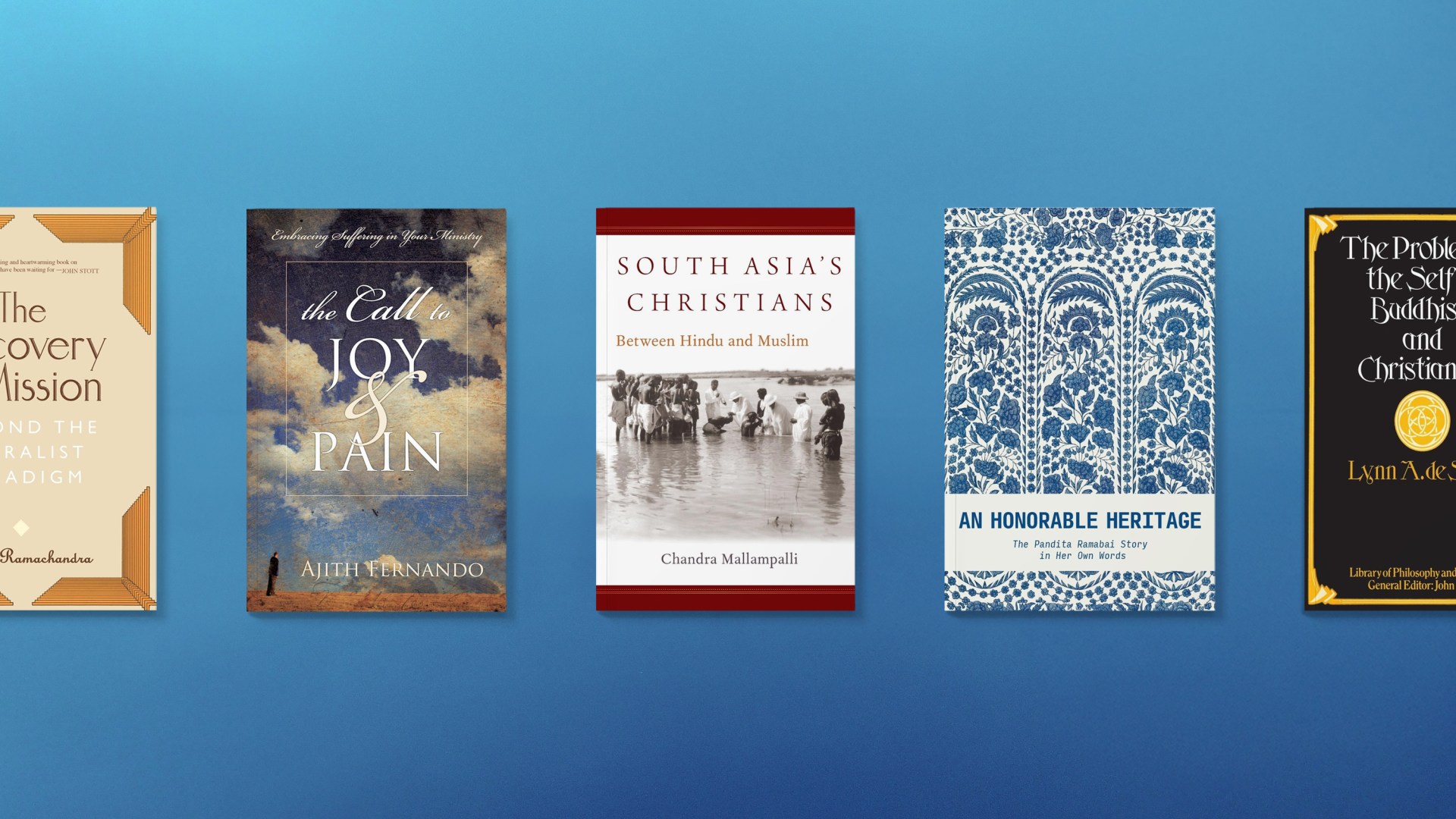
South Asia’s Christians: Between Hindu and Muslim by Chandra Mallampalli
A ubiquitous narrative in world Christianity studies today is that the faith is rapidly expanding in the Global South and that the center of gravity in the Christian faith has consequently shifted from North America and Europe to regions such as Africa, Asia, and Latin America. However, studies often overlook a large sector of this new demographic: South Asia.
In this recent monograph, historian Chandra Mallampalli, a second-generation American born to immigrant Indian parents, sheds light on why this is the case. The preoccupation with numerical growth within world Christianity studies has obscured “vital lessons about interreligious encounters and the experiences of marginal people” within South Asia, he argues.
Mallampalli’s historiography focuses particularly on Indian believers whose stories are profoundly shaped by the Hindu and Muslim environments they live in. He weaves a compelling narrative of Indian Christian identities that often exist as religious minorities on the fringes of society. The book covers an impressive range of Christian groups across nearly two millennia, leaving the reader inspired by a Christianity that may not have triumphed in numbers but certainly has in spirit and witness.
The Call to Joy and Pain: Embracing Suffering in Your Ministry by Ajith Fernando
Prominent Sri Lankan theologian Ajith Fernando responds to a common misconception that Christians must not suffer, especially in ministry. Drawing from his experiences as Youth for Christ’s former national director for more than three decades and how he navigated several ministry crises, Fernando relates the themes of suffering and pain to lament, gospel witness, and discipleship. He encourages readers to embrace hardship without losing the joy of serving God.
This book is an encouragement for people on the verge of burnout as they struggle with ministry life, marked by euphoric mountaintop experiences and dark, difficult valleys. Fernando’s thesis can be summarized in this quote: “Something is seriously wrong not when Christians suffer but when they do not have the joy of the Lord.”
The Recovery of Mission: Beyond the Pluralist Paradigm by Vinoth Ramachandra
This 1996 book remains a seminal contribution to mission studies. Ramachandra wrote it as a response to a widespread debate in the field at the time on whether all religious traditions offer a path to salvation and whether interfaith dialogue and cooperation in social work could replace a traditional understanding of mission as evangelization.
The effectiveness of Ramachandra’s critique of pluralism, represented by three of its most influential proponents—Stanley Samartha, Raimundo Panikkar, and Aloysius Pieris—lies in the fact that Ramachandra is an Asian theologian who lives in Sri Lanka and offers insights shaped by this local missional context.
Ramachandra draws on Lesslie Newbigin’s paradigm of mission—namely, the gospel as public truth in a pluralist society—and focuses on the “scandal” of the person and work of Jesus. Throughout, he emphasizes the incarnational implications for mission as an alternative to the pluralist paradigm. The book ultimately points to his conviction that the Good News produces a new humanity—the church—which is integral to gospel proclamation.
The Problem of the Self in Buddhism and Christianity by Lynn A. de Silva
Second only to Hinduism, Buddhism dominates the religious landscape of South Asia, particularly in countries such as Sri Lanka, Nepal, and Bhutan. In this context, Buddhist-Christian dialogue is paramount for fostering mutual understanding and peaceful coexistence. A notable example in this regard is the Sri Lankan Methodist minister Lynn de Silva, who pioneered many conversations between adherents of the faiths.
In this book, De Silva addresses the challenging question of what the “self” is. He identifies how Christianity tends toward eternalism and Buddhism toward nihilism and coins the concept of anattā–pneuma (non-egocentric mutuality) as a meeting place between the two faith traditions. This concept enriches the Buddhist-Christian understanding of personhood and helps to facilitate a “communal selflessness” in his view. I recommend this book to those interested in the academic study of cross-cultural missions and interreligious dialogue with Buddhism.
An Honorable Heritage: The Pandita Ramabai Story in Her Own Words by Pandita Ramabai
Pandita Ramabai is frequently overlooked for the pioneering role she played in Indian Christianity. She led the 1905 Mukti revivals, where thousands of young girls experienced the baptism of the Holy Spirit, and inspired the subsequent Pentecostal movement that emerged in South Asia.
Here, Ramabai recounts her Brahmin upbringing, her training as a Sanskrit scholar, and how she ended up as a Christian evangelist and social reformer dedicated to women’s emancipation in India. After her parents and sister died of starvation during a famine, young Ramabai was thrown into despair. Later, she encountered several Christians and was baptized, but she only fully encountered Christ when she stumbled upon the book From Death Into Life by 19th-century Anglican revivalist William Haslam while in England. She came to realize that she needed Jesus Christ the person, not just Christianity the religion.
Ramabai’s autobiography is a must-read for believers of all ages. Her life exemplifies revival, transformation, and hope—dimensions that are inseparable from the Christian gospel and the work of the Spirit.
Check out other top 5 books on Christianity in East Asia and Southeast Asia.