This piece was adapted from CT’s books newsletter. Subscribe here.

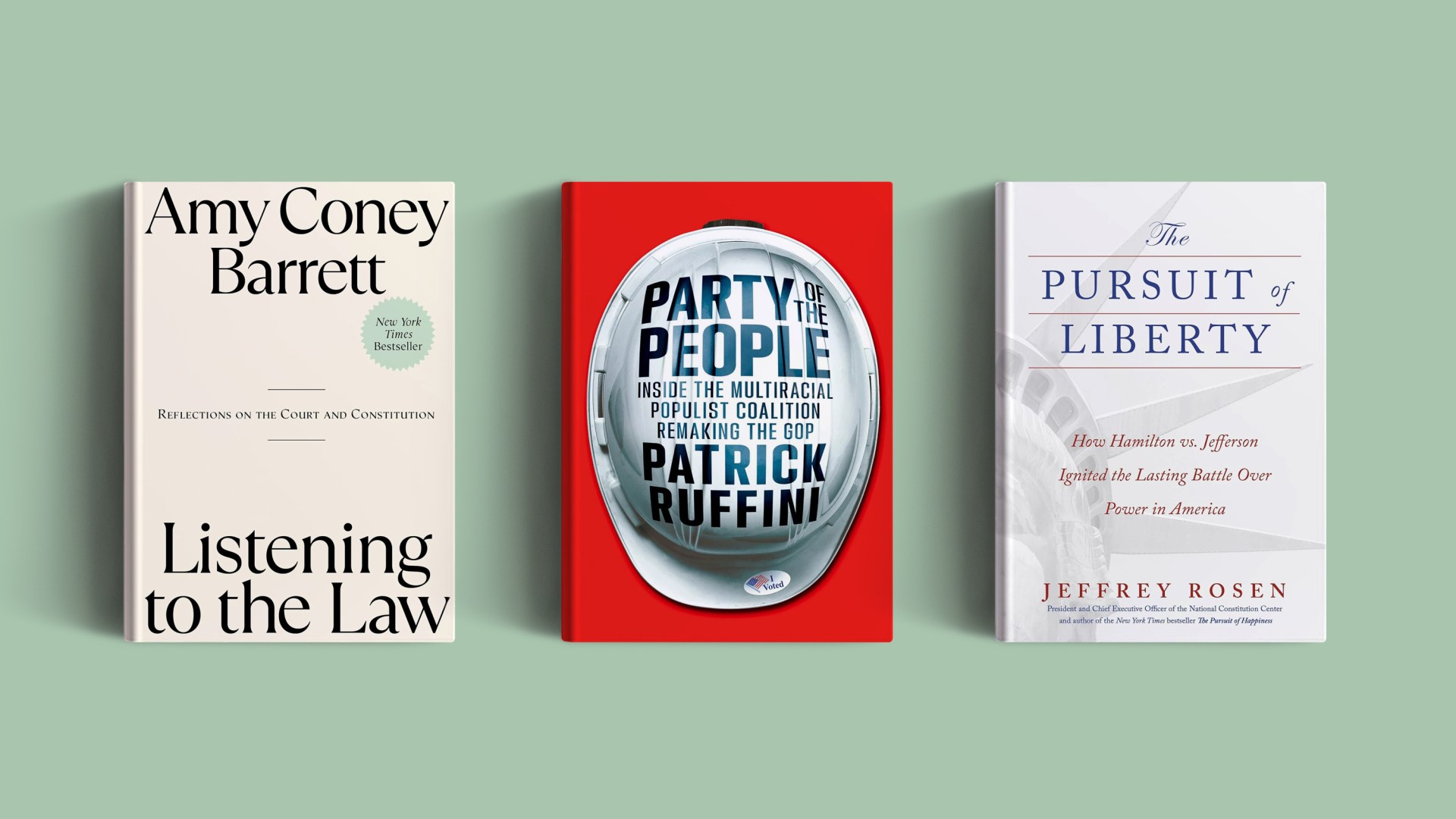
The Pursuit of Liberty: How Hamilton vs. Jefferson Ignited the Lasting Battle Over Power in America
Simon & Schuster
448 pages
The Pursuit of Liberty, How Hamilton vs. Jefferson Ignited the Lasting Battle Over Power in America, Jeffrey Rosen (Simon & Schuster, 2025)
In his latest book, Jeffrey Rosen, president of the National Constitution Center, wastes no time plunging readers into an American history primer. From page 1, he zeroes in on the central disagreement of two Founding Fathers which, he holds, still animates our current national debate about liberty and governmental power.
Always fearful of tyrants and demagogues, Thomas Jefferson supported crafting a small and weak federal government to keep states’ rights and individual liberties robust. Fearful of mob rule, Alexander Hamilton saw the advantages of a strong central government helmed by a powerful executive.
The tension between the two views has often, though not always, “kept American politics from descending into violence,” Rosen writes.
The debate between the two is a familiar one all the way back to classrooms, but Rosen’s offering focuses on tracing the “competing threads” of Hamilton’s and Jefferson’s ideas from the nucleus of America to present-day politics. He notes how both views have found champions throughout the “tapestry” of American history, from the Civil War to the New Deal, and continue to find expression in modern debates around the administrative state and the size of government.
His thesis—that the founders’ debate explains “nearly everything” about American political history—runs the risk of oversimplification, but history nerds and political junkies alike will find much to enjoy in Rosen’s history tour.
Listening to the Law: Reflections on the Court and Constitution, Amy Coney Barrett (Penguin Random House, 2025)
Even for folks who are not constitutional law nerds, Listening to the Law provides a fascinating glimpse into the life of one of the most powerful women in America. Supreme Court Justice Amy Coney Barrett’s book is part autobiography, part civics primer on the inner workings of the high court, and part constitutional treatise.
The personal details she includes about her family, school-age children, and life before her appointment are sparse yet humanizing. Occasionally, her anecdotes are humorous, such as the time she snuck out of Mass through a side door and scaled a fence in high heels to avoid camera crews.
Coney Barrett also explains how the Supreme Court works—why and how the justices accept or reject certain cases, how she personally prepares for oral arguments, and how she and her colleagues jockey each other into siding with their interpretation of the right ruling.
A devout Catholic, she defends the ability of people of faith to faithfully follow the law rather than their own moral views.
“Whatever the source of the conviction, it cannot affect the outcome of the case,” she argues, after discussing a case where she voted in favor of upholding the death penalty despite her own moral repugnance to capital punishment.
While there are plenty of high-profile cases relating to the current administration that she doesn’t address, she does discuss the most controversial ruling the Supreme Court has made in recent years, Dobbs v. Jackson Women’s Health Organization. As she had not written a separate concurrence with the decision overturning the national right to abortion, her argument (no spoilers!) is worth perusing.
Party of the People: Inside the Multiracial Populist Coalition Remaking the GOP, Patrick Ruffini (Simon & Schuster, 2023)
In the wake of the last presidential election, Patrick Ruffini received renewed attention for writing the book that “predicted the 2024 election.” It was well-deserved. Many of Ruffini’s insights in his 2023 book, Party of the People: Inside the Multiracial Populist Coalition Remaking the GOP, hold up, even on a revisit two years later.
Ruffini, a Republican pollster and cofounder of the polling firm Echelon Insights, draws from a deep well of experience in mapping the sentiments of American voters to explain the gains Republicans made among racial and ethnic minorities.
Partisan affinity is increasingly determined by whether a voter has a college diploma, he argues, rather than race, ethnicity, or income. Democratic candidate Kamala Harris dominated among voters with a college degree in the last election, winning them by 16 percentage points. But only 40 percent of all voters have a college degree, and Donald Trump captured voters without one by a double-digit margin at 14 percentage points.
This multiracial working-class coalition is particularly sympathetic, Ruffini holds, to a party focused on kitchen table issues over cultural issues vis-a-vis race and gender. Ruffini notes historic GOP gains among Hispanic voters and other immigrant communities. The 2024 election continued that trend, as Trump captured nearly half of Hispanic voters and made gains among immigrants, Asian voters and Black men.
It’s still an open question, especially in the wake of the recent midterm election, whether the right will be able to make convincing economic arguments, steer clear of culture war dumpster fires, and hold onto those gains. But Ruffini’s core argument—that demography is decidedly not destiny—should keep both parties vigilant.
Harvest Prude is national political correspondent for Christianity Today.