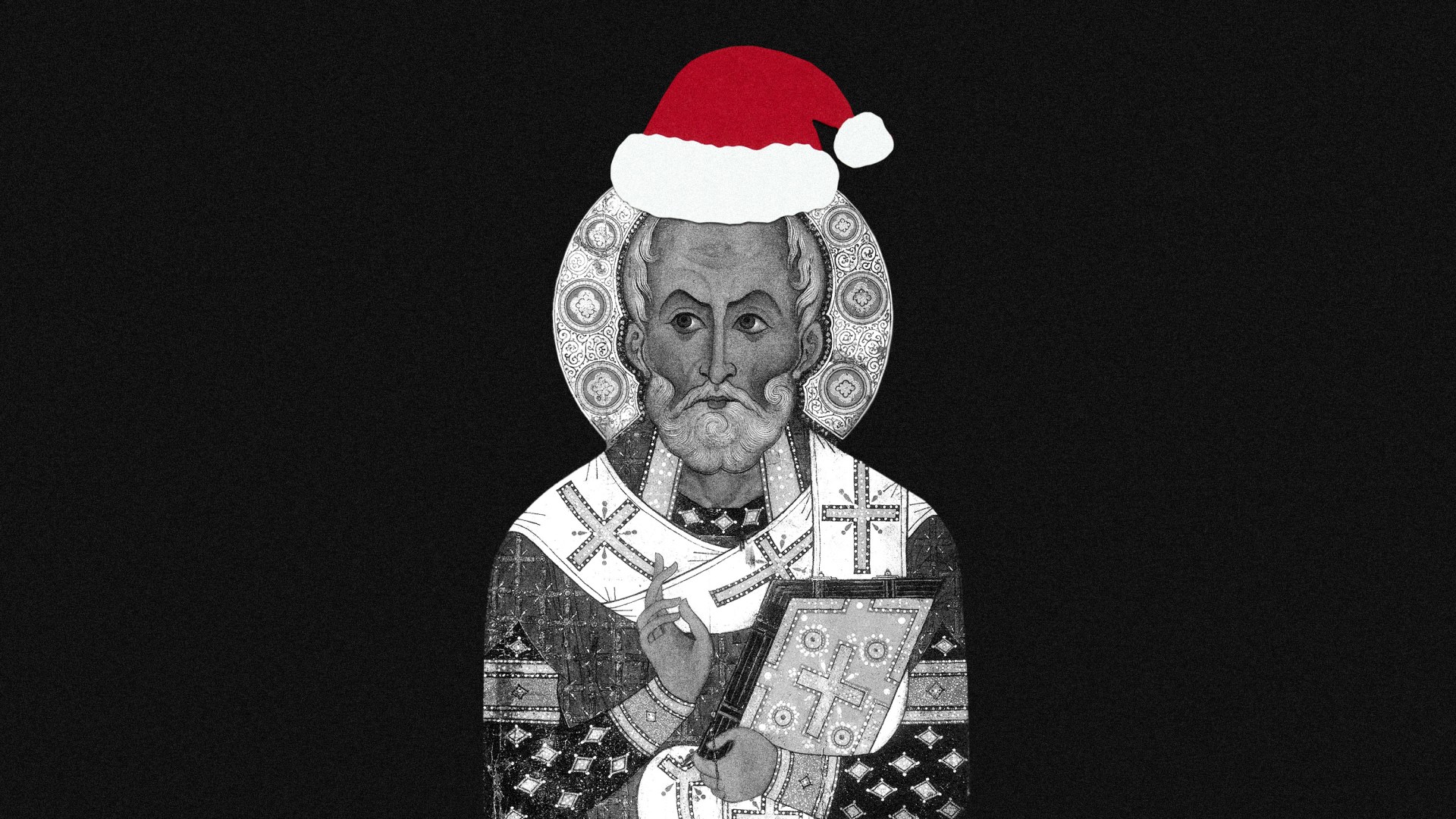
Many Christians wrestle with whether to include Santa Claus legends in their holiday traditions. Printmaker Ned Bustard offers the church tradition and history of Saint Nicholas as a winsome middle ground, pointing believers to the beautiful truths of God’s greatest gift in the Incarnation.
Bustard, author of Saint Nicholas the Giftgiver, sat down with Clarissa Moll of The Bulletin to share what Nicholas teaches us about giving and generosity. Here are edited excerpts from the conversation.
Why do Christians need the ecclesial tradition and story of Saint Nicholas?
There is a gravitas when you realize this is not just a made-up story. One of my favorite reviews of my book Saint Nicholas The Giftgiver is the complaint that there was too much Jesus and too much Santa. How could I dare bring magic and Jesus together? I like that the story of Saint Nicholas presents such a tension.
Twenty years ago, I wanted my children to enjoy the magic of Christmas and enjoy Saint Nicholas but not miss out on Jesus. We tend to do one or the other. I wanted to take back Saint Nicholas and claim him as mine because I’m a believer and part of the church. He was a real person, had dark skin, and was from Turkey. These are all real things. I’m investing in this person because he really existed.
I’m happy to write stories about imaginary creatures and people, but when it comes to church history and the faith that I’m a part of, I want it to be real and I want others to experience the weight and glory of being part of the church of Christ. We’re part of this church; we’re part of this tradition that goes back. We are moored, in the best possible way, across time with the cloud of witnesses, and we are connected to them.
What is the real story of Nicholas?
Nicholas was born in Turkey on March 17, 270, as far as we know. His story was written down after his death. He was born to a wealthy Christian couple who died soon after due to a plague. He was then given to his uncle to raise.
Nicholas’s uncle was an abbot in a monastery, and when Nicholas grew up he was made a bishop in his 20s or 30s. Folks were trying to decide who the next bishop should be, and they decided the next person to walk through the door would be him. Nicholas walked through the door, and he was made a bishop.
Some stories say that he went to Jerusalem and spent time as a hermit in a cave near there praying. Records show that he was at the Council of Nicaea. He was persecuted and imprisoned during the great persecution under Emperor Diocletian, and he died an old man.
There’s a story of Nicholas battling Artemis, the goddess of the city in which he served as bishop. He prayed against the goddess, and her statue fell over, kind of like Dagon in 1 Samuel 5. How much of these stories are true? We don’t know, but we do know that he really did exist and has this reputation for being generous.
That reputation for generosity is perhaps what we know best of Nicholas.
In the classic story, a family doesn’t have enough for the wedding dowries of their three daughters. Nicholas deposits three bags of gold in their home while they’re sleeping to give them the capacity to be married.
Why do you think that we need that particular perspective of Nicholas, as the public-facing bishop who gives in secret?
Secret giving is great and sometimes underrated. In our house, we had Saint Nicholas stockings, and I never said who filled those stockings. Other presents we’d put names on, but stocking gifts just appeared. My wife and I always had a long-running argument of whether or not these gifts should be practical. She would say, “Let’s put a toothbrush in the stocking.” I said, “No toothbrushes on Christmas. That’s too ordinary.”
We need joyful, raucous, superfluous gifts because Christmas is an extravagant gift. Even though prophets foretold this for hundreds of years, when you get the real gift of Christ in the Incarnation, it’s beyond what you can imagine. James says that all good gifts come from our Father above. All of the things that we receive are generous gifts from God.
What is the greatest gift you’ve ever given, and what’s the greatest gift you’ve ever received?
One of my happiest Christmases was in the ’70s. There was an action figure of a pirate and his first mate. The pirate had a peg leg, and you could open it to find a little treasure map inside. You could push on the characters’ backs, and they would swing their swords. On top of all that, it came with a fold-out ship for the figures to ride in.
Besides life and being chosen and loved by God, my greatest earthly present would be the day my wife said “Yes” and “I do.” That was the best gift I have ever received, such a glorious thing. However, in our family’s culture, we love to give gifts. I’m always searching for the best present because it is the way that I show love. Like Nicholas, I’d always rather participate in the joy of giving.