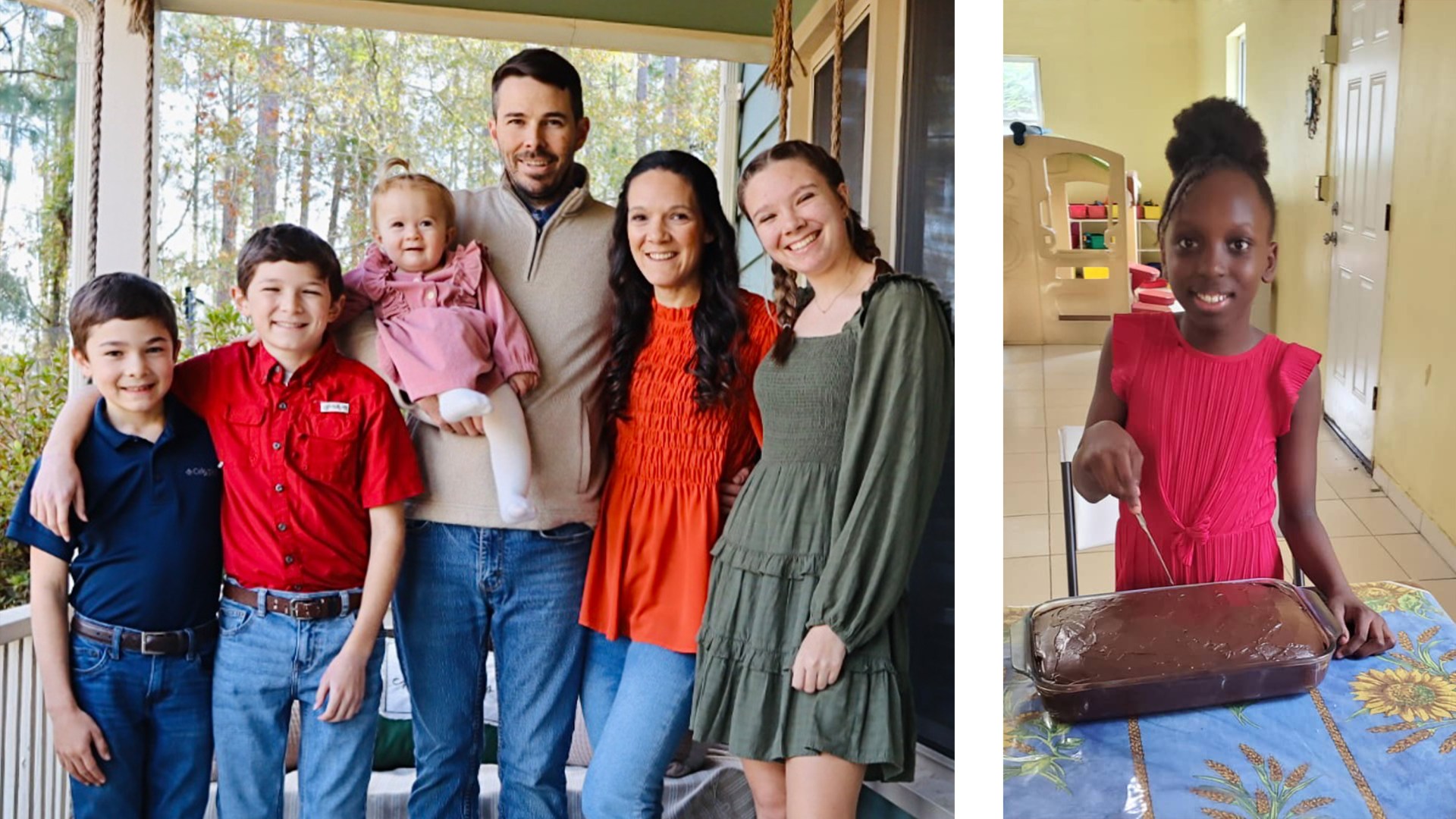
Grace and Dave Macchioni sat down excitedly for a call with their adoption agency in mid-January. After more than a year of submitting background checks, financial records, and other paperwork, they finally had a travel date to pick up their soon-to-be adopted daughter: January 24.
In Colombia, they would reunite with 14-year-old Zuli then head to the US embassy in Bogotá to obtain a visa to bring her home. Yet over the call, the case worker informed them that earlier that day, the Trump administration had issued a visa freeze for 75 countries, including Colombia.
The Macchionis recalled the case worker didn’t seem concerned and assured them it was probably an oversight. But the couple felt something was wrong.
“We looked at each other, and once we hung up the phone, I just bawled,” Grace Macchioni said.
The Macchionis first met Zuli through a hosting program called Project 143. She spent a month in their Rhode Island home in 2024, where she experienced snow for the first time, attended a ceramic painting class, helped Macchioni’s aging mother walk to her appointments, and bonded with the Macchionis’ two sons.
“She became a part of the family,” Macchioni said. As soon as she left, the couple started working on the adoption process.
At the beginning of January, the Macchionis had a video call with Zuli, who had been transferred from her foster home to a waiting facility ahead of their arrival. Grace Macchioni showed her the bedroom she had prepared with all of Zuli’s favorite things–a purple butterfly bedspread, butterfly paintings, a Colombia nightlight to remind her of home, a wall hanging of a Spanish Bible verse, and figurines of Stitch from Disney’s Lilo and Stitch.
“Are you happy?” Macchioni recalled asking Zuli.
“I prayed to God for this,” she responded.
Now the Macchionis, like hundreds of families in the international adoption process, have no idea when they’ll be able to bring their adopted daughter home. They canceled their flights as well as the caretaker they had hired for Macchioni’s mother. They called family members who were planning to stay with their boys and informed Dave’s work he would not be taking leave.
The State Department’s January visa freeze temporarily halted the issuance of all immigrant visas for 75 “nationalities at high risk of public benefits usage.” It came on the heels of President Donald Trump’s December presidential proclamation, which banned immigration from 39 countries and could last until the end of his term.
Past visa suspensions have always included a blanket exemption for adoption visas. Yet the December travel ban and January freeze do not.
The announcement sent shock waves through the adoption community. While grappling with the news of an indefinite delay on top of years of waiting and extensive vetting, adoptive parents mobilized. They shared their stories on social media, made calls, sent letters, signed petitions, met with their representatives, and urged others to do the same.
Last Friday, the Congressional Coalition on Adoption wrote a joint bipartisan letter to Secretary of State Marco Rubio, urging him to reinstate the categorical exemption for adoption visas, provide pre-travel exemptions to adoptive families, or issue clear guidance on how to apply for case-by-case exceptions.
On January 28, the White House released a guidance instructing families to proceed in the adoption process, saying, “Consular posts have been instructed that intercountry adoptions are eligible for National Interest Exceptions under the current presidential proclamation and should be processed on a priority, case-by-case basis.”
Karla Thrasher, vice president of international ministries at Lifeline Children’s Services, the largest evangelical adoption agency in the country, said the adoption community is celebrating the news while still advocating for the categorical exemption to be reinstated.
“The visas are going to be adjudicated on a case-by-case basis, and we’re just not quite sure what that means at this point,” Thrasher said. “Is there still a chance that a visa could be denied? And if so, what is that criteria? There’s still a lot of clarification that we’d like to see.”
Christine Deason of Louisville, Kentucky, is in the process of adopting a 7-year-old from Thailand. She and her husband never thought that getting a visa would be an issue in her two-and-a-half-year-long adoption process.
She said she doesn’t understand why the visa freeze would not have an exemption for adoption visas, since its stated purpose is to prevent the entry of immigrants who will become a “public charge,” or use government benefits.
Most adopted children become citizens upon entry to the US, and the public charge rule only applies to noncitizens. Also, the adoption vetting process requires submitting extensive financial documentation, including the records of a designated guardian should something happen to the adoptive parents.
“Time and time again, we’ve had to prove ourselves financially stable,” Deason said, adding that they’ve even postponed big purchases, like buying a house or car, to prevent any change in their records that could cause delays.
The Deasons are hoping to bring their daughter home in April. Her room has been ready for two years, and in the corner sits a pile of wrapped presents—one for every birthday they’ve missed since she was born.
“We were very excited about traveling in April, because she turns 8 in May,” Deason said. “Fingers crossed, we’re not gonna miss another birthday.”
Parents adopting from the 39 countries included in Trump’s December proclamation have now spent a month and a half in limbo.
Ashley and Ted Dowey of Camden, South Carolina, have been in the process of adopting their 10-year-old daughter, Grace, from Haiti for more than five years. After countless setbacks, the couple finally received their adoption decree from Haiti, meaning Grace is legally their child and Dowey is legally her last name. But since the announcement of the travel ban, they have no idea when, or if, she can come to the US.
“We expected delays from Haiti from the beginning,” Ashley Dowey said. “But the last thing we expected was to get almost to the end and then for it to be the [US] that’s causing a delay. That was really shocking and disappointing.”
Grace has been in an orphanage her whole life. She loves music, spaghetti, and the color yellow. The girl lives in a particularly unstable part of Haiti, so the Doweys have completed many hours of trauma training to prepare for her arrival. They speak with her once or twice a month on Zoom, and Dowey noted that she always asks, “When do I get to come home? When do I get to come live with you guys?”
Dowey is holding onto a line from Psalm 68:6: “God sets the lonely in families.” She prays this can be true for Grace soon.
Meanwhile, back in Rhode Island, Grace Macchioni said she is feeling “very hopeful” to hear the White House announcement that adoptions are eligible for exemptions. “There’s power in numbers,” she said, noting the adoption community’s petitions. “I’m hoping this is really a move forward.”
She spoke to Zuli on Wednesday, who she said seemed “restless” in the temporary waiting facility. “I reassured her,” Macchioni said. “I said, ‘Once they give us the green light, we’ll be there.’”