My quest for the ark of the covenant was abruptly disrupted at 35,000 feet over the Atlantic Ocean. Three hours into our flight to Israel and several hundred miles south of Greenland, the pilot announced that we were turning back to the US because Israel had closed its air space. Israel’s attack on Iran had begun.
Unlike Indiana Jones, I was not searching for the ark as it might exist today. The ark disappeared from the pages of the Bible during the latter days of the kingdom of Judah.
Instead of the ark’s departure from the Jerusalem temple, its arrival interested me. The arrival of the ark of the covenant designated Jerusalem as the Holy City of God.
The City of David is archaeologists’ name for the most ancient area of Jerusalem, a narrow ridge that begins near the southern wall of the Temple Mount and descends to the Pool of Siloam near where the Kidron and Hinnom valleys intersect.
Nineteenth-century photos of a bare hillside give little hint that a forgotten ancient city is buried underneath. Archaeologists began working in this area in the late 1800s and are still there to the present day, all while settlements spread across the hillside. But it wasn’t until the 21st century that the City of David became an attraction for groups of pilgrims and tourists eager to see biblical discoveries.
The organization driving the change is Rabbi Yehuda Maly’s City of David Foundation (often called Elad), “dedicated to revealing and preserving the birthplace of Jerusalem, transforming it into a premier national tourist center.”
In Jerusalem, such a simple proclamation, like its archaeology, has many layers and can be deeply controversial. In Israel, some see archaeology as a weapon wielded in the same struggle that includes the war in Gaza and the bombing of Iran.
Spurring my quest was a January 2025 news release that prompted memory of a conversation with Rabbi Maly almost 25 years prior. As I recalled that conversation and reviewed the news release, there seemed to be an obvious omission.
In that interview, Rabbi Maly mentioned that Solomon came to the throne and was crowned king in an impromptu ceremony at the Gihon Spring. It seemed then like a non sequitur: a king crowned next to a waterspout and not in a palace or a temple? The incongruity stuck in the back of my brain, but then the penny dropped when the news release arrived.
After my in-flight trip cancellation, I reached Doron Spielman, former Elad vice president and spokesman, via Zoom to continue my sleuthing from a distance and, as researchers often do, discovered more than I initially sought.
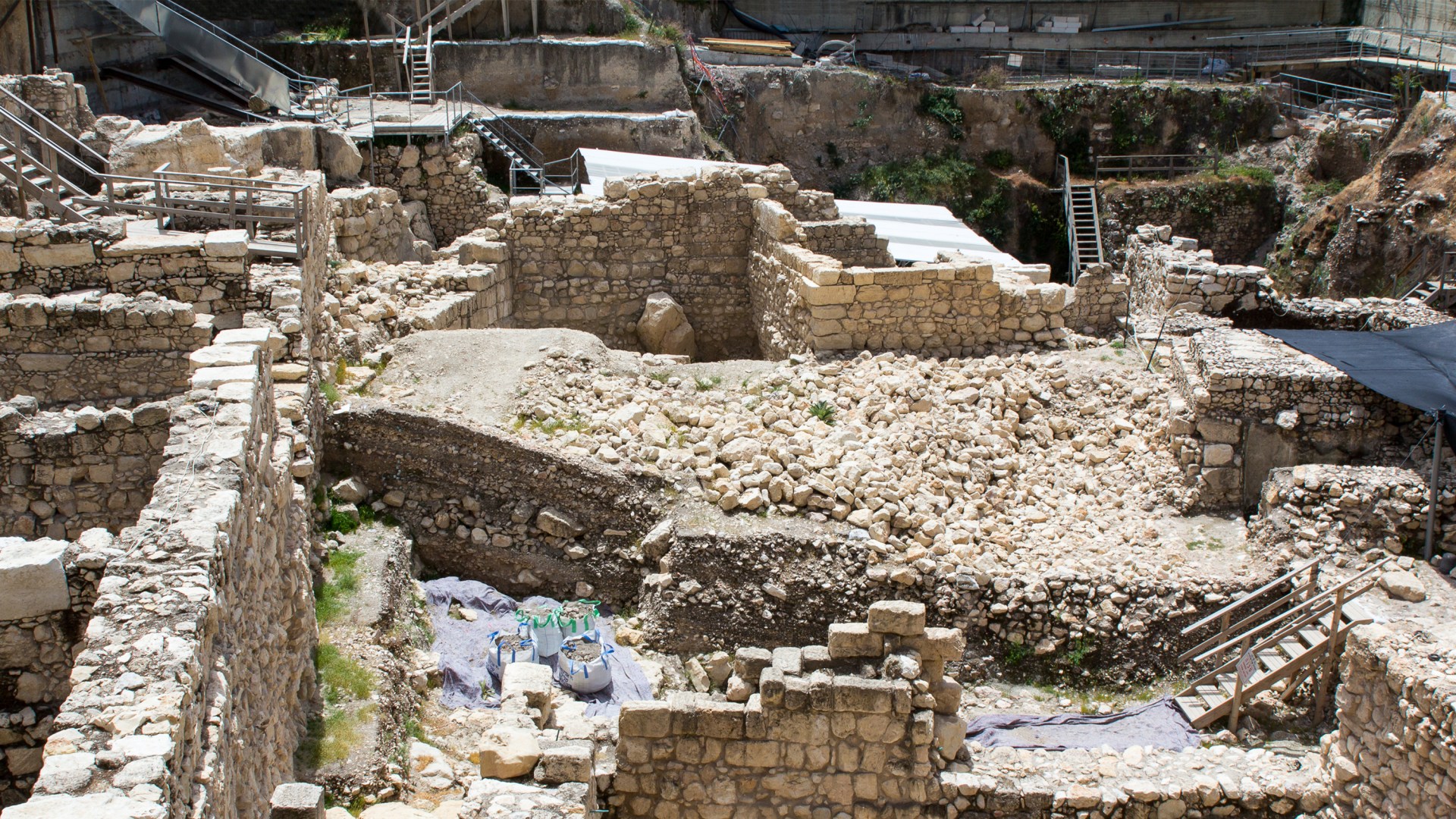
For many years, a portion of the City of David was a nondescript one-acre parking lot outside the Dung Gate that leads to the Western Wall.
As Spielman recounts in his book, When the Stones Speak, the City of David Foundation had a chance to buy the lot in the mid-1990s but couldn’t raise the money. When another opportunity came in 2000, the foundation quickly acquired it.
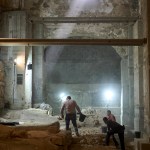
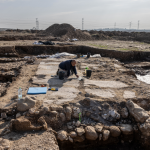
The Givati Parking Lot opened to archaeologists in 2007, and the work continues today. I had signed up to be an excavation volunteer with archaeologist Yiftah Shalev for a week during my trip. Instead, Spielman was my excavation guide from afar, describing the unparalleled opportunity to dig deeply into the history of Jerusalem.
“Thirteen different civilizations,” he said. “One hundred feet down and we’re still not at the bottom. It’s like walking through the pages of a book as you’re walking down the staircase. Every floor is another 200 years.”
Over the past 17 years, archaeologists have announced many discoveries from the Givati dig, including gold coins and gold jewelry, among the smaller items. A gold ring has been found in each of the last two years.
More precious than gold in the ancient world was ivory. In the ruins of a palatial home, destroyed when Babylonians burned Jerusalem in 586 BC, archaeologists recovered fragments of ivory in 2022 that had been inlaid in furnishings—the first time ivory has been found in modern Jerusalem, reflecting the days of Solomon (1 Kings 10; 2 Chron. 9).
Jamie Fraser directs Jerusalem’s Albright Institute for Archaeological Research, the center for US archaeology in Israel. He toured Givati earlier this year.
He compared previous excavations in the City of David to a series of telephone booth–sized probes scattered across a football field. Suddenly, an opportunity opened to dig up half the field. “In order to find big-scale stuff, you need big-scale excavations,” he said.
Opening up the excavation site further has yielded even larger discoveries. In 2023, researchers were surprised to discover a massive moat, 30 feet deep and 100 feet wide, separating the lower city from the temple and the king’s palace on the acropolis. Though the Bible has no specific indication that such a moat existed, it appears to have been part of the biblical landscape for much of the first millennium BC, going back perhaps as early as the time of King David.
“What blew my mind was the sheer scale of this dig,” Fraser said. “It’s reshaping the way we understand the mechanics of ancient Jerusalem.”
Similarly, that January 2025 news release described remains of an eight-room cultic sanctuary found on the other side of the City of David, within 100 feet of the Gihon Spring. Spielman said this sanctum, as he called it, was actually discovered in an excavation 15 years ago that had started out to uncover the oldest city walls of Jerusalem, from 3,850 years old.
“This is the Middle Bronze II period, roughly the time of Abraham,” Spielman said, “which means when Abraham meets Melchizedek [Gen. 14:18], those are the walls that Abraham saw.”
Within these rooms—which seem to have gone out of use several centuries after the Israelites built the temple and installed the ark of the covenant, around the time of King Hezekiah—were found a small olive oil press and winepress that the Israelites apparently used for rituals.
In another room, archaeologists found a masseba, a standing stone. Standing stones commonly mark sites of religious significance, such as with the stone Jacob erected following his dream at Bethel (28:18). Givati’s masseba is the only one standing in Jerusalem.
Two of the most important features of any ancient city were a water source and a temple or cultic installation. Now, in Jerusalem, they have been linked together. That suddenly puts flesh on the bones of the biblical story that started my quest.
The drama unfolds in 1 Kings 1. David is in his final days, and his son Adonijah convenes a banquet, anticipating his accession to the throne. The prophet Nathan takes the news to Bathsheba, knowing that Bathsheba’s and Solomon’s lives are in danger. She immediately goes to David, who confirms that Solomon should be king:
He said to them: “Take your lord’s servants with you and have Solomon my son mount my own mule and take him down to Gihon. There have Zadok the priest and Nathan the prophet anoint him king over Israel. Blow the trumpet and shout, ‘Long live King Solomon!’” (vv. 33–34)
To fill in the rest of the story, we have to go back to 2 Samuel 6:16–17, when David, “leaping and dancing,” installed the ark of the covenant in his new capital city: “They brought the ark of the Lord and set it in its place inside the tent that David had pitched for it, and David sacrificed burnt offerings and fellowship offerings before the Lord.”
Archaeologist Scott Stripling, provost of The Bible Seminary in Katy, Texas, has visited the cultic center with Israeli archaeologist Eli Shukron, who directed the excavation. Stripling notes there is a podium in this cultic center with the exact dimensions of the ark of the covenant. He believes the biblical reference to the oil that anointed Solomon and the olive oil press found in the cultic center reinforces the connection to Solomon’s story.
Stripling has been excavating Tel Shiloh, where the ark paused for 300 years in its journey from Mount Sinai to Mount Zion. “We know what’s going on at Shiloh. We understand the temple history. But the little period of David’s tabernacle has eluded us until now,” he said.
Eventually, when Givati has yielded all its secrets, the City of David Foundation plans to erect a multistory visitors’ complex called the Kedem Center. The foundation has a controversial plan to build a cable car that would increase access to the Western Wall and City of David and would terminate on the center’s top floor.
Doron Spielman said the City of David Foundation is still grappling with how best to open up the cramped quarters of the cultic installation to a flood of pilgrims.
“It’s one of the most important things we are doing,” he said. “That is the origin story of the Bible right there.”
Scott Stripling noted, “The first verse of the New Testament is ‘This is the story of Jesus Christ, the son of David, the son of Abraham.’ If you have a place where David and Abraham come together, that’s really exciting.”
Related