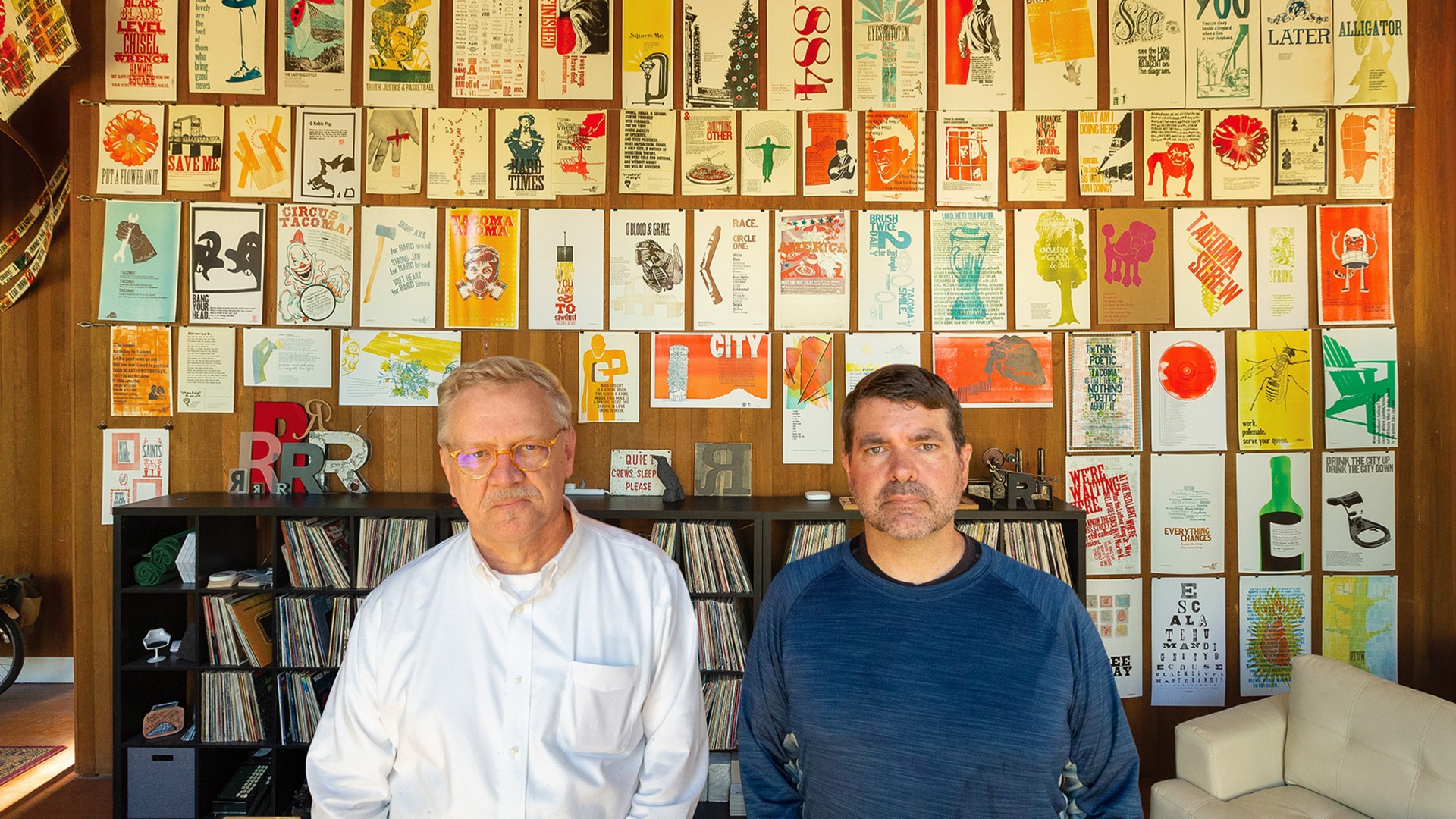
Paper was once a far more precious resource. Sometimes, our ancestors would scrape markings from parchment, clean it, and start anew. Historians call these documents, inscribed with layers of text, palimpsest. Often, visible traces of past writing remain underneath the new words. I couldn’t help but think of that age-old practice as I stepped into the basement of Lance Kagey’s home last month.
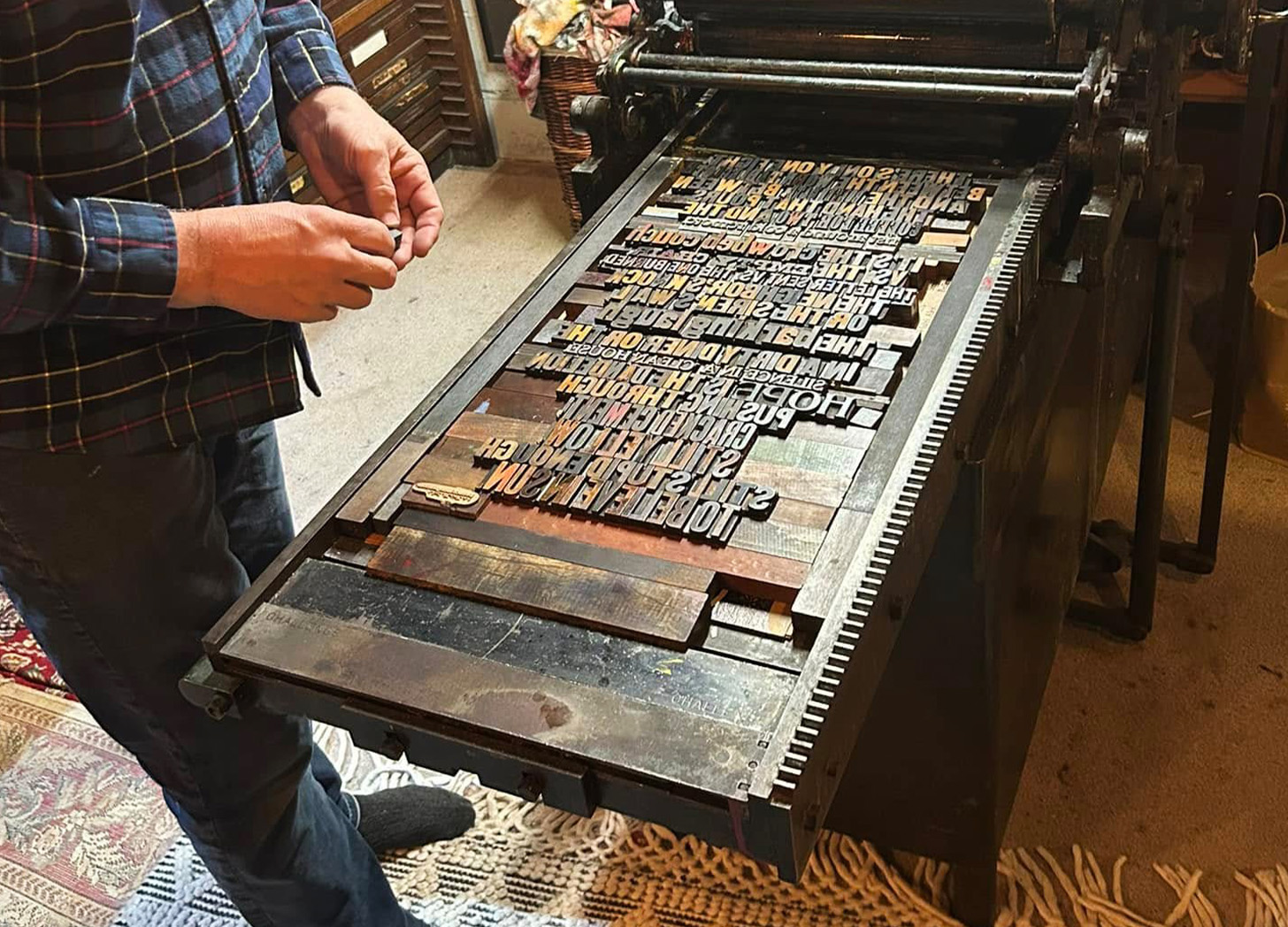
Palimpsest is a good word for it. The bottom level of Kagey’s historic house in Tacoma, Washington, is a study in bygone eras adapted ingeniously for reuse. Old wooden cabinets line the perimeter, holding trays upon trays of vintage letterpress wood type. Artwork and artifacts from decades gone by fill the remaining wall space.
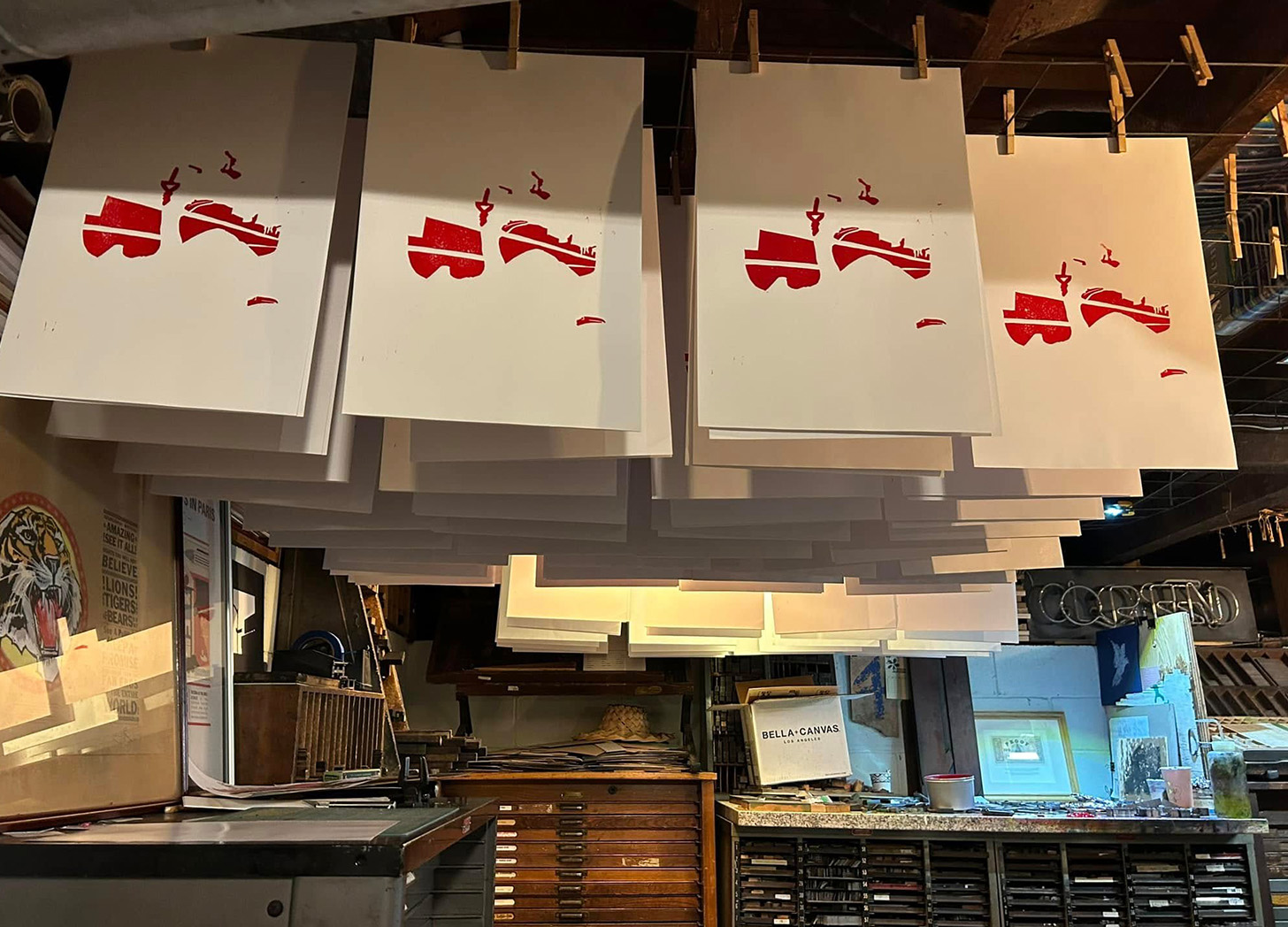
In the middle of it all stands an industrial relic that’s been given a new reason for life: a cylinder letterpress, complete with a manual crank. Rows of freshly inked pages often float above the machine, hung to dry with clothespins like laundry.
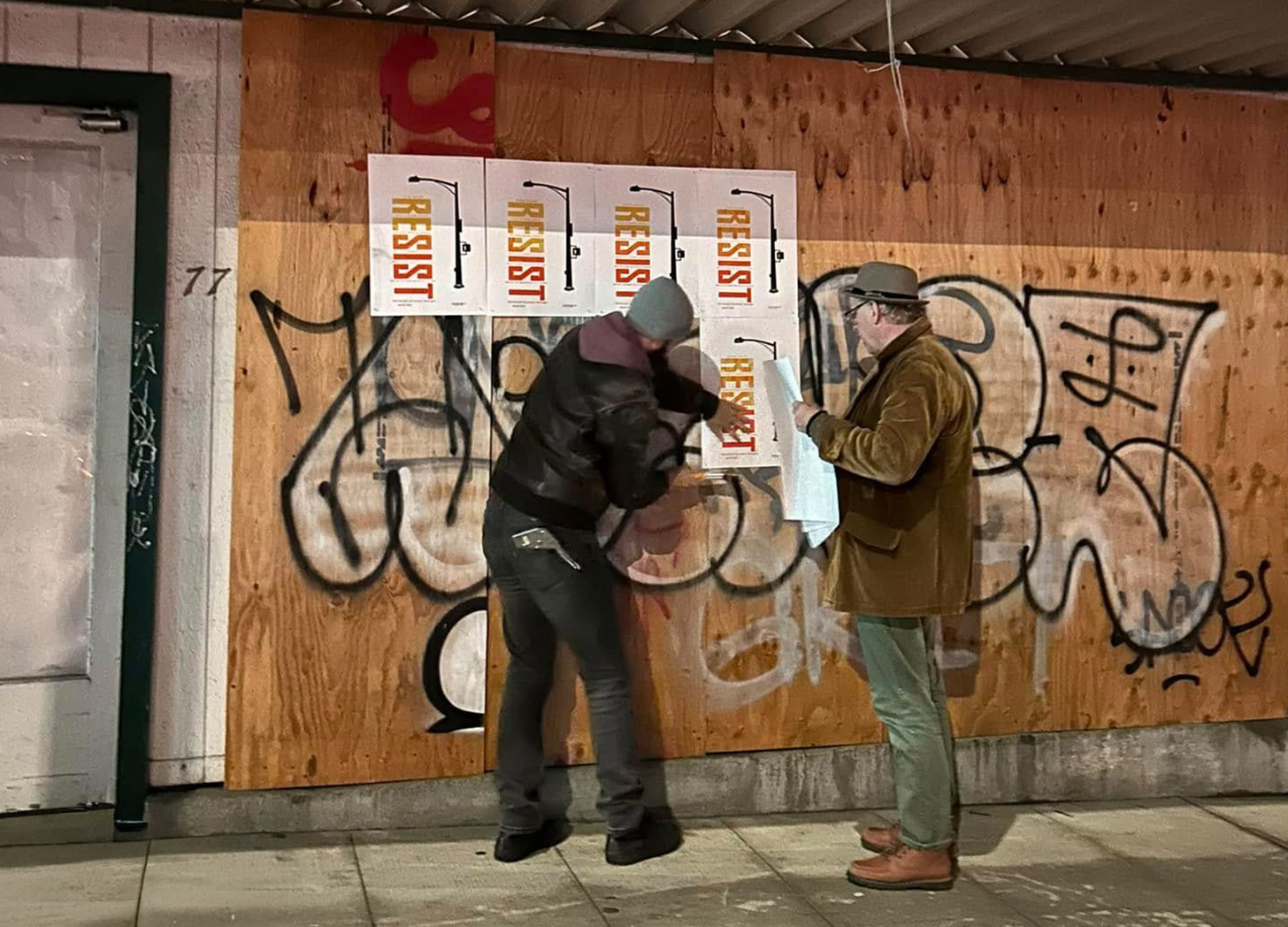
What the printing press churns out could also be called palimpsest, with layers of color, words, and meaning. This art is part of a creative endeavor known as Beautiful Angle, the brainchild of Kagey and his equally creative friend, Tom Llewellyn. Roughly once a month, the two men develop a new poster design and then print a short run of about 100 copies. Using wheat paste and staples, they hang their completed work all around Tacoma.
This effort to engage with their city, crafting physical art in a world gone digital, has now been unfolding for more than two decades, generating a substantial body of work and an enthusiastic fan base. The artwork is compelling, the messages provocative, and their reach surprising.
I had the chance to sit down with Kagey and Llewellyn in that basement studio to hear more about their work, their fierce loyalty to their locale, and the role faith plays in this unique undertaking.
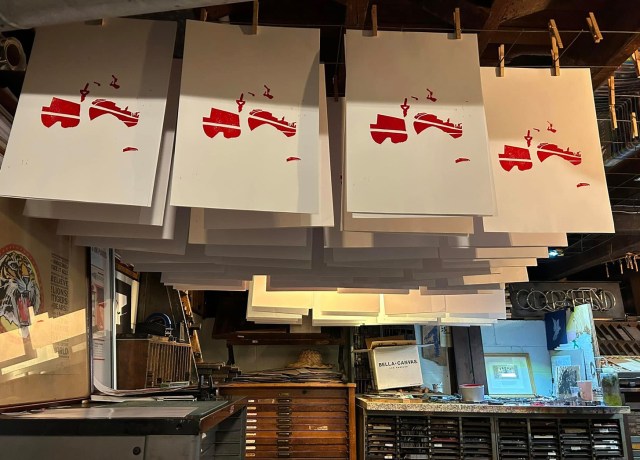 Image used with permission.
How did this whole thing start?
Kagey: I had taken some letterpress classes and fell in love with the old-school process of printing.
You mean the kind that Gutenberg invented, with the movable type?
Kagey: Exactly. It’s the printing method where you press one color of ink onto one page at a time. We found this 1952 Challenge proof press on eBay for $50. But it was in Ohio, so it cost me six times that much to have it shipped here.
Wait. You’re saying you invested in a press before knowing what you wanted to do with it?
Kagey: That’s right. Well, we knew we wanted to make art.
Llewellyn: We came up with the poster project very quickly once the press was here. We’re both big fans of street art.
Street art being public art that’s not officially authorized by anyone.
Llewellyn: Right. The beauty of street art is that you’re not waiting on an editor or publisher or mediator between you and your audience. If you don’t care about getting paid, you can create whatever you want. And that’s worth a lot.
Kagey: Street art posters have a long history. We decided, “What if we just made one poster a month?”
Llewellyn: We wanted a schedule that would be sustainable over the long haul. Now here we are, 23 years later, still going.
Why did you choose posters as your art form?
Kagey: Art that goes up unofficially can come down unofficially. We’re making art that is meant for people to peel off the walls or telephone poles and take home for themselves.
Llewellyn: A poster is a very specific medium with three levels of impact. You have the drive-by impact where something cool turns your head. Then there’s the impact of stopping to read the words. And then if you take it home and hang on your wall, it has an ongoing impact.
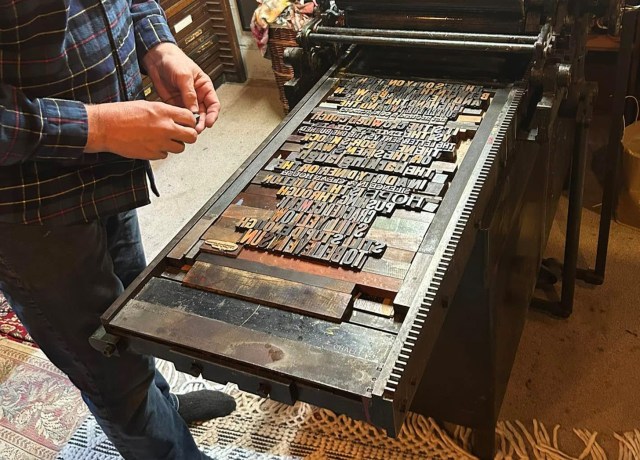 Image used with permission.
For the uninitiated, why bother going old school with the printing? Couldn’t you do the same thing more quickly and cheaply with Photoshop and a color printer?
Kagey: The process is a key part of the end product. I don’t see this press through a nostalgic lens. It’s a tool that we are pushing to use in innovative ways.
Llewellyn: Every single print that comes off of the press is unique. Each has slightly different flaws or levels of ink. Sometimes there are imperfections in the wood blocks themselves that add character you wouldn’t get from a digital copy.
Kagey: The limitations of analog make the design better. We had one poster concept where I knew I wouldn’t have enough letters in one particular wood type for all the text. If I don’t have enough E’s in one font, I have to choose a different typeface for certain words. That creates design choices in real time.
The Christian artists I know are constantly wrestling with how to express the truth about themselves (which includes their beliefs) without their art becoming simplistic propaganda. How have you navigated that tension?
Llewellyn: This isn’t an evangelistic project. We both grew up soaked in church, so biblical language shows up regularly in our work. We talk about our faith all the time, but we talk about lots of other things, too. There’s no hidden agenda.
Kagey: I’ve been reading Makoto Fujimura’s Art and Faith. Part of his thesis is that we are creators made by the Creator. It is in our nature to make. The making itself is the thing.
Llewellyn: Sometimes in Christian circles there’s almost a mentality that as long as art is faith-based, quality doesn’t really matter. To me, that’s verging on taking the Lord’s name in vain. The opposite should be true. Art made by people of faith needs to be astonishingly good and honest.
The thing about work of the caliber you two are doing is that it gains widespread attention and accolades. That raises the question: Why limit yourselves to Tacoma? Why keep this goodness local?
Kagey: The simplest answer is that Tacoma needs our love. When we started, the city still had that “ugly stepsister syndrome.” People always focused on Seattle. No one ever talked about Tacoma.
Llewellyn: There’s something compelling about a city that needs you. It’s like that quote from G. K. Chesterton: “Men did not love Rome because she was great. She was great because they had loved her.”
Kagey: We’re not just cheerleaders for Tacoma, though. We talk about its flaws, too.
Llewellyn: We refer to Tacoma as the “holy city,” picking up on the biblical idea. We want this community to see its own sacredness in the midst of its ordinariness.
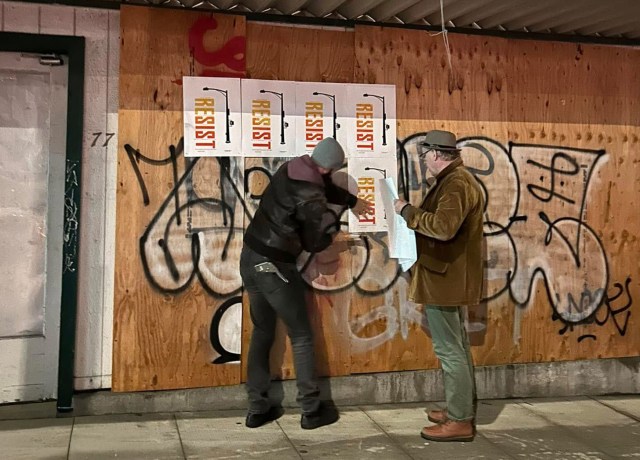 Image used with permission.
It makes me think of Jeremiah 29, where the Lord instructs the exiles to seek the prosperity of the city where he sent them. What is it you hope your work is doing for Tacoma?
Kagey: When we first started, we were just putting the posters out there, expressing ourselves. But our art has become much more of a community event. And we realized part of our goal was to have people connect around a common activity and build relationships.
Llewellyn: Now often, there will now be 50 people gathered before we even arrive to hang posters. And while they’re there, they’re interacting, asking each other which posters they have, comparing tools they’re using to take down posters. It’s become a community rhythm.
Kagey: The repetition has been key. The only way to get into the cultural consciousness of a place is to keep showing up in the same place and not spread out too much.
Llewellyn: We have to keep the focus on one little area and go deep rather than broad.
Over two decades in, is it still fun?
Llewellyn: Definitely. We’ve been friends for so long. We’re just relaxed with each other. Even after all this time, there’s something very Willy Wonka-ish about putting blank paper in one end of the press, turning the crank, and watching that first poster come out the other side. It’s still pretty magical.
J. D. Peabody is the author of the fantasy trilogyThe Inkwell Chronicles as well as Perfectly Suited: The Armor of God for the Anxious Mind. His website is www.jdpeabody.com.