This piece was adapted from CT’s books newsletter. Subscribe here.
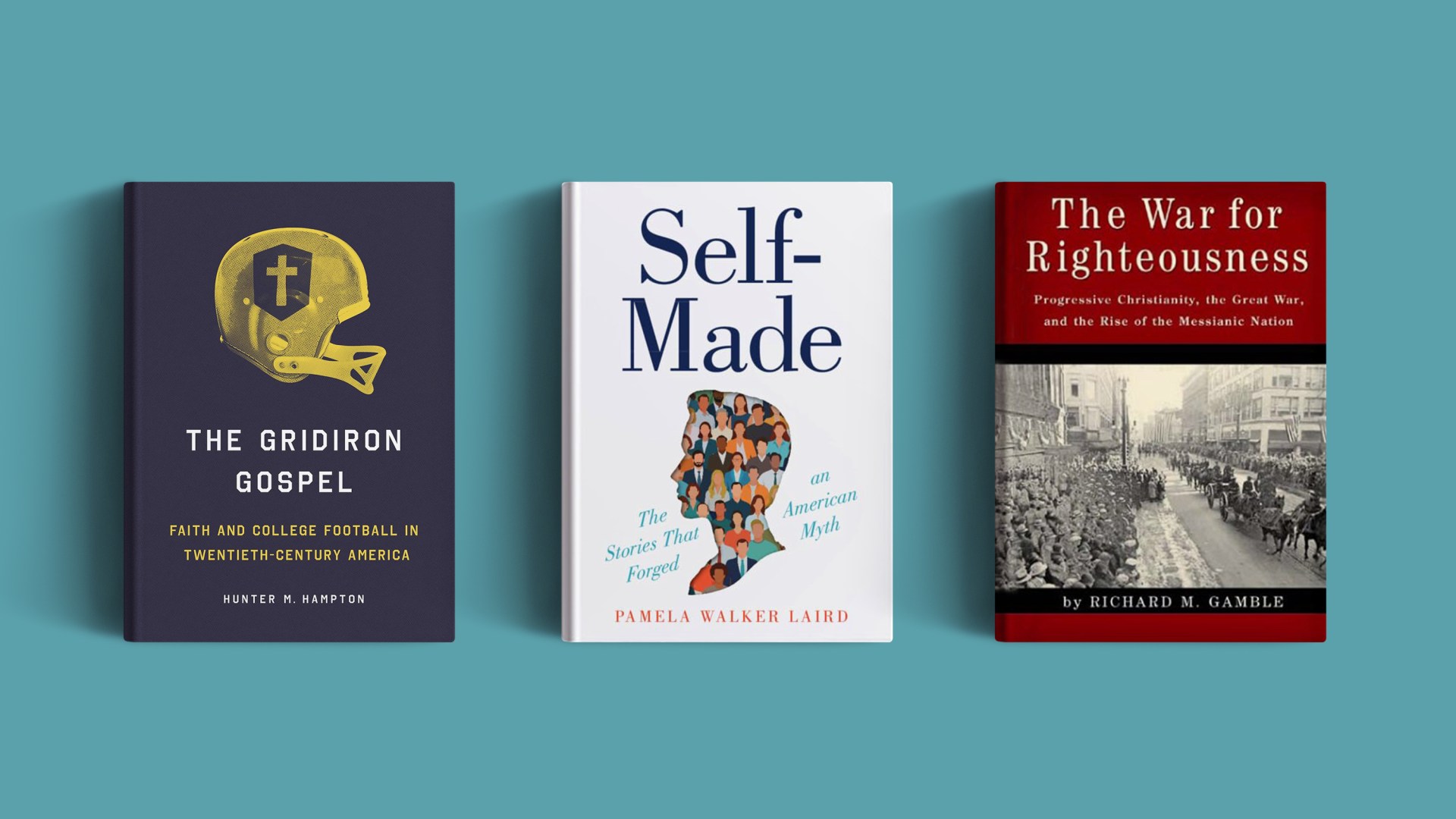
The Gridiron Gospel: Faith and College Football in Twentieth-Century America (Sport and Society)
University of Illinois Press
220 pages
Hunter M. Hampton, The Gridiron Gospel: Faith and College Football in Twentieth- Century America (University of Illinois Press, 2025)
In Gridiron Gospel, historian Hunter M. Hampton explores how Christian colleges and universities—his case studies are Notre Dame, Brigham Young, Wheaton, Wiley, Baylor, and Liberty—used football to promote Christian masculinity and adapt to the shifting social and religious landscapes of 20th-century America. Muscular Christianity plays such a central role in this book that it is surprising the word masculinity is not included in the title or subtitle.
The book contains a significant amount of straightforward football history, at times reminiscent of reading the sports section of an old newspaper. Hunter chronicles specific games, records of wins and losses, and coaching changes. However, his narrative is most compelling when he moves beyond these details to examine how administrators—many of whom initially questioned whether football was too violent for Christian colleges—concluded that the sport could build good Christian men.
Hunter demonstrates that administrators consistently integrated football programs into broader efforts to reinforce institutional identity. For instance, at Wiley University—a historically Black school in Texas—football strengthened the school’s Black identity. At Baylor, the sport reinforced the university’s commitment to racial segregation. At Wheaton, football facilitated the evangelical liberal arts college’s transition out of fundamentalism, though Hunter is not entirely clear about how this occurred.
In recent years, sport historians have begun to take religion seriously, while American religious historians are also starting to recognize the importance of sports. Hampton’s book fits squarely within these promising trends.
Pamela Walker Laird, Self-Made: The Stories That Forged an American Myth, Cambridge University Press, 2025)
What do 17th-century English Puritan statesman Oliver Cromwell have to do with 21st-century socialite and influencer Kylie Jenner? Both have been described as “self-made.” Like Hunter Hampton, Pamela Walker Laird is interested in the myth of the “self-made man.” In a sweeping narrative covering 400 years of American history, she examines how American culture celebrates “self-made” as a “badge of honor that rewards individualist ambitions while it hammers against community obligations.”
In Cromwell’s era, presenting oneself as “self-made” signaled sinful pride, selfishness, and unhealthy ambition. “Well aware of their roots and forces outside themselves,” Laird writes, “self-fashioners then did not—could not—see themselves as self-made.” By the 19th century, however, the term had become a largely positive character trait. Laird masterfully explains how this transformation occurred.
As historian Seth Rockman observes in his endorsement of this book, “To call someone ‘self-made’ has almost never been true.” Laird recognizes that the pursuit of individual ambition and self-fashioning was not accessible to all Americans. The ability to improve oneself or “rise up” was consistently limited by entrenched systems of inequality. Laird also points out that as Americans celebrated a meritocracy based on hard work and determination, they were simultaneously constructing the myth of “self-made failure.”
From Benjamin Franklin to Davy Crockett, from Horatio Alger to Donald Trump, the idea of the self-made American endures. For those interested in how such individualism and ambition may or may not contradict the teachings of the Christian faith, this book is an essential read.
When Pseudoscience Swallowed Scripture
Richard M. Gamble, The War for Righteousness: Progressive Christianity, the Great War, and the Rise of the Messianic Nation (ISI Books, 2003)
Progressive Christians are often associated with opposition to American wars. As historian Richard M. Gamble demonstrates, pacifism has a long tradition within this branch of modern American Christianity. Yet, progressive Christians—the advocates of what was called the “social gospel” in the first half of the 20th century—sometimes acted as war hawks.
The War for Righteousness did not receive the attention it deserved when it was first published in 2003. Gamble argues progressive Christians were “crusading interventionists” who championed United States involvement in World War I as a means of spreading a messianic vision of American exceptionalism and the coming kingdom of God throughout Europe. Today, much of this pro-war rhetoric might sooner be found coming from a Christian nationalist.
The key actors in Gamble’s book are the so-called modernists. They are the theologians and church leaders who sought to integrate Christianity with modern science (including Darwinism), taught critical methods of interpreting the Bible, and believed that social justice was a central feature of the gospel. They include Lyman Abbott, Washington Gladden, Shailer Mathews, Harry Emerson Fosdick, and the leaders of the Federal Council of the Churches of Christ.
Although many of these men were opposed to war in principle, they eventually viewed President Woodrow Wilson’s intervention in Europe during World War I as a means of preventing the spread of German evil and advancing the kingdom of God. As Gamble writes, “The great irony of the war was that, in the very name of perpetual peace, the Protestant liberal clergy rationalized and legitimized the mass destruction of the first total war of the twentieth century, and demanded that it be carried on to a decisive victory.”
John Fea is a visiting fellow in history at the Lumen Center in Madison, Wisconsin, and distinguished professor of history at Messiah University in Mechanicsburg, Pennsylvania.