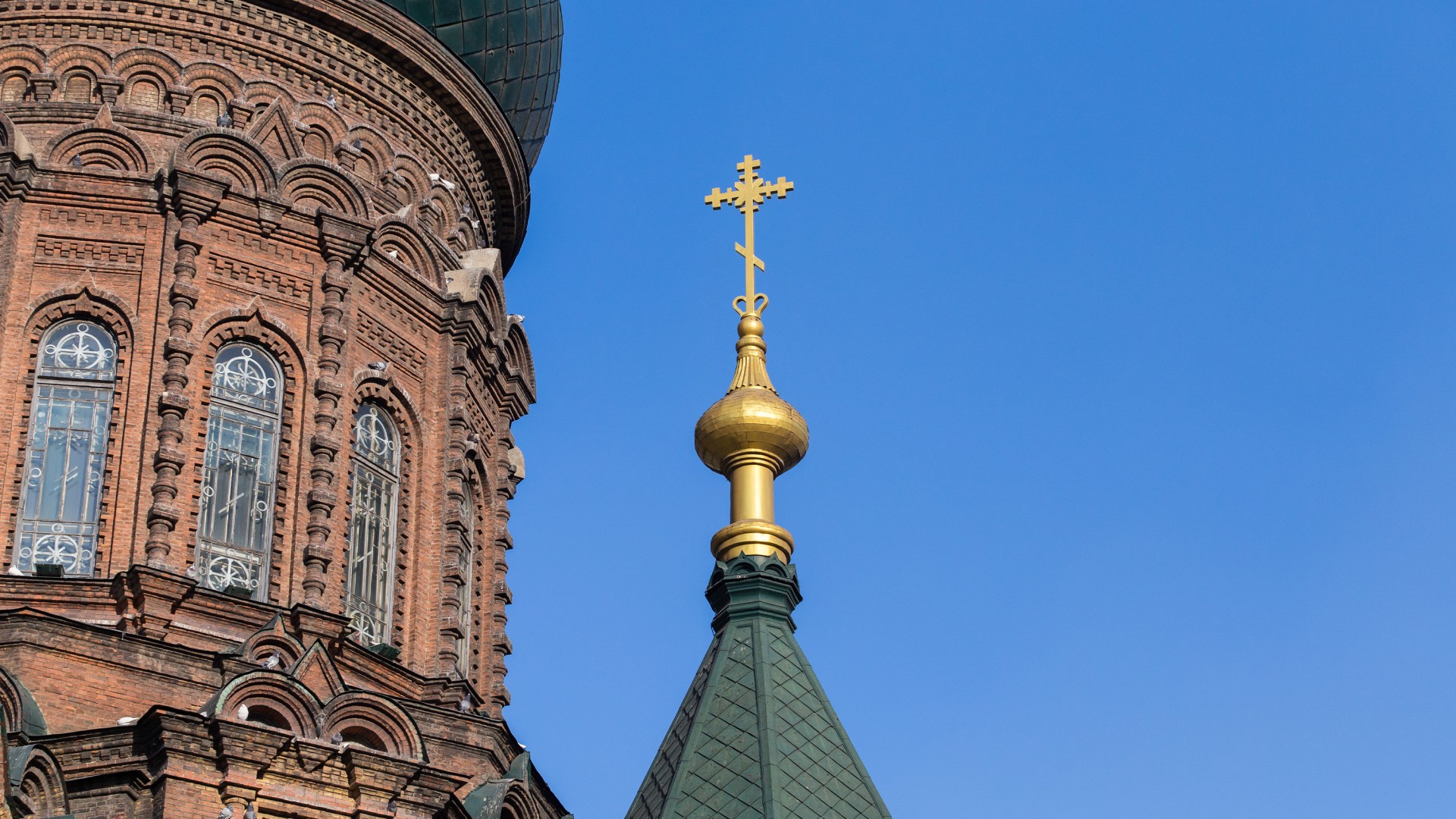
In the late 2000s, as an undergraduate law student in Beijing, Justin Li grappled with questions about justice, morality, and the meaning of life. Atheism felt increasingly inadequate in providing answers to these big questions, and Li became a believer through a campus Bible study shortly after he began attending its meetings.
Li worshiped in an evangelical church that held contemporary services shaped by joyful, fast-paced praise songs. But the upbeat worship music, coupled with his busy work schedule, “made his heart even less quiet,” said Li, who is in his mid-30s.
Then he stumbled upon Ancient Faith Radio, a digital network of broadcasts offering Eastern Orthodox liturgical music and teaching. The melodies he listened to were simple, solemn, and contemplative. “It felt like another world,” he said.
Li began exploring the Eastern Orthodox tradition while studying theology at the University of Oxford’s Wycliffe Hall. He read widely, comparing Protestant and Orthodox arguments about the faith, and found the Orthodox responses “more persuasive than expected.” He joined the Orthodox church in China in 2022.
“There was a deep dissonance between the beauty I found in the writings of the early church and the functional pragmatism of much [of] evangelical church life,” Li said on a Zoom call from a room lined with Chinese evangelical theology books, now flanked by Orthodox icons and a wooden cross.
Li is not the only evangelical of Chinese descent who has turned eastward in recent years. A burgeoning number of Chinese believers find Eastern Orthodoxy appealing because it offers a connection to a historically rooted faith and a richer experience of the spiritual life—aspects that contemporary evangelicalism seems to lack.
Last year, I interviewed seven Mandarin-speaking Christians from mainland China and Taiwan about their conversion to Orthodoxy. My interest in the subject arose out of personal curiosity after I conducted a research project on Chinese Christian communities in Britain four years ago, when I met with several Chinese Orthodox converts who came from evangelical backgrounds.
The seven interviewees with whom I spoke are highly educated, with most holding or pursuing doctorates in fields ranging from theology to physics and history, and are dispersed across Europe, Asia, and North America.
Although all of them first came to faith within evangelical traditions, their shift eastward arose not from any frustrations with evangelicalism but from a deeper intellectual and spiritual search shaped by their academic formation.
In their eyes, the path from Beijing’s bright praise songs to Byzantium’s ancient chants is not a wholesale rejection of evangelicalism but a search for spiritual ground that does not move.
Many of these Orthodox adherents long for historical depth. Because their theological imaginations had been shaped largely within modern evangelical frameworks, many discovered—often for the first time—the vast expanse of early Christian history that lies between the New Testament and the Reformation.
As they read the church fathers, learned about the early councils, and studied how the canon of Scripture was discerned, they asked whether their inherited evangelical structures had adequately preserved the breadth of the apostolic tradition.
related


Sarah Lin, a believer from Taiwan, encountered the Eastern Orthodox faith through a research project during her graduate studies in the United States. What began as academic curiosity gradually unsettled her spiritually.
As she read Byzantine texts on early prayer practices and monastic devotion, she felt surprised to discover how so many centuries of Christian life and thought had been rendered invisible within the Chinese-speaking church.
Lin also sensed a depth to prayer that she had never experienced before. Previously, she regarded prayer as a response to an “immediate spiritual feeling,” but she now understood that prayer could also be a “formative” experience that would shape her over time.
“Orthodoxy reordered my spiritual life—it taught me to pray before I feel ready and to be formed through habit, not just emotion,” she said.
Besides Lin, nearly every interviewee described a sense of hollowness in the fast-paced, event-driven, emotionally charged worship cultures they grew up in. In contrast, the spiritual disciplines Eastern Orthodoxy emphasizes, such as hesychasm (repeating short prayers), fasting, and liturgy, offered a framework for inner transformation that felt slow, grounded, and deeply embodied.
What these interviewees found compelling about Orthodoxy was not a mystical aesthetic but a different anthropology: the belief that the heart is shaped through habit, not spontaneity.
“In evangelicalism, devotion was often spontaneous or reactive,” Li said. “In Orthodoxy, it is habitual and formational. I do not wait to feel spiritual before I pray. Instead, I submit into prayer and am formed by it.”
Another reason some converts left evangelicalism is ecclesial fragmentation. Several people, particularly those who have lived in the West, spoke about the disorienting variety of doctrines, moral teachings, and worship styles within Protestantism.
For some interviewees, this raised questions about whether “Scripture alone” could sustain a coherent witness across time and cultures. In their view, Orthodoxy was attractive because of a perceived continuity that connected contemporary practice with the first millennium of the church.


Ephrem Yuan, a London-based PhD candidate, experienced his conversion to Orthodoxy in 2022 as a gradual, often reluctant transformation. Like Li, he did not grow up Christian. He became a believer in university, was formed in evangelical contexts, and later sought theological training outside China.
The Chinese evangelical church communities in which he was involved did not seem interested in preserving historic Christian traditions. Chinese theological education often jumped from the New Testament to Augustine to the Reformation, leaving out contributions from the Eastern Church and the seven ecumenical councils.
“This [history] is almost the entire backbone of the church’s first thousand years,” he said. “Yet it is missing from most Chinese Protestant understanding.”
In 2015, Yuan enrolled at Holy Cross Greek Orthodox School of Theology near Boston, where he spent four years studying the Greek language and Orthodox spirituality. Six years later, he founded an initiative dedicated to making patristic and Orthodox resources accessible to Chinese readers. He translated several texts that introduced the church fathers to Chinese believers, and created a YouTube channel for people interested in exploring the tradition.
Yuan’s goal, however, is not recruitment but theological literacy. He envisions a future where young Chinese Christians can read the works of Basil the Great or Gregory of Nazianzus with the same ease as they now read Tim Keller or John Stott.
“The early saints and church fathers give us a spiritual and theological world that is both ancient and alive,” he said. “Even if someone remains evangelical their whole life, they can still pray with the early church, think with the fathers, and worship with the saints across the centuries.”
Orthodox churches in the US have been filling up with new converts, especially conservative young men. But the interviewees I spoke with do not expect a mass movement toward the tradition among Chinese evangelicals, even as they notice rising interest in aspects of Orthodoxy from their peers.
Converting to Eastern Orthodoxy from evangelicalism within Chinese Christian communities comes with certain challenges. When friends learned of Li’s conversion, their reactions were mixed. Some were curious. Others quietly distanced themselves. A few interpreted the couple’s later miscarriages as divine discipline for “leaving the faith,” which revealed to him how deep misunderstandings between Christian traditions can run.
Li remains at peace with his decision to become an Orthodox believer. “People are looking for a faith that is not only true but solid: something that can stand when everything around them is changing,” he said.
A previous version of this piece was published on ChinaSource.